


Page 406 - Concise Pathology for Exam Preparation ( PDFDrive )
P. 406
14  The Oral Cavity and Gastrointestinal Tract  391


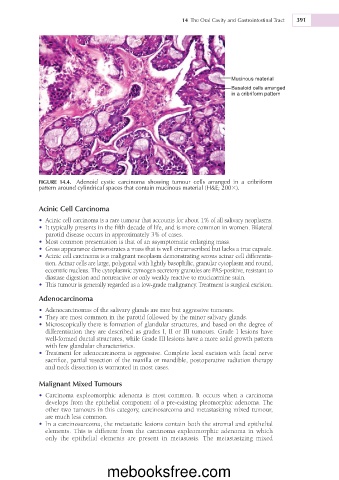
                                                                        Mucinous material
                                                                        Basaloid cells arranged
                                                                        in a cribriform pattern


             FIGURE  14.4.  Adenoid  cystic  carcinoma  showing  tumour  cells  arranged  in  a  cribriform
             pattern around cylindrical spaces that contain mucinous material (H&E; 2003).


             Acinic Cell Carcinoma

             •	 Acinic cell carcinoma is a rare tumour that accounts for about 1% of all salivary neoplasms.
             •	 It typically presents in the fifth decade of life, and is more common in women. Bilateral
               parotid disease occurs in approximately 3% of cases.
             •	 Most common presentation is that of an asymptomatic enlarging mass.
             •	 Gross appearance demonstrates a mass that is well circumscribed but lacks a true capsule.
             •	 Acinic cell carcinoma is a malignant neoplasm demonstrating serous acinar cell differentia-
               tion. Acinar cells are large, polygonal with lightly basophilic, granular cytoplasm and round,
               eccentric nucleus. The cytoplasmic zymogen secretory granules are PAS-positive, resistant to
               diastase digestion and nonreactive or only weakly reactive to mucicarmine stain.
             •	 This tumour is generally regarded as a low-grade malignancy. Treatment is surgical excision.
             Adenocarcinoma

             •	 Adenocarcinomas of the salivary glands are rare but aggressive tumours.
             •	 They are most common in the parotid followed by the minor salivary glands.
             •	 Microscopically there is formation of glandular structures, and based on the degree of
               differentiation they are described as grades I, II or III tumours. Grade I lesions have
               well-formed ductal structures, while Grade III lesions have a more solid growth pattern
               with few glandular characteristics.
             •	 Treatment for adenocarcinoma is aggressive. Complete local excision with facial nerve
               sacrifice, partial resection of the maxilla or mandible, postoperative radiation therapy
               and neck dissection is warranted in most cases.

             Malignant Mixed Tumours
             •	 Carcinoma  expleomorphic  adenoma  is  most  common.  It  occurs  when  a  carcinoma
               develops from the epithelial component of a pre-existing pleomorphic adenoma. The
               other two tumours in this category, carcinosarcoma and metastasizing mixed tumour,
               are much less common.
             •	 In a carcinosarcoma, the metastatic lesions contain both the stromal and epithelial
               elements. This is different from the carcinoma expleomorphic adenoma in which
               only  the  epithelial  elements  are  present  in  metastasis.  The  metastasizing  mixed


                                  mebooksfree.com

