


Page 405 - Concise Pathology for Exam Preparation ( PDFDrive )
P. 405
390
           390    SECTION II  Diseases of Organ Systems


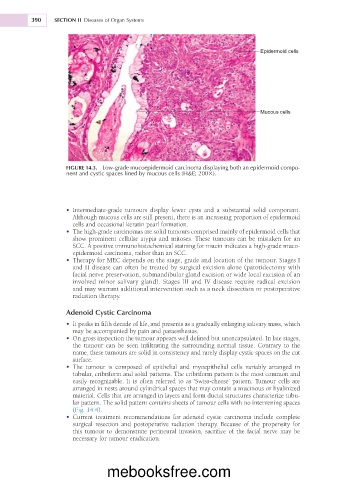
                                                                                 Epidermoid cells


                                                                                 Mucous cells


                     FIGURE 14.3.  Low-grade mucoepidermoid carcinoma displaying both an epidermoid compo-
                     nent and cystic spaces lined by mucous cells (H&E; 2003).


                     •	 Intermediate-grade  tumours  display  fewer  cysts  and  a  substantial  solid  component.
                       Although mucous cells are still present, there is an increasing proportion of epidermoid
                       cells and occasional keratin pearl formation.
                     •	 The high-grade carcinomas are solid tumours comprised mainly of epidermoid cells that
                       show prominent cellular atypia and mitoses. These tumours can be mistaken for an
                       SCC. A positive immunohistochemical staining for mucin indicates a high-grade muco-
                       epidermoid carcinoma, rather than an SCC.
                     •	 Therapy for MEC depends on the stage, grade and location of the tumour. Stages I
                       and II disease can often be treated by surgical excision alone (parotidectomy with
                       facial nerve preservation, submandibular gland excision or wide local excision of an
                       involved minor salivary gland). Stages III and IV disease require radical excision
                       and may warrant additional intervention such as a neck dissection or postoperative
                       radiation therapy.

                     Adenoid Cystic Carcinoma

                     •	 It peaks in fifth decade of life, and presents as a gradually enlarging salivary mass, which
                       may be accompanied by pain and paraesthesias.
                     •	 On gross inspection the tumour appears well defined but unencapsulated. In late stages,
                       the  tumour  can  be  seen  infiltrating  the  surrounding  normal  tissue.  Contrary  to  the
                       name, these tumours are solid in consistency and rarely display cystic spaces on the cut
                       surface.
                     •	 The  tumour  is  composed  of  epithelial  and  myoepithelial  cells  variably  arranged  in
                       tubular, cribriform and solid patterns. The cribriform pattern is the most common and
                       easily recognizable. It is often referred to as ‘Swiss-cheese’ pattern. Tumour cells are
                       arranged in nests around cylindrical spaces that may contain a mucinous or hyalinized
                       material. Cells that are arranged in layers and form ductal structures characterize tubu-
                       lar pattern. The solid pattern contains sheets of tumour cells with no intervening spaces
                       (Fig. 14.4).
                     •	 Current  treatment  recommendations  for  adenoid  cystic  carcinoma  include  complete
                       surgical  resection  and  postoperative  radiation  therapy.  Because  of  the  propensity  for
                       this tumour to demonstrate perineural invasion, sacrifice of the facial nerve may be
                       necessary for tumour eradication.


                                  mebooksfree.com

