


Page 455 - Concise Pathology for Exam Preparation ( PDFDrive )
P. 455
440    SECTION II  Diseases of Organ Systems


                     •	 Due to mutation in ATP7B, a gene located on chromosome 13 (encodes for ATPase
                       metal iron transporter, localized to Golgi region of hepatocytes; the deficiency of which
                       impairs copper excretion into bile)

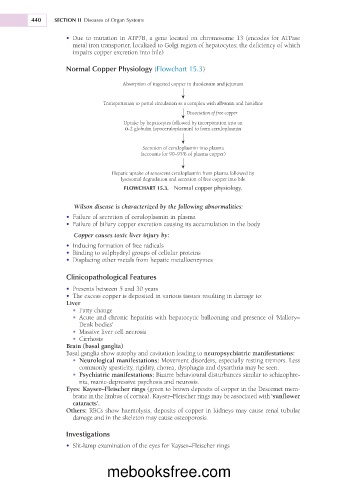
                     Normal Copper Physiology (Flowchart 15.3)


                                       Absorption of ingested copper in duodenum and jejunum

                                 Transportation to portal circulation as a complex with albumin and histidine
                                                          Dissociation of free copper
                                       Uptake by hepatocytes followed by incorporation into an
                                        α-2 globulin (apoceruloplasmin) to form ceruloplasmin


                                             Secretion of ceruloplasmin into plasma
                                            (accounts for 90–95% of plasma copper)


                                    Hepatic uptake of senescent ceruloplasmin from plasma followed by
                                      lysosomal degradation and secretion of free copper into bile
                                       FLOWCHART 15.3.  Normal copper physiology.


                        Wilson disease is characterized by the following abnormalities:
                     •	 Failure of secretion of ceruloplasmin in plasma
                     •	 Failure of biliary copper excretion causing its accumulation in the body
                        Copper causes toxic liver injury by:
                     •	 Inducing formation of free radicals
                     •	 Binding to sulphydryl groups of cellular proteins
                     •	 Displacing other metals from hepatic metalloenzymes

                     Clinicopathological Features

                     •	 Presents between 5 and 30 years
                     •	 The excess copper is deposited in various tissues resulting in damage to:
                     Liver
                       •	 Fatty change
                       •	 Acute and chronic hepatitis with hepatocytic ballooning and presence of ‘Mallory–
                         Denk bodies’
                       •	 Massive liver cell necrosis
                       •	 Cirrhosis
                     Brain	(basal	ganglia)
                     Basal ganglia show atrophy and cavitation leading to	neuropsychiatric	manifestations:
                       •	 Neurological	manifestations: Movement disorders, especially resting tremors. Less
                         commonly spasticity, rigidity, chorea, dysphagia and dysarthria may be seen.
                       •	 Psychiatric	manifestations:	Bizarre behavioural disturbances similar to schizophre-
                         nia, manic-depressive psychosis and neurosis.
                     Eyes:	Kayser–Fleischer	rings (green to brown deposits of copper in the Descemet mem-
                       brane in the limbus of cornea). Kayser–Fleischer rings may be associated with ‘sunflower
                       cataracts’.
                     Others: RBCs show haemolysis, deposits of copper in kidneys may cause renal tubular
                       damage and in the skeleton may cause osteoporosis.

                     Investigations
                     •	 Slit-lamp examination of the eyes for Kayser–Fleischer rings


                                  mebooksfree.com

