


Page 457 - Concise Pathology for Exam Preparation ( PDFDrive )
P. 457
442    SECTION II  Diseases of Organ Systems


                     Pathology
                     •	 Early lesions show dense lymphocytic and plasma cell infiltrate around small bile ducts
                       in the portal tracts.
                     •	 Late lesions show chronic granulomatous inflammation destroying the interlobular bile
                       ducts (florid	duct	lesion),	resulting in fibrosis and later cirrhosis of the liver.
                     •	 In both early and late stages, there is marked hepatomegaly, contrary to other end-stage
                       liver diseases which show a small shrunken liver. This is probably due to the minimal
                       hepatocytic loss and extensive regeneration, typical of PBC.
                     PSC

                     Salient Features
                     •	 PSC is an immune-mediated chronic cholestatic disease characterized by progressive
                       concentric periductal (onion skin) fibrosis and destruction of extrahepatic and large
                       intrahepatic bile ducts. It has the following features:
                     •	 Median age is 30 years.
                     •	 Patient presents with fatigue, pruritis, jaundice, increased ALP levels and other features
                       of chronic cholestatic liver disease.
                     •	 Patchy involvement of the biliary tree results in characteristic ‘beading’ appearance of
                       the affected segment during a retrograde cholangiogram.
                     •	 Commonly coexists with inflammatory	bowel	disease,	pancreatitis and retroperitoneal
                       fibrosis.
                     •	 Sixty-five percent patients are ANCA-positive.
                     •	 Cholangiocarcinomas may develop in 10–15% cases.
                     Pathology
                     •	 Obstruction of intrahepatic bile ducts leads to proliferation of bile ductules, inflamma-
                       tion and necrosis of adjacent periportal hepatic parenchyma and cholestasis.
                     •	 Large bile ducts show periductal fibrosis that obliterates the lumen leaving a solid cord-like
                       scar with a few inflammatory cells.
                     •	 Primary  biliary  cirrhosis  and  primary  sclerosing  cholangitis  eventually  lead  to
                       end-stage  liver  disease  (liver  becomes  hard  and  finely  granular  and  shows  yellow-
                       green pigmentation).

                     Q. Differentiate between PBC and PSC.
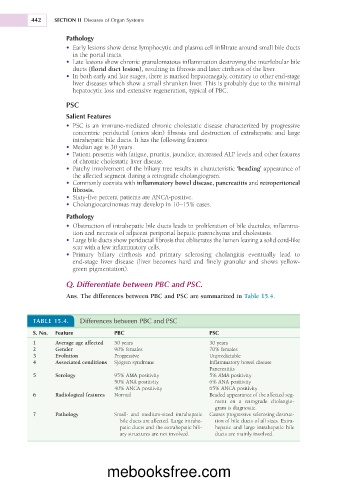
                     Ans.	The	differences	between	PBC	and	PSC	are	summarized	in	Table	15.4.


           TABLE 15.4.    Differences between PBC and PSC
           S. No.  Feature          PBC                          PSC
           1      Average	age	affected  50 years                 30 years
           2      Gender            90% females                  70% females
           3      Evolution         Progressive                  Unpredictable
           4      Associated	conditions  Sjögren syndrome        Inflammatory bowel disease
                                                                 Pancreatitis
           5      Serology          95% AMA positivity           5% AMA positivity
                                    50% ANA positivity           6% ANA positivity
                                    40% ANCA positivity          65% ANCA positivity
           6      Radiological	features  Normal                  Beaded appearance of the affected seg-
                                                                   ment  on  a  retrograde  cholangio-
                                                                   gram is diagnostic.
           7      Pathology         Small-  and  medium-sized  intrahepatic   Causes progressive sclerosing destruc-
                                      bile ducts are affected. Large intrahe-  tion of bile ducts of all sizes. Extra-
                                      patic ducts and the extrahepatic bili-  hepatic  and  large  intrahepatic  bile
                                      ary structures are not involved.  ducts are mainly involved.


                                  mebooksfree.com

