


Page 459 - Concise Pathology for Exam Preparation ( PDFDrive )
P. 459
444    SECTION II  Diseases of Organ Systems


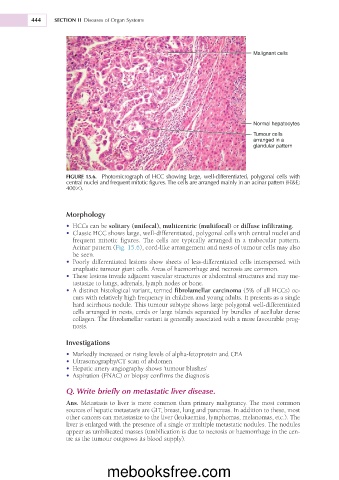
                                                                               Malignant cells


                                                                               Normal hepatocytes
                                                                               Tumour cells
                                                                               arranged in a
                                                                               glandular pattern


                     FIGURE 15.6.  Photomicrograph of HCC showing large, well-differentiated, polygonal cells with
                     central nuclei and frequent mitotic figures. The cells are arranged mainly in an acinar pattern (H&E;
                     4003).


                     Morphology

                     •	 HCCs can be solitary	(unifocal),	multicentric	(multifocal) or diffuse	infiltrating.
                     •	 Classic HCC shows large, well-differentiated, polygonal cells with central nuclei and
                       frequent  mitotic  figures.  The  cells  are  typically  arranged  in  a  trabecular  pattern.
                       Acinar pattern (Fig. 15.6), cord-like arrangement and nests of tumour cells may also
                       be seen.
                     •	 Poorly differentiated lesions show sheets of less-differentiated cells interspersed with
                       anaplastic tumour giant cells. Areas of haemorrhage and necrosis are common.
                     •	 These lesions invade adjacent vascular structures or abdominal structures and may me-
                       tastasize to lungs, adrenals, lymph nodes or bone.
                     •	 A distinct histological variant, termed fibrolamellar	carcinoma (5% of all HCCs) oc-
                       curs with relatively high frequency in children and young adults. It presents as a single
                       hard scirrhous nodule. This tumour subtype shows large polygonal well-differentiated
                       cells arranged in nests, cords or large islands separated by bundles of acellular dense
                       collagen. The fibrolamellar variant is generally associated with a more favourable prog-
                       nosis.

                     Investigations
                     •	 Markedly increased or rising levels of alpha-fetoprotein and CEA
                     •	 Ultrasonography/CT scan of abdomen
                     •	 Hepatic artery angiography shows ‘tumour blushes’
                     •	 Aspiration (FNAC) or biopsy confirms the diagnosis
                     Q. Write briefly on metastatic liver disease.

                     Ans.	Metastasis to liver is more common than primary malignancy. The most common
                     sources of hepatic metastasis are GIT, breast, lung and pancreas. In addition to these, most
                     other cancers can metastasize to the liver (leukaemias, lymphomas, melanomas, etc.). The
                     liver is enlarged with the presence of a single or multiple metastatic nodules. The nodules
                     appear as umbilicated masses (umbilication is due to necrosis or haemorrhage in the cen-
                     tre as the tumour outgrows its blood supply).


                                  mebooksfree.com

