


Page 450 - Concise Pathology for Exam Preparation ( PDFDrive )
P. 450
15  Diseases of the Hepatobiliary System and Pancreas  435


             •	 Movement of proteins (albumin, clotting factors and lipoproteins) between plasma and
               hepatocytes is markedly impaired, leading to functional changes in the liver.

             Clinical Features

             •	 Low-grade  fever,  weakness,  fatigue,  weight  loss,  anorexia,  nausea,  vomiting,  upper
               abdominal discomfort and abdominal distension due to ascites
             •	 Menstrual irregularities like amenorrhea and irregular menses, hypogonadism, dimin-
               ished body hair and gynaecomastia (due to impaired oestrogen metabolism and resulting
               hyperestrogenaemia)
             •	 Haemorrhagic tendencies like easy bruising, purpura, epistaxis, menorrhagia and gas-
               trointestinal  bleeding  (decreased  production  of  coagulation  factors  by  the  liver  and
               thrombocytopenia resulting from hypersplenism)
             •	 Portal hypertension and its sequelae

             Signs of Hepatocellular Failure
             •	 Jaundice (due to abnormal bilirubin metabolism)
             •	 Palmar erythema and spider naevi (due to localized vasodilatation)
             •	 Parotid enlargement (attributed to fatty infiltration since liver’s ability to break down
               body fat is reduced in cirrhosis)
             •	 Ascites (due to portal hypertension; and low levels of albumin in the blood)
             •	 Hepatic encephalopathy and flapping tremors (associated with increased blood ammo-
               nia levels)
             •	 Progressive renal dysfunction (due to decreased renal perfusion attributed to systemic
               vasodilatation)

             Q.  Outline  the  aetiopathogenesis  and  clinical  features  of  portal
             hypertension.
             Ans. Portal hypertension is defined as a clinical condition in which there is prolonged
             elevation of portal venous pressure due to increased resistance to portal blood flow.

             Causes

             •	 Prehepatic: Portal vein thrombosis and fibrosis of bile ducts (schistosomiasis)
             •	 Intrahepatic:	Cirrhosis, schistosomiasis, massive fatty change, sarcoidosis and miliary
               tuberculosis
             •	 Posthepatic: Obstruction of hepatic vein by thrombosis (Budd–Chiari syndrome) or tumours

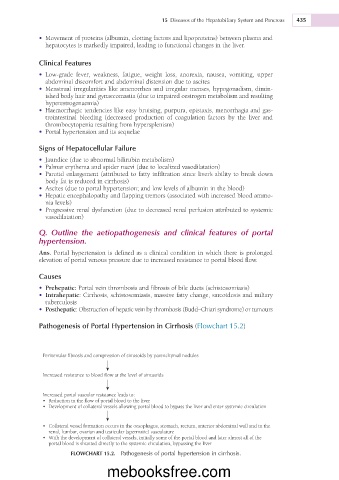
             Pathogenesis of Portal Hypertension in Cirrhosis (Flowchart 15.2)


              Perivenular fibrosis and compression of sinusoids by parenchymal nodules


              Increased resistance to blood flow at the level of sinusoids

              Increased portal vascular resistance leads to:
              •  Reduction in the flow of portal blood to the liver
              •  Development of collateral vessels allowing portal blood to bypass the liver and enter systemic circulation

              •  Collateral vessel formation occurs in the oesophagus, stomach, rectum, anterior abdominal wall and in the
                renal, lumbar, ovarian and testicular (spermatic) vasculature
              •  With the development of collateral vessels, initially some of the portal blood and later almost all of the
                portal blood is shunted directly to the systemic circulation, bypassing the liver
                       FLOWCHART 15.2.  Pathogenesis of portal hypertension in cirrhosis.


                                  mebooksfree.com

