


Page 472 - Concise Pathology for Exam Preparation ( PDFDrive )
P. 472
16  Diseases of the Kidney and Lower Urinary Tract  457


             •  Variability in composition may create a practical problem in the timing of collection of
               urine specimens.
             •  Timed urinary collections are preferred to random specimens.
             •  In a normal adult, 25% of cardiac output (.1 L of blood) perfuses two kidneys each
               minute.
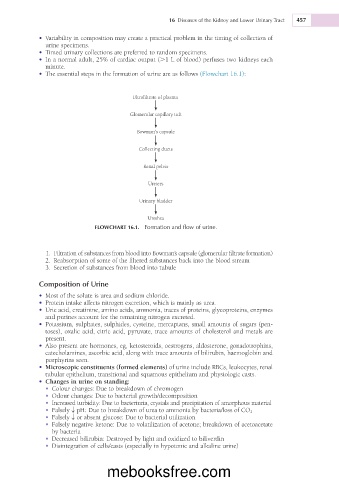
             •  The essential steps in the formation of urine are as follows (Flowchart 16.1):


                                          Ultrafiltrate of plasma

                                         Glomerular capillary tuft


                                           Bowman’s capsule

                                            Collecting ducts

                                             Renal pelvis


                                               Ureters

                                            Urinary bladder

                                               Urethra
                              FLOWCHART 16.1.  Formation and flow of urine.


                1.  Filtration of substances from blood into Bowman’s capsule (glomerular filtrate formation)
                2.  Reabsorption of some of the filtered substances back into the blood stream
                3.  Secretion of substances from blood into tubule

             Composition of Urine
             •  Most of the solute is urea and sodium chloride.
             •  Protein intake affects nitrogen excretion, which is mainly as urea.
             •  Uric acid, creatinine, amino acids, ammonia, traces of proteins, glycoproteins, enzymes
               and purines account for the remaining nitrogen excreted.
             •  Potassium, sulphates, sulphides, cysteine, mercaptans, small amounts of sugars (pen-
               toses), oxalic acid, citric acid, pyruvate, trace amounts of cholesterol and metals are
               present.
             •  Also present are hormones, eg, ketosteroids, oestrogens, aldosterone, gonadotrophins,
               catecholamines, ascorbic acid, along with trace amounts of bilirubin, haemoglobin and
               porphyrins seen.
             •  Microscopic constituents (formed elements) of urine include RBCs, leukocytes, renal
               tubular epithelium, transitional and squamous epithelium and physiologic casts.
             •  Changes in urine on standing:
               •  Colour changes: Due to breakdown of chromogen
               •  Odour changes: Due to bacterial growth/decomposition
               •  Increased turbidity: Due to bacteriuria, crystals and precipitation of amorphous material
                       g
               •  Falsely   pH: Due to breakdown of urea to ammonia by bacteria/loss of CO 2
                       g
               •  Falsely   or absent glucose: Due to bacterial utilization
               •  Falsely negative ketone: Due to volatilization of acetone; breakdown of acetoacetate
                 by bacteria
               •  Decreased bilirubin: Destroyed by light and oxidized to biliverdin
               •  Disintegration of cells/casts (especially in hypotonic and alkaline urine)


                                  mebooksfree.com

