


Page 469 - Concise Pathology for Exam Preparation ( PDFDrive )
P. 469
454    SECTION II  Diseases of Organ Systems


                                                 Glomerulus        Distal convoluted
                                                                       tubule

                                   Proximal
                                 convoluted  Bowman’s                    Cortical
                                    tubule   capsule                     collecting
                                                                         duct
                                                        Thick
                                                     ascending
                                   Cortex                limb

                                                                          Collecting
                                  Outer medulla                           duct


                                              Thin              Thin
                                            descending        ascending
                                               limb
                                    Inner                       limb
                                   medulla                               Inner medulla
                                   (papilla)                             collecting duct


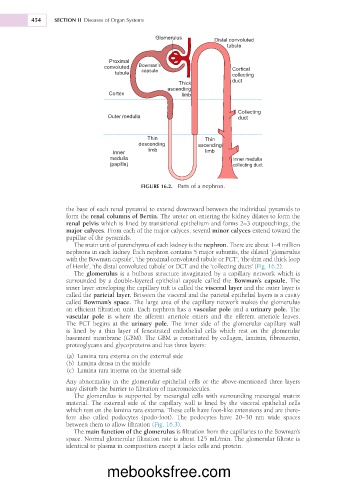
                                            FIGURE 16.2.  Parts of a nephron.


                     the base of each renal pyramid to extend downward between the individual pyramids to
                     form the renal columns of Bertin. The ureter on entering the kidney dilates to form the
                     renal pelvis which is lined by transitional epithelium and forms 2–3 outpouchings, the
                     major calyces. From each of the major calyces, several minor calyces extend toward the
                     papillae of the pyramids.
                        The main unit of parenchyma of each kidney is the nephron. There are about 1–4 million
                     nephrons in each kidney. Each nephron contains 5 major subunits, the dilated ‘glomerulus
                     with the Bowman capsule’, ‘the proximal convoluted tubule or PCT’, ‘the thin and thick loop
                     of Henle’, ‘the distal convoluted tubule’ or DCT and the ‘collecting ducts’ (Fig. 16.2).
                        The glomerulus is a bulbous structure invaginated by a capillary network which is
                     surrounded  by  a  double-layered  epithelial  capsule  called  the  Bowman’s  capsule.  The
                     inner layer enveloping the capillary tuft is called the visceral layer and the outer layer is
                     called the parietal layer. Between the visceral and the parietal epithelial layers is a cavity
                     called Bowman’s space. The large area of the capillary network makes the glomerulus
                     an efficient filtration unit. Each nephron has a vascular pole and a urinary pole. The
                     vascular  pole  is  where  the  afferent  arteriole  enters  and  the  efferent  arteriole  leaves.
                     The  PCT  begins  at  the  urinary  pole.  The  inner  side  of  the  glomerular  capillary  wall
                     is  lined  by  a  thin  layer  of  fenestrated  endothelial  cells  which  rest  on  the  glomerular
                     basement membrane (GBM). The GBM is constituted by collagen, laminin, fibronectin,
                     proteoglycans and glycoproteins and has three layers:
                      (a)  Lamina rara externa on the external side
                      (b)  Lamina densa in the middle
                      (c)  Lamina rara interna on the internal side

                     Any abnormality in the glomerular epithelial cells or the above-mentioned three layers
                     may disturb the barrier to filtration of macromolecules.
                        The glomerulus is supported by mesangial cells with surrounding mesangial matrix
                     material.  The  external  side  of  the  capillary  wall  is  lined  by  the  visceral  epithelial  cells
                     which rest on the lamina rara externa. These cells have foot-like extensions and are there-
                     fore  also  called  podocytes  (podo-foot).  The  podocytes  have  20–30  nm  wide  spaces
                     between them to allow filtration (Fig. 16.3).
                        The main function of the glomerulus is filtration from the capillaries to the Bowman’s
                     space. Normal glomerular filtration rate is about 125 mL/min. The glomerular filtrate is
                     identical to plasma in composition except it lacks cells and protein.


                                  mebooksfree.com

