


Page 478 - Concise Pathology for Exam Preparation ( PDFDrive )
P. 478
16  Diseases of the Kidney and Lower Urinary Tract  463

             Q. Enumerate the cystic lesions of kidney.

             Ans.  Cysts of the kidney include
             •  Polycystic kidney (adult and infantile type)
             •  Medullary cystic disease (medullary sponge kidney and nephronophthisis)
             •  Localized or simple renal cyst
             •  Multicystic renal dysplasia
             •  Acquired (dialysis-associated) cystic disease
             •  Renal cysts associated with tuberous sclerosis
             •  Calyceal or pyelogenic cyst
             •  Pelvic cyst
             •  Perinephric cyst
             •  Cystic degeneration in tumours

             Q.  Differentiate  between  adult  and  childhood  polycystic  kidney
             disease.
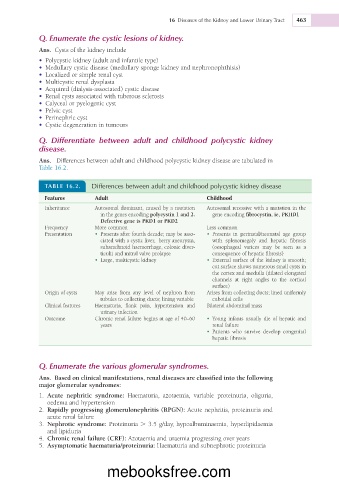
             Ans.   Differences between adult and childhood polycystic kidney disease are tabulated in
             Table 16.2.

               TABLE 16.2.   Differences between adult and childhood polycystic kidney disease
               Features       Adult                              Childhood
               Inheritance    Autosomal dominant, caused by a mutation   Autosomal recessive with a mutation in the
                                in the genes encoding polycystin 1 and 2.   gene encoding fibrocystin, ie, PKHD1
                                Defective gene is PKD1 or PKD2
               Frequency      More common                        Less common
               Presentation   •  Presents after fourth decade; may be asso-  •  Presents  in  perinatal/neonatal  age  group
                                ciated with a cystic liver,  berry aneurysm,   with  splenomegaly  and  hepatic  fibrosis
                                subarachnoid haemorrhage, colonic diver-  (oesophageal  varices  may  be  seen  as  a
                                ticulii and mitral valve prolapse  consequence of hepatic fibrosis)
                              •  Large, multicystic kidney       •  External surface of the kidney is smooth;
                                                                  cut surface shows numerous small cysts in
                                                                  the cortex and medulla (dilated elongated
                                                                  channels  at  right  angles  to  the  cortical
                                                                  surface)
               Origin of cysts  May  arise  from  any  level  of  nephron  from   Arises from collecting ducts; lined uniformly
                                tubules to collecting ducts; lining variable  cuboidal cells
               Clinical features  Haematuria,  flank  pain,  hypertension  and   Bilateral abdominal mass
                                urinary infection
               Outcome        Chronic renal failure begins at age of 40–60   •  Young  infants  usually  die  of  hepatic  and
                                years                             renal failure
                                                                 •  Patients  who  survive  develop  congenital
                                                                  hepatic fibrosis


             Q. Enumerate the various glomerular syndromes.
             Ans.  Based on clinical manifestations, renal diseases are classified into the following
             major glomerular syndromes:
               1.  Acute  nephritic  syndrome:  Haematuria,  azotaemia,  variable  proteinuria,  oliguria,
                oedema and hypertension
               2.  Rapidly progressing glomerulonephritis (RPGN): Acute nephritis, proteinuria and
                acute renal failure
               3.  Nephrotic syndrome: Proteinuria . 3.5 g/day, hypoalbuminaemia, hyperlipidaemia
                and lipiduria
               4.  Chronic renal failure (CRF): Azotaemia and uraemia progressing over years
               5.  Asymptomatic haematuria/proteinuria: Haematuria and subnephrotic proteinuria


                                  mebooksfree.com

