


Page 482 - Concise Pathology for Exam Preparation ( PDFDrive )
P. 482
16  Diseases of the Kidney and Lower Urinary Tract  467


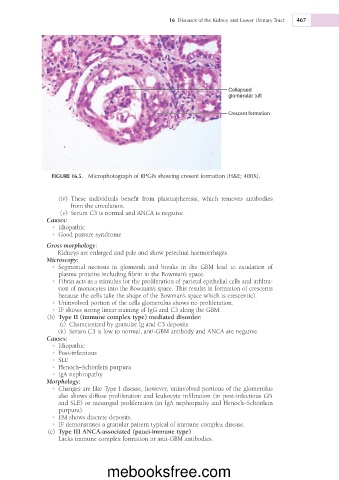
                                                                       Collapsed
                                                                       glomerular tuft

                                                                       Crescent formation


                 FIGURE 16.5.  Microphotograph of RPGN showing cresent formation (H&E; 400X).


                   (iv)  These  individuals  benefit  from  plasmapheresis,  which  removes  antibodies
                       from the circulation.
                    (v)  Serum C3 is normal and ANCA is negative.
               Causes:
                 •  Idiopathic
                 •  Good pasture syndrome
               Gross morphology:
                   Kidneys are enlarged and pale and show petechial haemorrhages.
               Microscopy:
                 •  Segmental  necrosis  in  glomeruli  and  breaks  in  the  GBM  lead  to  exudation  of
                   plasma proteins including fibrin in the Bowman’s space.
                 •  Fibrin acts as a stimulus for the proliferation of parietal epithelial cells and infiltra-
                   tion of monocytes into the Bowman’s space. This results in formation of crescents
                   because the cells take the shape of the Bowman’s space which is crescentic).
                 •  Uninvolved portion of the cells glomerulus shows no proliferation.
                 •  IF shows strong linear staining of IgG and C3 along the GBM.
                 (b)  Type II (immune complex type) mediated disorder:
                    (i)  Characterized by granular Ig and C3 deposits
                     (ii)  Serum C3 is low to normal, anti-GBM antibody and ANCA are negative.
               Causes:
                 •  Idiopathic
                 •  Post-infectious
                 •  SLE
                 •  Henoch–Schönlein purpura
                 •  IgA nephropathy
               Morphology:
                 •  Changes are like Type I disease, however, uninvolved portions of the glomerulus
                   also shows diffuse proliferation and leukocyte infiltration (in post-infectious GN
                   and SLE) or mesangial proliferation (in IgA nephropathy and Henoch–Schönlein
                   purpura).
                 •  EM shows discrete deposits.
                 •  IF demonstrates a granular pattern typical of immune complex disease.
                 (c)  Type III ANCA-associated (pauci-immune type)
                   Lacks immune complex formation or anti-GBM antibodies.


                                  mebooksfree.com

