


Page 483 - Concise Pathology for Exam Preparation ( PDFDrive )
P. 483
468    SECTION II  Diseases of Organ Systems


                        Causes:
                         •  Idiopathic
                         •  Granulomatosis with polyangiitis (Wegener granulomatosis)
                         •  Microscopic polyangiitis
                        Morphology:
                         •  Same as Type I disease
                         •  Uninvolved segments appear normal without proliferation or inflammation
                         •  In  contrast  to  anti-GBM  disease,  immunofluorescence  studies  are  negative  for
                           immunoglobulins or complement and no deposits are seen on EM

                     Clinical Features of RPGN:

                     •  Like nephritic syndrome except that oliguria and azotaemia are more pronounced.
                     •  Proteinuria approaches nephrotic range
                     •  Prognosis related to the number of crescents

                     Q. Define nephrotic syndrome. Describe its pathogenesis. Enumerate
                     its causes and clinicopathological features.
                     Ans.  Nephrotic syndrome is a syndrome complex having the following components:
                     •  Daily loss of .3.5 g of protein (less in children)
                     •  Hypoalbuminaemia with protein levels ,3 g/dL
                     •  Generalized oedema/anasarca
                     •  Hyperlipidaemia and lipiduria

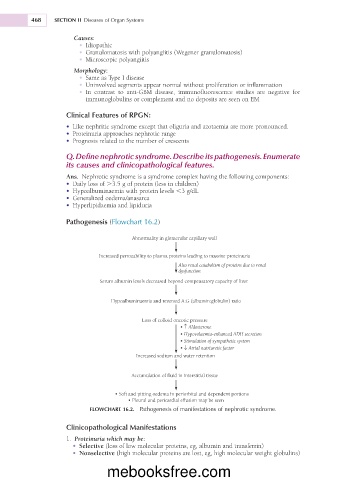
                     Pathogenesis (Flowchart 16.2)

                                          Abnormality in glomerular capillary wall


                               Increased permeability to plasma proteins leading to massive proteinuria
                                                        Also renal catabolism of proteins due to renal
                                                        dysfunction
                                Serum albumin levels decreased beyond compensatory capacity of liver

                                   Hypoalbuminaemia and reversed A:G (albumin:globulin) ratio


                                             Loss of colloid oncotic pressure
                                                        • ↑ Aldosterone
                                                        • Hypovolaemia-enhanced ADH secretion
                                                        • Stimulation of sympathetic system
                                                        • ↓ Atrial natriuretic factor
                                           Increased sodium and water retention


                                         Accumulation of fluid in interstitial tissue

                                    • Soft and pitting oedema in periorbital and dependent portions
                                        • Pleural and pericardial effusion may be seen
                             FLOWCHART 16.2.  Pathogenesis of manifestations of nephrotic syndrome.

                     Clinicopathological Manifestations

                       1.  Proteinuria which may be:
                       •  Selective (loss of low molecular proteins, eg, albumin and transferrin)
                       •  Nonselective (high molecular proteins are lost, eg, high molecular weight globulins)


                                  mebooksfree.com

