


Page 551 - Concise Pathology for Exam Preparation ( PDFDrive )
P. 551
536    SECTION II  Diseases of Organ Systems


                     supported by the fact that there is a 60% concordance in monozygotic twins and an as-
                     sociation with HLA B8 and DR3. The genetic susceptibility is linked to polymorphisms
                     in  multiple  immune  regulatory  genes,  eg,  cytotoxic  T-lymphocyte-associated  antigen
                     4 (CTLA 4) and protein tyrosine phosphatase 22 (PTPN 22). Graves disease is a triad of:
                     •	 Hyperthyroidism due to diffuse hyperplasia of follicular epithelium
                     •	 Infiltrative ophthalmopathy with resultant exophthalmos
                     •	 Localized infiltrative dermopathy called pretibial myxoedema
                     Pathogenesis

                     Multiple	 autoantibodies	 have	 been	 demonstrated	 in	 Graves	 disease,	 primarily
                     against	the	TSH	receptor.	These	include:
                       1.  Thyroid-stimulating	immunoglobulin	or	TSI
                        •	 TSI is an IgG immunoglobulin that binds to TSH receptor on the membrane of
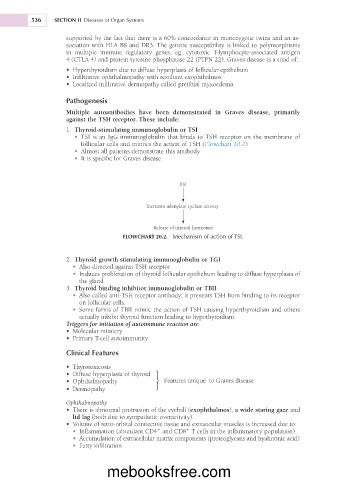
                          follicular cells and mimics the action of TSH (Flowchart 20.2)
                        •	 Almost all patients demonstrate this antibody
                        •	 It is specific for Graves disease


                                                        TSI


                                              Increases adenylate cyclase activity


                                                Release of thyroid hormones
                                       FLOWCHART 20.2.  Mechanism of action of TSI.


                       2.  Thyroid	growth	stimulating	immunoglobulin	or	TGI
                       •	 Also directed against TSH receptor
                       •	 Induces proliferation of thyroid follicular epithelium leading to diffuse hyperplasia of
                         the gland
                       3.  Thyroid	binding	inhibitor	immunoglobulin	or	TBII
                       •	 Also called anti-TSH receptor antibody; it prevents TSH from binding to its receptor
                         on follicular cells.
                       •	 Some forms of TBII mimic the action of TSH causing hyperthyroidism and others
                         actually inhibit thyroid function leading to hypothyroidism.
                     Triggers for initiation of autoimmune reaction are
                     •	 Molecular mimicry
                     •	 Primary T-cell autoimmunity

                     Clinical Features

                     •	 Thyrotoxicosis
                     •	 Diffuse hyperplasia of thyroid
                     •	 Ophthalmopathy           }  Features unique  to Graves disease
                     •	 Dermopathy

                     Ophthalmopathy
                     •	 There is abnormal protrusion of the eyeball (exophthalmos), a	wide	staring	gaze and
                       lid	lag (both due to sympathetic overactivity).
                     •	 Volume of retro-orbital connective tissue and extraocular muscles is increased due to:
                                                          1
                                                 1
                       •	 Inflammation (abundant CD4  and CD8  T cells in the inflammatory population)
                       •	 Accumulation of extracellular matrix components (proteoglycans and hyaluronic acid)
                       •	 Fatty infiltration


                                  mebooksfree.com

