


Page 555 - Concise Pathology for Exam Preparation ( PDFDrive )
P. 555
540    SECTION II  Diseases of Organ Systems


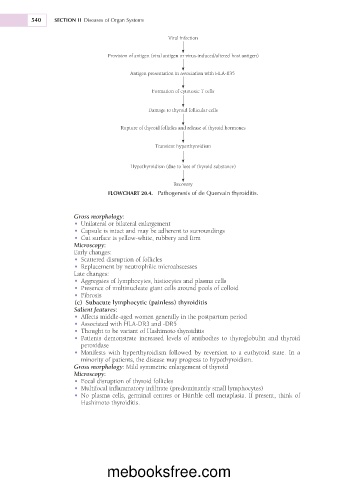
                                                     Viral infection

                                  Provision of antigen (viral antigen or virus-induced/altered host antigen)


                                         Antigen presentation in association with HLA-B35

                                                Formation of cytotoxic T cells


                                               Damage to thyroid follicular cells

                                      Rupture of thyroid follicles and release of thyroid hormones


                                                 Transient hyperthyroidism


                                         Hypothyroidism (due to loss of thyroid substance)

                                                      Recovery
                                  FLOWCHART 20.4.  Pathogenesis of de Quervain thyroiditis.


                        Gross morphology:
                        •	 Unilateral or bilateral enlargement
                        •	 Capsule is intact and may be adherent to surroundings
                        •	 Cut surface is yellow-white, rubbery and firm
                        Microscopy:
                        Early changes:
                        •	 Scattered disruption of follicles
                        •	 Replacement by neutrophilic microabscesses
                        Late changes:
                        •	 Aggregates of lymphocytes, histiocytes and plasma cells
                        •	 Presence of multinucleate giant cells around pools of colloid
                        •	 Fibrosis
                        	(c)	 Subacute	lymphocytic	(painless)	thyroiditis
                        Salient features:
                        •	 Affects middle-aged women generally in the postpartum period
                        •	 Associated with HLA-DR3 and -DR5
                        •	 Thought to be variant of Hashimoto thyroiditis
                        •	 Patients  demonstrate  increased  levels  of  antibodies  to  thyroglobulin  and  thyroid
                          peroxidase
                        •	 Manifests  with  hyperthyroidism  followed  by  reversion  to  a  euthyroid  state.  In  a
                          minority of patients, the disease may progress to hypothyroidism.
                        Gross morphology: Mild symmetric enlargement of thyroid
                        Microscopy:
                        •	 Focal disruption of thyroid follicles
                        •	 Multifocal inflammatory infiltrate (predominantly small lymphocytes)
                        •	 No plasma cells, germinal centres or Hürthle cell metaplasia. If present, think of
                          Hashimoto thyroiditis.


                                  mebooksfree.com

