


Page 554 - Concise Pathology for Exam Preparation ( PDFDrive )
P. 554
20  Endocrinology  539


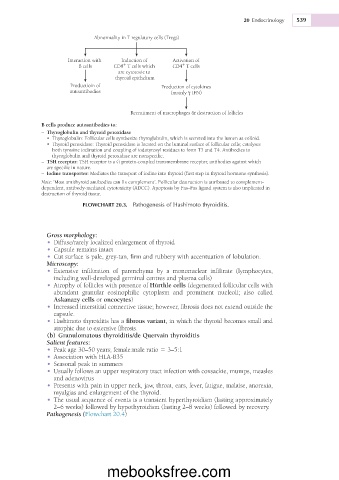
                              Abnormality in T regulatory cells (Tregs)


                      Interaction with   Induction of   Activation of
                                                         +
                                       +
                         B cells    CD8  T cells which   CD4  T cells
                                     are cytotoxic to
                                     thyroid epithelium
                       Productioin of              Production of cytokines
                       autoantibodies                 (mainly γ IFN)

                                          Recruitment of macrophages & destruction of follicles
              B cells produce autoantibodies to:
              –  Thyroglobulin and thyroid peroxidase
                  •  Thyroglobulin: Follicular cells synthesize thyroglobulin, which is secreted into the lumen as colloid.
                  •  Thyroid peroxidase: Thyroid peroxidase is located on the luminal surface of follicular cells; catalyses
                      both tyrosine iodination and coupling of iodotyrosyl residues to form T3 and T4. Antibodies to
                      thyroglobulin and thyroid peroxidase are nonspecific.
              –  TSH receptor: TSH receptor is a G protein-coupled transmembrane receptor, antibodies against which
                  are specific in nature.
              –  Iodine transporter: Mediates the transport of iodine into thyroid (first step in thyroid hormone synthesis).
              Note: ‘Most antithyroid antibodies can fix complement’. Follicular destruction is attributed to complement-
              dependent, antibody-mediated cytotoxicity (ADCC). Apoptosis by Fas–Fas ligand system is also implicated in
              destruction of thyroid tissue.
                          FLOWCHART 20.3.  Pathogenesis of Hashimoto thyroiditis.


               Gross morphology:
                •	 Diffuse/rarely localized enlargement of thyroid
                •	 Capsule remains intact
                •	 Cut surface is pale, grey-tan, firm and rubbery with accentuation of lobulation.
               Microscopy:
                •	 Extensive  infiltration  of  parenchyma  by  a  mononuclear  infiltrate  (lymphocytes,
                  including well-developed germinal centres and plasma cells)
                •	 Atrophy of follicles with presence of Hürthle	cells (degenerated follicular cells with
                  abundant  granular  eosinophilic  cytoplasm  and  prominent  nucleoli;  also  called
                  Askanazy	cells or oncocytes)
                •	 Increased interstitial connective tissue; however, fibrosis does not extend outside the
                  capsule.
                •	 Hashimoto thyroiditis has a fibrous	variant, in which the thyroid becomes small and
                  atrophic due to extensive fibrosis.
                (b)	 Granulomatous	thyroiditis/de	Quervain	thyroiditis
               Salient features:
                •	 Peak age 30–50 years; female:male ratio 5 3–5:1
                •	 Association with HLA-B35
                •	 Seasonal peak in summers
                •	 Usually follows an upper respiratory tract infection with coxsackie, mumps, measles
                  and adenovirus
                •	 Presents with pain in upper neck, jaw, throat, ears, fever, fatigue, malaise, anorexia,
                  myalgias and enlargement of the thyroid.
                •	 The usual sequence of events is a transient hyperthyroidism (lasting approximately
                  2–6 weeks) followed by hypothyroidism (lasting 2–8 weeks) followed by recovery.
               Pathogenesis (Flowchart 20.4)


                                  mebooksfree.com

