


Page 556 - Concise Pathology for Exam Preparation ( PDFDrive )
P. 556
20  Endocrinology  541

             Q. Define and classify goitre. Describe the aetiopathogenesis, clinical
             manifestations and morphology of the various types of goitre.
             Ans.	 Goitre is defined as enlargement of thyroid gland.
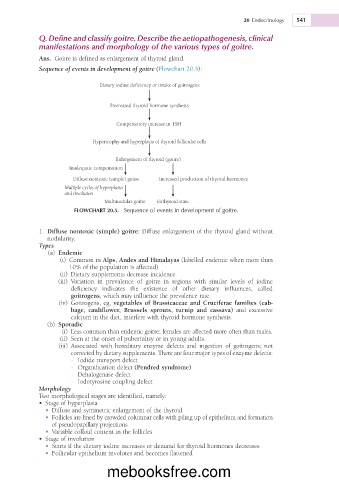
             Sequence of events in development of goitre (Flowchart 20.5):


                                Dietary iodine deficiency or intake of goitrogens


                                   Decreased thyroid hormone synthesis

                                     Compensatory increase in TSH


                              Hypertrophy and hyperplasia of thyroid follicular cells

                                     Enlargement of thyroid (goitre)
                      Inadequate compensation
                        Diffuse nontoxic (simple) goitre  Increased production of thyroid hormones
                     Multiple cycles of hyperplasia
                     and involution
                                 Multinodular goitre  Euthyroid state
                        FLOWCHART 20.5.  Sequence of events in development of goitre.


               1.  Diffuse	nontoxic	(simple)	goitre: Diffuse enlargement of the thyroid gland without
                nodularity.
             Types
                 (a)  Endemic
                    (i)  Common in Alps,	Andes	and	Himalayas (labelled endemic when more than
                      10% of the population is affected)
                    (ii)  Dietary supplements decrease incidence
                     (iii)  Variation  in  prevalence  of  goitre  in  regions  with  similar  levels  of  iodine
                       deficiency  indicates  the  existence  of  other  dietary  influences,  called
                       goitrogens, which may influence the prevalence rate.
                    (iv)  Goitrogens, eg, vegetables	of	Brassicaceae	and	Cruciferae	families	(cab-
                       bage,	 cauliflower,	 Brussels	 sprouts,	 turnip	 and	 cassava)  and  excessive
                       calcium in the diet, interfere with thyroid hormone synthesis.
                 (b)  Sporadic
                     (i)  Less common than endemic goitre; females are affected more often than males.
                    (ii)  Seen at the onset of pubertultsy or in young adults.
                    (iii)  Associated  with  hereditary  enzyme  defects  and  ingestion  of  goitrogens;  not
                       corrected by dietary supplements. There are four major types of enzyme defects:
                       -	 Iodide transport defect
                       -	 Organification defect (Pendred	syndrome)
                       -	 Dehalogenase defect
                       -	 Iodotyrosine coupling defect
             Morphology
             Two morphological stages are identified, namely:
             •	 Stage of hyperplasia
               •	 Diffuse and symmetric enlargement of the thyroid
               •	 Follicles are lined by crowded columnar cells with piling up of epithelium and formation
                 of pseudopapillary projections
               •	 Variable colloid content in the follicles
             •	 Stage of involution
               •	 Starts if the dietary iodine increases or demand for thyroid hormones decreases
               •	 Follicular epithelium involutes and becomes flattened


                                  mebooksfree.com

