


Page 616 - Concise Pathology for Exam Preparation ( PDFDrive )
P. 616
21  Musculoskeletal System  601

             Q. Write briefly on myasthenia gravis.

             Ans.  Autoimmune disease characterized by reduction in acetylcholine receptors due to
             the presence of an autoantibody against them.
             •	 Acetylcholine  receptor  antibody  accelerates  degradation  of  the  receptor  aided  by
               complement activation and blocks receptor function.
             •	 Myasthenia gravis may be associated with thymic hyperplasia as well as thymomas.
             •	 Ptosis and diplopia are the most common initial presentations.
             •	 Histopathology is not diagnostic; Type II fibre atrophy may be observed in late stage.
             •	 Treatment  includes  anticholinesterase  drugs,  thymectomy,  immunosuppression  and
               plasmapheresis.

             Q. Write briefly on Lambert–Eaton myasthenic syndrome.

             Ans.  Develops as a paraneoplastic process, commonly with small cell carcinoma of lung.
             •	 Patients develop proximal muscle weakness with autonomic dysfunction.
             •	 No improvement found with anticholinesterase agents.
             •	 Content of anticholinesterase is normal in neuromuscular junction synaptic vesicles, but
               fewer vesicles are released.

             Soft Tissue
             Q. Summarize the clinicopathological features of soft tissue tumours.

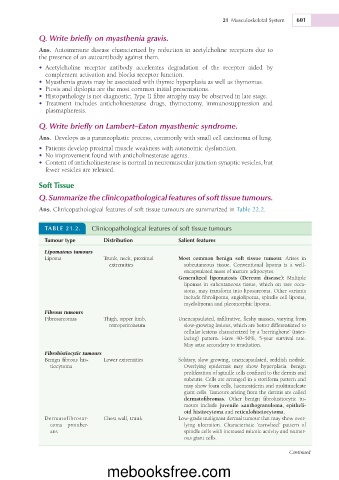
             Ans. Clinicopathological features of soft tissue tumours are summarized in Table 22.2.

               TABLE 21.2.   Clinicopathological features of soft tissue tumours

               Tumour type       Distribution           Salient features
               Lipomatous tumours
               Lipoma            Trunk, neck, proximal    Most	 common	 benign	 soft	 tissue	 tumour.  Arises  in
                                   extremities            subcutaneous  tissue.  Conventional  lipoma  is  a  well-
                                                          encapsulated mass of mature adipocytes.
                                                        Generalized	 lipomatosis	 (Dercum	 disease):  Multiple
                                                          lipomas  in  subcutaneous  tissue,  which  on  rare  occa-
                                                          sions, may transform into liposarcoma. Other variants
                                                          include fibrolipoma, angiolipoma, spindle cell lipoma,
                                                          myelolipoma and pleomorphic lipoma.
               Fibrous tumours
               Fibrosarcomas     Thigh, upper limb,     Unencapsulated, infiltrative, fleshy masses, varying from
                                   retroperitoneum        slow-growing lesions, which are better differentiated to
                                                          cellular lesions characterized by a ‘herringbone’ (inter-
                                                          lacing)  pattern.  Have  40–50%,  5-year  survival  rate.
                                                          May arise secondary to irradiation.
               Fibrohistiocytic tumours
               Benign  fibrous  his-  Lower extremities  Solitary, slow growing, unencapsulated, reddish nodule.
                tiocytoma                                 Overlying  epidermis  may  show  hyperplasia.  Benign
                                                          proliferation of spindle cells confined to the dermis and
                                                          subcutis. Cells are arranged in a storiform pattern and
                                                          may show foam cells, haemosiderin and multinucleate
                                                          giant cells. Tumours arising from the dermis are called
                                                          dermatofibromas.  Other  benign  fibrohistiocytic  tu-
                                                          mours  include  juvenile	 xanthogranuloma,  epitheli-
                                                          oid	histiocytoma and reticulohistiocytoma.
               Dermatofibrosar-  Chest wall, trunk      Low-grade malignant dermal tumour that may show over-
                 coma  protuber-                          lying  ulceration.  Characteristic  ‘cartwheel’  pattern  of
                 ans                                      spindle cells with increased mitotic activity and numer-
                                                          ous giant cells.
                                                                                          Continued


                                  mebooksfree.com

