


Page 613 - Concise Pathology for Exam Preparation ( PDFDrive )
P. 613
598    SECTION II  Diseases of Organ Systems

                     Q. Write briefly on gouty arthritis.

                     Ans.  Salient	features	of	gouty	arthritis:
                     •	 Gouty  arthritis  is  a  male  dominant  disease,  characterized  by  hyperuricaemia  with
                       plasma urate level more than 7 mg/dL (upper limit of solubility of MSU in serum at
                       37°C and blood pH).
                     •	 It involves the metatarsophalangeal joints followed by ankles and knees; wrists may be
                       affected later.
                     •	 Typical manifestations include recurrent attacks of acute arthritis and deposits of MSU
                       tophi (meaning porous stones) in soft tissue and renal disease affecting interstitium and
                       blood vessels (uric acid nephrolithiasis).


                     Types
                     •	 Metabolic	gout	(10%	cases): Due to disorder in metabolism of uric acid (a product of
                       purine metabolism) leading to its overproduction.
                     •	 Renal	gout	(90%	cases): Due to reduced renal excretion of uric acid secondary to dia-
                       betes mellitus, leukaemia, diuretic therapy, treatment of disseminated cancer and drugs
                       like aspirin, pyrazinamide, nicotinic acid, ethambutol and ethanol.

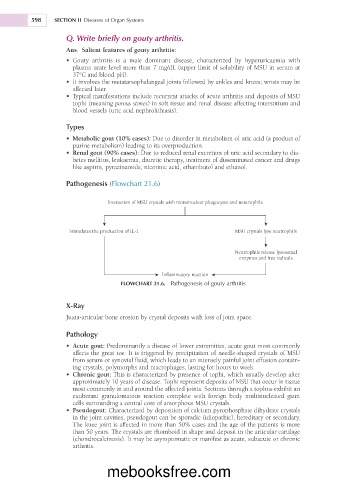
                     Pathogenesis (Flowchart 21.6)


                                  Interaction of MSU crystals with mononuclear phagocytes and neutrophils


                      Stimulates the production of IL-1                  MSU crystals lyse neutrophils


                                                                         Neutrophils release lysosomal
                                                                           enzymes and free radicals

                                                   Inflammatory reaction
                                      FLOWCHART 21.6.  Pathogenesis of gouty arthritis


                     X-Ray
                     Juxta-articular bone erosion by crystal deposits with loss of joint space.

                     Pathology

                     •	 Acute	gout: Predominantly a disease of lower extremities, acute gout most commonly
                       affects the great toe. It is triggered by precipitation of needle-shaped crystals of MSU
                       from serum or synovial fluid, which leads to an intensely painful joint effusion contain-
                       ing crystals, polymorphs and macrophages, lasting for hours to week.
                     •	 Chronic	gout: This is characterized by presence of tophi, which usually develop after
                       approximately 10 years of disease. Tophi represent deposits of MSU that occur in tissue
                       most commonly in and around the affected joints. Sections through a tophus exhibit an
                       exuberant  granulomatous  reaction  complete  with  foreign  body  multinucleated  giant
                       cells surrounding a central core of amorphous MSU crystals.
                     •	 Pseudogout: Characterized by deposition of calcium pyrophosphate dihydrate crystals
                       in the joint cavities, pseudogout can be sporadic (idiopathic), hereditary or secondary.
                       The knee joint is affected in more than 50% cases and the age of the patients is more
                       than 50 years. The crystals are rhomboid in shape and deposit in the articular cartilage
                       (chondrocalcinosis). It may be asymptomatic or manifest as acute, subacute or chronic
                       arthritis.


                                  mebooksfree.com

