


Page 611 - Concise Pathology for Exam Preparation ( PDFDrive )
P. 611
596    SECTION II  Diseases of Organ Systems


                     •	 Peripheral neuropathy
                     •	 Pulmonary involvement (Pleuritis, intrapulmonary nodules, interstitial fibrosis in the
                       form of Caplan syndrome—restrictive lung disease with rheumatoid nodules and coal
                       worker’s pneumoconiosis)
                     •	 Hepatitis
                     •	 Ocular involvement (scleritis, episcleritis and dryness of the eye)
                     •	 Secondary amyloidosis and Sjögren syndrome

                     Pathogenesis
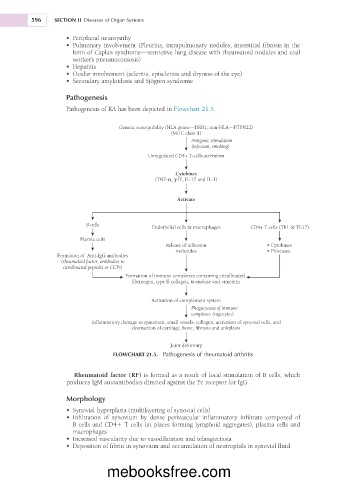
                     Pathogenesis of RA has been depicted in Flowchart 21.5.


                                      Genetic susceptibility (HLA genes---DRB1; non-HLA---PTPN22)
                                                      (MHC class II)
                                                            Antigenic stimulation
                                                            (infection, smoking)
                                               Unregulated CD4+ T-cells activation


                                                       Cytokines
                                                 (TNF-α, γ-IF, IL-17 and IL-1)


                                                        Activate


                            B cells
                                                Endothelial cells & macrophages  CD4+ T cells (Th1 & Th17)
                          Plasma cells
                                                    Release of adhesion            • Cytokines
                                                       molecules                   • Proteases
                   Formation of  Anti-IgG antibodies
                    (rheumatoid factor, antibodies to
                    citrullinated peptides or CCPs)
                                        Formation of immune complexes containing citrullinated
                                          fibrinogen, type II collagen, α-enolase and vimentin

                                                Activation of complement system
                                                            Phagocytosis of immune
                                                            complexes (ragocytes)
                             Inflammatory damage to synovium, small vessels, collagen, activation of synovial cells, and
                                          destruction of cartilage, bone, fibrosis and ankylosis


                                                      Joint deformity
                                    FLOWCHART 21.5.  Pathogenesis of rheumatoid arthritis


                        Rheumatoid	factor	(RF) is formed as a result of local stimulation of B cells, which
                     produces IgM autoantibodies directed against the Fc receptor for IgG.

                     Morphology
                     •	 Synovial hyperplasia (multilayering of synovial cells)
                     •	 Infiltration  of  synovium  by  dense  perivascular  inflammatory  infiltrate  composed  of
                       B cells and CD41 T cells (at places forming lymphoid aggregates), plasma cells and
                       macrophages
                     •	 Increased vascularity due to vasodilatation and telangiectasia
                     •	 Deposition of fibrin in synovium and accumulation of neutrophils in synovial fluid


                                  mebooksfree.com

