


Page 624 - Concise Pathology for Exam Preparation ( PDFDrive )
P. 624
22  The Skin  609


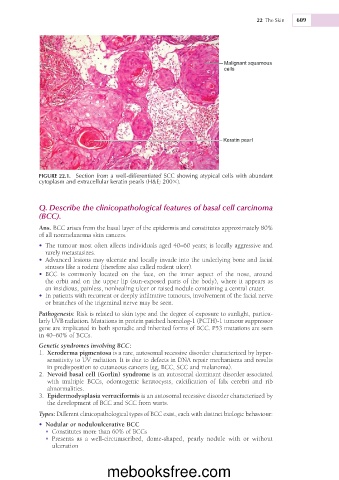
                                                                      Malignant squamous
                                                                      cells


                                                                      Keratin pearl


             FIGURE 22.1.  Section from a well-differentiated SCC showing atypical cells with abundant
             cytoplasm and extracellular keratin pearls (H&E; 2003).


             Q. Describe the clinicopathological features of basal cell carcinoma
             (BCC).
             Ans. BCC arises from the basal layer of the epidermis and constitutes approximately 80%
             of all nonmelanoma skin cancers.
             •  The tumour most often affects individuals aged 40–60 years; is locally aggressive and
               rarely metastasizes.
             •  Advanced lesions may ulcerate and locally invade into the underlying bone and facial
               sinuses like a rodent (therefore also called rodent ulcer).
             •  BCC  is  commonly  located  on  the  face,  on  the  inner  aspect  of  the  nose,  around
               the orbit and on the upper lip (sun-exposed parts of the body), where it appears as
               an insidious, painless, nonhealing ulcer or raised nodule containing a central crater.
             •  In patients with recurrent or deeply infiltrative tumours, involvement of the facial nerve
               or branches of the trigeminal nerve may be seen.
             Pathogenesis: Risk is related to skin type and the degree of exposure to sunlight, particu-
             larly UVB radiation. Mutations in protein patched homolog-1 (PCTH)-1 tumour suppressor
             gene are implicated in both sporadic and inherited forms of BCC. P53 mutations are seen
             in 40–60% of BCCs.
             Genetic syndromes involving BCC:
               1.  Xeroderma pigmentosa is a rare, autosomal recessive disorder characterized by hyper-
                sensitivity to UV radiation. It is due to defects in DNA repair mechanisms and results
                in predisposition to cutaneous cancers (eg, BCC, SCC and melanoma).
               2.  Nevoid basal cell (Gorlin) syndrome is an autosomal dominant disorder associated
                with  multiple  BCCs,  odontogenic  keratocysts,  calcification  of  falx  cerebri  and  rib
                abnormalities.
               3.  Epidermodysplasia verruciformis is an autosomal recessive disorder characterized by
                the development of BCC and SCC from warts.
             Types: Different clinicopathological types of BCC exist, each with distinct biologic behaviour:
             •  Nodular or noduloulcerative BCC
               •  Constitutes more than 60% of BCCs
               •  Presents  as  a  well-circumscribed,  dome-shaped,  pearly  nodule  with  or  without
                 ulceration


                                  mebooksfree.com

