


Page 629 - Concise Pathology for Exam Preparation ( PDFDrive )
P. 629
614    SECTION II    Diseases of Organ Systems


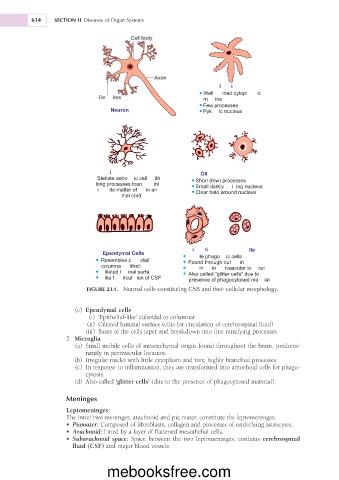
                            FIGURE 23.1.    Normal cells constituting CNS and their cellular morphology.


                            Ependymal  	cells
                        (c)

                             (i)  ‘Epithelial-like’ cuboidal to columnar
                            (ii)  Ciliated luminal surface (cilia for circulation of cerebrospinal fluid)

                             (iii)  Bases of the cells taper and breakdown into fine ramifying processes

                         Microglia
                     2.
                        (a)
                            Small mobile cells of mesenchymal origin found throughout the brain, predomi-
                           nantly in perivascular location.
                        (b)
                            Irregular nuclei with little cytoplasm and tiny, highly branched processes.
                        (c)
                            In response to inflammation, they are transformed into amoeboid cells for phago-
                           cytosis.
                        (d)               	cells’   (due to the presence of phagocytosed material).
                            Also called ‘glitter
                     Meninges
                     Leptomeninges:
                     The inner two meninges, arachnoid and pia mater, constitute the leptomeninges.
                     •		 Piamater:   Composed of fibroblasts, collagen and processes of underlying astrocytes.
                     •		 Arachnoid:   Lined by a layer of flattened mesothelial cells.

                     •		 Subarachnoid  	space:  Space between the two leptomeninges; contains cerebrospinal
                       fluid  	(CSF)   and major blood vessels.


                                  mebooksfree.com

