


Page 625 - Concise Pathology for Exam Preparation ( PDFDrive )
P. 625
610    SECTION II  Diseases of Organ Systems


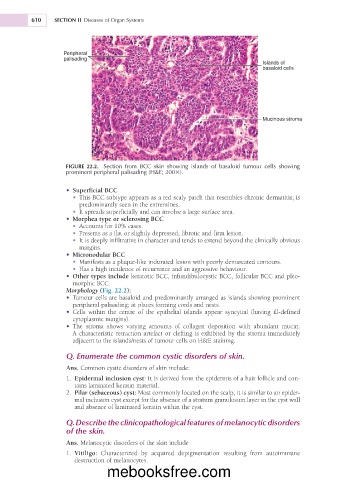
                     Peripheral
                     palisading
                                                                                  Islands of
                                                                                  basaloid cells


                                                                                  Mucinous stroma


                     FIGURE  22.2.  Section  from  BCC  skin  showing  islands  of  basaloid  tumour  cells  showing
                     prominent peripheral palisading (H&E; 2003).


                     •  Superficial BCC
                       •  This BCC subtype appears as a red scaly patch that resembles chronic dermatitis; is
                         predominantly seen in the extremities.
                       •  It spreads superficially and can involve a large surface area.
                     •  Morphea type or sclerosing BCC
                       •  Accounts for 10% cases.
                       •  Presents as a flat or slightly depressed, fibrotic and firm lesion.
                       •  It is deeply infiltrative in character and tends to extend beyond the clinically obvious
                         margins.
                     •  Micronodular BCC
                       •  Manifests as a plaque-like indurated lesion with poorly demarcated contours.
                       •  Has a high incidence of recurrence and an aggressive behaviour.
                     •  Other types include keratotic BCC, infundibulocystic BCC, follicular BCC and pleo-
                       morphic BCC.
                     Morphology (Fig. 22.2):
                     •  Tumour cells are basaloid and predominantly arranged as islands showing prominent
                       peripheral palisading; at places forming cords and nests.
                     •  Cells  within  the  centre  of  the  epithelial  islands  appear  syncytial  (having  ill-defined
                       cytoplasmic margins).
                     •  The  stroma  shows  varying  amounts  of  collagen  deposition  with  abundant  mucin.
                       A characteristic retraction artefact or clefting is exhibited by the stroma immediately
                       adjacent to the islands/nests of tumour cells on H&E staining.

                     Q. Enumerate the common cystic disorders of skin.
                     Ans. Common cystic disorders of skin include:
                       1.  Epidermal inclusion cyst: It is derived from the epidermis of a hair follicle and con-
                        tains laminated keratin material.
                       2.  Pilar (sebaceous) cyst: Most commonly located on the scalp, it is similar to an epider-
                        mal inclusion cyst except for the absence of a stratum granulosum layer in the cyst wall
                        and absence of laminated keratin within the cyst.
                     Q. Describe the clinicopathological features of melanocytic disorders
                     of the skin.
                     Ans. Melanocytic disorders of the skin include
                       1.  Vitiligo:  Characterized  by  acquired  depigmentation  resulting  from  autoimmune
                        destruction of melanocytes.
                                  mebooksfree.com

