


Page 1035 - Hematology_ Basic Principles and Practice ( PDFDrive )
P. 1035
918    Part VII  Hematologic Malignancies


                                          Mutation Type                           Cytogenetic Risk
                          Exclusive across  Co-occuring across  Co-occuring within
                          categories  categories  category  2-Hit mutation  Unfavorable  Intermediate  Favorable  Unknown


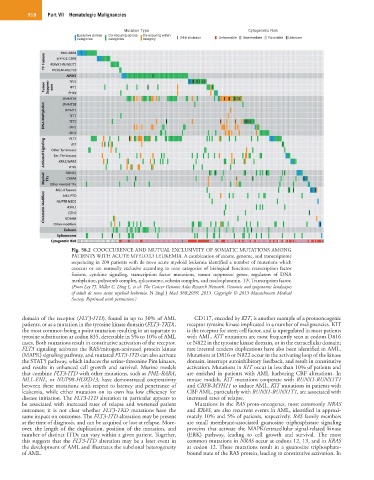
                        Fig. 58.2  COOCCURENCE AND MUTUAL EXCLUSIVITY OF SOMATIC MUTATIONS AMONG
                        PATIENTS WITH ACUTE MYELOID LEUKEMIA. A combination of exome, genome, and transcriptome
                        sequencing in 200 patients with de novo acute myeloid leukemia identified a number of mutations which
                        cooccur  or  are  mutually  exclusive  according  to  nine  categories  of  biological  function:  transcription  factor
                        fusions,  cytokine  signaling,  transcription  factor  mutations,  tumor  suppressor  genes,  regulators  of  DNA
                        methylation, polycomb complex, spliceosome, cohesin complex, and nucleophosmin. TF, Transcription factor.
                        (From Ley TJ, Miller C, Ding L, et al: The Cancer Genome Atlas Research Network. Genomic and epigenomic landscapes
                        of adult de novo acute myeloid leukemia. N Engl J Med 368:2059, 2013. Copyright © 2013 Massachusetts Medical
                        Society. Reprinted with permission.)


        domain of the receptor (FLT3-ITD), found in up to 30% of AML   CD117, encoded by KIT, is another example of a protooncogenic
        patients, or as a mutation in the tyrosine kinase domain (FLT3-TKD),   receptor tyrosine kinase implicated in a number of malignancies. KIT
        the most common being a point mutation resulting in an aspartate to   is the receptor for stem cell factor, and is upregulated in most patients
        tyrosine substitution at codon 835, detectable in 5% to 10% of AML   with AML. KIT mutations are most frequently seen at codons D816
        cases. Both mutations result in constitutive activation of the receptor.   or N822 in the tyrosine kinase domain, or in the extracellular domain;
        FLT3 signaling activates the RAS/mitogen-activated protein kinase   rare internal tandem duplications have also been identified in AML.
        (MAPK) signaling pathway, and mutated FLT3-ITD can also activate   Mutations at D816 or N822 occur in the activating loop of the kinase
        the STAT5 pathway, which induces the serine-threonine Pim kinases,   domain, interrupt autoinhibitory feedback, and result in constitutive
        and  results  in  enhanced  cell  growth  and  survival.  Murine  models   activation. Mutations in KIT occur in less than 10% of patients and
        that combine FLT3-ITD with other mutations, such as PML-RARA,   are  enriched  in  patients  with  AML  harboring  CBF  alterations.  In
        MLL-ENL, or NUP98-HOXD13, have demonstrated cooperativity   mouse models, KIT mutations cooperate with RUNX1-RUNX1T1
        between these mutations with respect to latency and penetrance of   and CBFB-MYH11 to induce AML. KIT mutations in patients with
        leukemia,  while  either  mutation  on  its  own  has  low  efficiency  for   CBF AML, particularly with RUNX1-RUNX1T1, are associated with
        disease initiation. The FLT3-ITD alteration in particular appears to   increased rates of relapse.
        be  associated  with  increased  rates  of  relapse  and  worsened  patient   Mutations in the RAS proto-oncogenes, most commonly NRAS
        outcomes;  it  is  not  clear  whether  FLT3-TKD  mutations  have  the   and KRAS, are also recurrent events in AML, identified in approxi-
        same impact on outcomes. The FLT3-ITD alteration may be present   mately 10% and 5% of patients, respectively. RAS family members
        at the time of diagnosis, and can be acquired or lost at relapse. More-  are  small  membrane-associated  guanosine  triphosphatase  signaling
        over, the length of the duplication, position of the mutation, and   proteins  that  activate  the  MAPK/extracellular  signal-related  kinase
        number of distinct ITDs can vary within a given patient. Together,   (ERK)  pathway,  leading  to  cell  growth  and  survival.  The  most
        this suggests that the FLT3-ITD alteration may be a later event in   common mutations in NRAS occur at codons 12, 13, and in KRAS
        the development of AML and illustrates the subclonal heterogeneity     at  codon  12. These  mutations  result  in  a  guanosine  triphosphate-
        of AML.                                               bound state of the RAS protein, leading to constitutive activation. In

