


Page 1062 - Hematology_ Basic Principles and Practice ( PDFDrive )
P. 1062
Chapter 60  Myelodysplastic Syndromes  945


             A                                 B                                     C
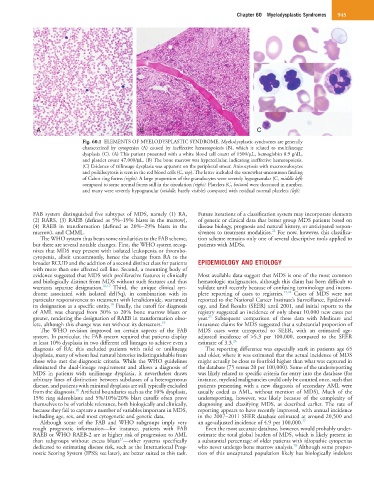
                            Fig. 60.1  ELEMENTS OF MYELODYSPLASTIC SYNDROME. Myelodysplastic syndromes are generally
                            characterized  by  cytopenias  (A)  caused  by  ineffective  hematopoiesis  (B),  which  is  related  to  multilineage
                            dysplasia (C). (A) This patient presented with a white blood cell count of 1500/µL, hemoglobin 8.9 g/dL,
                            and platelet count 47,000/µL. (B) The bone marrow was hypercellular, indicating ineffective hematopoiesis.
                            (C) Evidence of trilineage dysplasia was apparent on the peripheral smear. Anisocytosis with macroovalocytes
                            and poikilocytosis is seen in the red blood cells (C, top). The latter included the somewhat uncommon finding
                            of Cabot ring forms (right). A large proportion of the granulocytes were severely hypogranular (C, middle left)
                            compared to some normal forms still in the circulation (right). Platelets (C, bottom) were decreased in number,
                            and many were severely hypogranular (middle, barely visible) compared with residual normal platelets (left).


            FAB  system  distinguished  five  subtypes  of  MDS,  namely  (1)  RA,    Future iterations of a classification system may incorporate elements
            (2) RARS, (3) RAEB (defined as 5%–19% blasts in the marrow),     of genetic or clinical data that better group MDS patients based on
            (4)  RAEB  in  transformation  (defined  as  20%–29%  blasts  in  the   disease biology, prognosis and natural history, or anticipated respon-
                                                                                          22
            marrow), and CMML.                                    siveness to treatment modalities.  For now, however, this classifica-
              The WHO system thus bears some similarities to the FAB scheme,   tion scheme remains only one of several descriptive tools applied to
            but there are several notable changes. First, the WHO system recog-  patients with MDSs.
            nizes that MDS may present with isolated leukopenia or thrombo-
            cytopenia,  albeit  uncommonly,  hence  the  change  from  RA  to  the
            broader RCUD and the addition of a second distinct class for patients   EPIDEMIOLOGY AND ETIOLOGY
            with more than one affected cell line. Second, a mounting body of
            evidence suggested that MDS with proliferative features is clinically   Most available data suggest that MDS is one of the most common
            and biologically distinct from MDS without such features and thus   hematologic malignancies, although this claim has been difficult to
            warrants  separate  designation. 16,17   Third,  the  unique  clinical  syn-  validate until recently because of confusing terminology and incom-
            drome  associated  with  isolated  del(5q),  in  combination  with  its   plete  reporting  of  cases  to  registries. 23,24   Cases  of  MDS  were  not
            particular responsiveness to treatment with lenalidomide, warranted   reported to the National Cancer Institute’s Surveillance, Epidemiol-
                                     18
            its designation as a specific entity.  Finally, the cutoff for diagnosis   ogy, and End Results (SEER) until 2001, and initial reports to the
            of  AML  was  changed  from  30%  to  20%  bone  marrow  blasts  or   registry suggested an incidence of only about 10,000 new cases per
                                                                     25
            greater, rendering the designation of RAEB in transformation obso-  year.   Subsequent  comparison  of  these  data  with  Medicare  and
            lete, although this change was not without its detractors. 19  insurance claims for MDS suggested that a substantial proportion of
              The  WHO  revision  improved  on  certain  aspects  of  the  FAB   MDS  cases  went  unreported  to  SEER,  with  an  estimated  age-
            system. In particular, the FAB system required that patients display   adjusted  incidence  of  >5.3  per  100,000,  compared  to  the  SEER
            at least 10% dysplasia in two different cell lineages to achieve even a   estimate of 3.3. 26
            diagnosis  of  RA;  this  excluded  patients  with  mild  or  unilineage   The reporting difference was especially stark in patients age 65
            dysplasia, many of whom had natural histories indistinguishable from   and older, where it was estimated that the actual incidence of MDS
            those who met the diagnostic criteria. While the WHO guidelines   might actually be close to fourfold higher than what was captured in
            eliminated  the  dual-lineage  requirement  and  allows  a  diagnosis  of   the database (75 versus 20 per 100,000). Some of the underreporting
            MDS  in  patients  with  unilineage  dysplasia,  it  nevertheless  draws   was likely related to specific criteria for entry into the database (for
            arbitrary lines of distinction between subclasses of a heterogeneous   instance, myeloid malignancies could only be counted once, such that
            disease, and patients with minimal dysplasia are still typically excluded   patients  presenting  with  a  new  diagnosis  of  secondary  AML  were
                          20
            from the diagnosis.  Artificial boundaries such as the 10% dysplasia,   usually  coded  as  AML,  without  mention  of  MDS).  Much  of  the
            15% ring sideroblasts and 5%/10%/20% blast cutoffs often prove   underreporting,  however,  was  likely  because  of  the  complexity  of
            themselves to be of variable relevance, both biologically and clinically,   diagnosing  and  classifying  MDS,  as  described  earlier. The  rate  of
            because they fail to capture a number of variables important in MDS,   reporting appears to have recently improved, with annual incidence
            including age, sex, and most cytogenetic and genetic data.  in the 2007–2011 SEER database estimated at around 20,500 and
              Although  some  of  the  FAB  and  WHO  subgroups  imply  very   an age-adjusted incidence of 4.9 per 100,000. 27
            rough  prognostic  information—for  instance,  patients  with  FAB   Even the most accurate database, however, would probably under-
            RAEB or WHO RAEB-2 are at higher risk of progression to AML   estimate the total global burden of MDS, which is likely present in
                                        21
            than  subgroups  without  excess  blasts —other  systems  specifically   a substantial percentage of older patients with idiopathic cytopenias
                                                                                                 28
            dedicated to estimating disease risk, such as the International Prog-  who never undergo bone marrow analysis.  Although some propor-
            nostic Scoring System (IPSS; see later), are better suited to this task.   tion of this uncaptured population likely has biologically indolent

