


Page 1063 - Hematology_ Basic Principles and Practice ( PDFDrive )
P. 1063
946    Part VII  Hematologic Malignancies


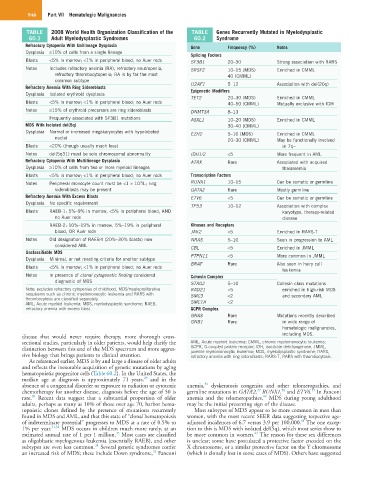
          TABLE   2008 World Health Organization Classification of the   TABLE   Genes Recurrently Mutated in Myelodysplastic
          60.1    Adult Myelodysplastic Syndromes               60.2    Syndrome
         Refractory Cytopenia With Unilineage Dysplasia        Gene        Frequency (%)    Notes
         Dysplasia  ≥10% of cells from a single lineage
                                                               Splicing Factors
         Blasts  <5% in marrow; <1% in peripheral blood; no Auer rods  SF3B1  20–30         Strong association with RARS
         Notes   Includes refractory anemia (RA), refractory neutropenia,   SRSF2  10–15 (MDS)  Enriched in CMML
                   refractory thrombocytopenia; RA is by far the most       40 (CMML)
                   common subtype
         Refractory Anemia With Ring Sideroblasts              U2AF1        5–12            Association with del(20q)
         Dysplasia  Isolated erythroid dysplasia               Epigenetic Modifiers
                                                               TET2         20–30 (MDS)     Enriched in CMML
         Blasts  <5% in marrow; <1% in peripheral blood; no Auer rods       40–50 (CMML)    Mutually exclusive with IDH
         Notes   ≥15% of erythroid precursors are ring sideroblasts  DNMT3A  8–13
                 Frequently associated with SF3B1 mutations    ASXL1        10–20 (MDS)     Enriched in CMML
         MDS With Isolated del(5q)                                          30–40 (CMML)
         Dysplasia  Normal or increased megakaryocytes with hypolobated   EZH2  5–10 (MDS)  Enriched in CMML
                   nuclei
                                                                            20–30 (CMML)    May be functionally involved
         Blasts  <20% (though usually much less)                                             in 7q−
         Notes   del(5q31) must be sole chromosomal abnormality  IDH1/2     <5              More frequent in AML
         Refractory Cytopenia With Multilineage Dysplasia      ATRX         Rare            Associated with acquired
         Dysplasia  ≥10% of cells from two or more myeloid lineages                          thalassemia
         Blasts  <5% in marrow; <1% in peripheral blood; no Auer rods  Transcription Factors
                                               9
         Notes   Peripheral monocyte count must be <1 × 10 /L; ring   RUNX1  10–15          Can be somatic or germline
                   sideroblasts may be present                 GATA2        Rare            Mostly germline
         Refractory Anemia With Excess Blasts                  ETV6         <5              Can be somatic or germline
         Dysplasia  No specific requirement
                                                               TP53         10–12           Association with complex
         Blasts  RAEB-1: 5%–9% in marrow, <5% in peripheral blood, AND                       karyotype, therapy-related
                   no Auer rods                                                              disease
                 RAEB-2: 10%–19% in marrow, 5%–19% in peripheral   Kinases and Receptors
                   blood, OR Auer rods                         JAK2         <5              Enriched in RARS-T
         Notes   Old designation of RAEB-t (20%–30% blasts) now   NRAS      5–10            Seen in progression to AML
                   considered AML                              CBL          <5              Enriched in JMML
         Unclassifiable MDS
         Dysplasia  Minimal, or not meeting criteria for another subtype  PTPN11  <5        More common in JMML
                                                               BRAF         Rare            Also seen in hairy cell
         Blasts  <5% in marrow; <1% in peripheral blood; no Auer rods
                                                                                             leukemia
         Notes   In presence of clonal cytogenetic finding considered   Cohesin Complex
                   diagnostic of MDS
                                                               STAG2        5–10            Cohesin class mutations
         Note: excludes refractory cytopenias of childhood. MDS/myeloproliferative   RAD21  <5  enriched in high-risk MDS
         neoplasms such as chronic myelomonocytic leukemia and RARS with   SMC3  <2          and secondary AML.
         thrombocytosis are classified separately.
         AML, Acute myeloid leukemia; MDS, myelodysplastic syndrome; RAEB,   SMC1A  <2
         refractory anemia with excess blast.                  GCPR Complex
                                                               GNAS         Rare            Mutations recently described
                                                               GNB1         Rare             in wide range of
                                                                                             hematologic malignancies,
                                                                                             including MDS.
        disease  that  would  never  require  therapy,  more  thorough  cross-
        sectional studies, particularly in older patients, would help clarify the   AML, Acute myeloid leukemia; CMML, chronic myelomonocytic leukemia;
        distinction between this end of the MDS spectrum and more aggres-  GCPR, G-coupled protein receptor; IDH, isocitrate dehdryogenase; JMML,
                                                               juvenile myelomonocytic leukemia; MDS, myelodysplastic syndrome; RARS,
        sive biology that brings patients to clinical attention.  refractory anemia with ring sideroblasts; RARS-T, RARS with thrombocytosis.
           As referenced earlier, MDS is by and large a disease of older adults
        and reflects the inexorable acquisition of genetic mutations by aging
        hematopoietic progenitor cells (Table 60.2). In the United States, the
                                                29
        median  age  at  diagnosis  is  approximately  71  years,   and  in  the
                                                                    36
        absence of a congenital disorder or exposure to radiation or cytotoxic   anemia,   dyskeratosis  congenita  and  other  telomeropathies,  and
                                                                                     37
                                                                                             38
                                                                                                       39
        chemotherapy for another disease, diagnosis before the age of 50 is   germline mutations in GATA2,  RUNX1,  and ETV6.  In Fanconi
                                                                                       40
           30
        rare.   Recent  data  suggest  that  a  substantial  proportion  of  older   anemia  and  the  telomeropathies,   MDS  during  young  adulthood
        adults, perhaps as many as 10% of those over age 70, harbor hema-  may be the initial presenting sign of the disease.
        topoietic  clones  defined  by  the  presence  of  mutations  recurrently   Most subtypes of MDS appear to be more common in men than
        found in MDS and AML, and that this state of “clonal hematopoiesis   women, with the most recent SEER data suggesting respective age-
                                                                                                    41
        of indeterminate potential” progresses to MDS at a rate of 0.5% to   adjusted incidences of 6.7 versus 3.9 per 100,000.  The one excep-
        1% per year. 31,32  MDS occurs in children much more rarely, at an   tion to this is MDS with isolated del(5q), which most series show to
                                       33
                                                                                    42
        estimated annual rate of 1 per 1 million.  Most cases are classified   be more common in women.  The reason for these sex differences
        as oligoblastic myelogenous leukemia (essentially RAEB), and other   is unclear; some have postulated a protective factor encoded on the
                                34
        subtypes are even less common.  Several genetic syndromes confer   X chromosome, or a similar protective factor on the Y chromosome
                                                   35
        an increased risk of MDS; these include Down syndrome,  Fanconi   (which is clonally lost in some cases of MDS). Others have suggested

