


Page 1058 - Hematology_ Basic Principles and Practice ( PDFDrive )
P. 1058
Chapter 59  Clinical Manifestations and Treatment of Acute Myeloid Leukemia  941


            into a durable molecular (PCR-negative) response and maintain PCR
            negativity throughout. For patients who are treated with an ATRA/
            chemotherapy combination, common practice is to give another two
            or three anthracycline-based cycles. Addition of ATO to a standard
            consolidation has significantly improved EFS and disease-free survival
                                                    28
            in a large randomized United States Intergroup study.  For ATRA/
            ATO-treated  patients,  the  combination  is  continued  throughout
            consolidation. Following consolidation, maintenance therapy for 1
            to 2 years with ATRA ± mercaptopurine and methotrexate has been
            recommended. There is debate as to the benefit of maintenance and
            it is very likely that the impact of maintenance on overall outcome
            will change now that ATRA and ATO are a standard treatment for
            lower  risk  patients  during  induction.  High-dose  ara-C  and
            mercaptopurine-methotrexate maintenance may not add benefit in
            the  context  of  optimal  novel  therapies  using  ATRA-ATO  with  or
            without  anthracyclines  or  GO.  PCR  testing  is  essential  in  the
            follow-up  of  patients  with  APL.  In  no  other  leukemia,  with  the
            possible exception of chronic myeloid leukemia and emerging in CBF   A           B
            leukemias, does molecular testing play such a critical role and influ-
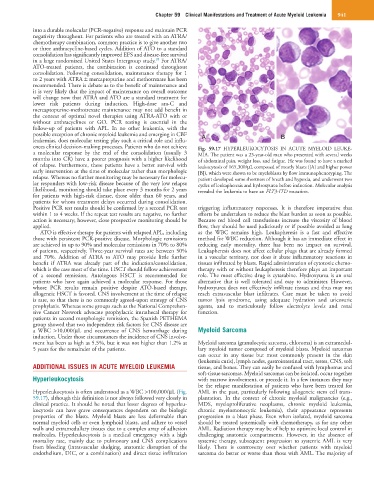
            ences clinical decision-making processes. Patients who do not achieve   Fig.  59.17  HYPERLEUKOCYTOSIS  IN  ACUTE  MYELOID  LEUKE-
            a  molecular  response  by  the  end  of  the  consolidation  (usually  3   MIA. The patient was a 23-year-old man who presented with several weeks
            months into CR) have a poorer prognosis with a higher likelihood   of abdominal pain, weight loss, and fatigue. He was found to have a marked
            of  relapse.  Furthermore,  these  patients  have  a  better  survival  with   leukocytosis of 165,300/µL composed of mostly blasts ([A] and higher power
            early intervention at the time of molecular rather than morphologic   [B]), which were shown to be myeloblasts by flow immunophenotyping. The
            relapse. Whereas no further monitoring may be necessary for molecu-  patient developed some shortness of breath and hypoxia, and underwent two
            lar responders with low-risk disease because of the very low relapse   cycles of leukapheresis and hydroxyurea before induction. Molecular analysis
            likelihood, monitoring should take place every 3 months for 2 years   revealed the leukemia to have an FLT3-ITD mutation.
            for  patients  with  high-risk  disease,  those  older  than  60  years,  and
            patients for whom treatment delays occurred during consolidation.
            Positive PCR test results should be confirmed by a second PCR test   triggering  inflammatory  responses.  It  is  therefore  imperative  that
            within 1 to 4 weeks. If the repeat test results are negative, no further   efforts be undertaken to reduce the blast burden as soon as possible.
            action is necessary; however, close prospective monitoring should be   Because  red  blood  cell  transfusions  increase  the  viscosity  of  blood
            applied.                                              flow, they should be used judiciously or if possible avoided as long
              ATO is effective therapy for patients with relapsed APL, including   as  the  WBC  remains  high.  Leukapheresis  is  a  fast  and  effective
            those with persistent PCR-positive disease. Morphologic remissions   method for WBC reduction. Although it has an immediate effect in
            are achieved in up to 90% and molecular remissions in 70% to 80%   reducing  early  mortality,  there  has  been  no  impact  on  survival.
            of patients, respectively. Three-year survival rates are between 50%   Leukapheresis does not affect cellular plugs that are already formed
            and  70%.  Addition  of  ATRA  to  ATO  may  provide  little  further   in a vascular territory, nor does it abate inflammatory reactions in
            benefit  if  ATRA  was  already  part  of  the  induction/consolidation,   tissues infiltrated by blasts. Rapid administration of cytotoxic chemo-
            which is the case most of the time. HSCT should follow achievement   therapy with or without leukapheresis therefore plays an important
            of  a  second  remission.  Autologous  HSCT  is  recommended  for   role. The most effective drug is cytarabine. Hydroxyurea is an oral
            patients  who  have  again  achieved  a  molecular  response.  For  those   alternative  that  is  well  tolerated  and  easy  to  administer.  However,
            whose  PCR  results  remain  positive  despite  ATO-based  therapy,   hydroxyurea does not effectively infiltrate tissues and thus may not
            allogeneic HSCT is favored. CNS involvement at the time of relapse   reach  extravascular  blast  infiltrates.  Care  must  be  taken  to  avoid
            is rare, so that there is no commonly agreed-upon strategy of CNS   tumor  lysis  syndrome,  using  adequate  hydration  and  uricosuric
            prophylaxis. Whereas some groups such as the National Comprehen-  agents,  and  to  meticulously  follow  electrolyte  levels  and  renal
            sive Cancer Network advocate prophylactic intrathecal therapy for   function.
            patients in second morphologic remission, the Spanish PETHEMA
            group showed that two independent risk factors for CNS disease are
            a  WBC  >10,000/µL  and  occurrence  of  CNS  hemorrhage  during   Myeloid Sarcoma
            induction. Under those circumstances the incidence of CNS involve-
            ment has been as high as 5.5%, but it was not higher than 1.2% at   Myeloid sarcoma (granulocytic sarcoma, chloroma) is an extramedul-
            5 years for the remainder of the patients.            lary myeloid tumor composed of myeloid blasts. Myeloid sarcomas
                                                                  can  occur  in  any  tissue  but  most  commonly  present  in  the  skin
                                                                  (leukemia cutis), lymph nodes, gastrointestinal tract, testes, CNS, soft
            ADDITIONAL ISSUES IN ACUTE MYELOID LEUKEMIA           tissue, and bones. They can easily be confused with lymphomas and
                                                                  soft-tissue sarcomas. Myeloid sarcomas can be isolated, occur together
            Hyperleukocytosis                                     with marrow involvement, or precede it. In a few instances they may
                                                                  be the relapse manifestation of patients who have been treated for
            Hyperleukocytosis is often understood as a WBC >100,000/µL (Fig.   AML in the past, particularly following allogeneic stem cell trans-
            59.17), although this definition is not always followed very closely in   plantation.  In  the  context  of  chronic  myeloid  malignancies  (e.g.,
            clinical practice. It should be noted that lesser degrees of hyperleu-  MDS,  myeloproliferative  neoplasms,  chronic  myeloid  leukemia,
            kocytosis  can  have  grave  consequences  dependent  on  the  biologic   chronic  myelomonocytic  leukemia),  their  appearance  represents
            properties  of  the  blasts.  Myeloid  blasts  are  less  deformable  than   progression to a blast phase. Even when isolated, myeloid sarcoma
            normal myeloid cells or even lymphoid blasts, and adhere to vessel   should be treated systemically with chemotherapy, as for any other
            walls and extramedullary tissues due to a complex array of adhesion   AML. Radiation therapy may be of help to optimize local control in
            molecules.  Hyperleukocytosis  is  a  medical  emergency  with  a  high   challenging  anatomic  compartments.  However,  in  the  absence  of
            mortality  rate,  mainly  due  to  pulmonary  and  CNS  complications   systemic  therapy,  subsequent  progression  to  systemic  AML  is  very
            from  bleeding  (intravascular  sludging,  anatomic  disruption  of  the   likely.  There  is  controversy  over  whether  patients  with  myeloid
            endothelium, DIC, or a combination) and direct tissue infiltration   sarcoma do better or worse than those with AML. The majority of

