


Page 1057 - Hematology_ Basic Principles and Practice ( PDFDrive )
P. 1057
940    Part VII  Hematologic Malignancies


                                                              immediate administration of steroids (dexamethasone 10 mg twice
                                                              daily  until  resolution  of  signs  and  symptoms)  and  interruption  of
                                                              therapy if no response or in the case of life-threatening complications.
                                                              This intervention will rapidly reverse the manifestations of differen-
                                                              tiation syndrome and has substantially reduced mortality to below
                                                              5%.  Some  investigators  have  proposed  prophylactic  use  of  dexa-
                                                                              2
                                                              methasone 2.5 mg/m  every 12 hours for the first 15 days in patients
                                                              with WBC exceeding 5000/µL.
                                                                 Subsequent clinical studies confirmed significantly better disease-
                                                              free survival for the combination of ATRA plus chemotherapy. In the
                                                              French APL 93 trial, concurrent administration of ATRA with che-
                                                              motherapy achieved identical CR rates of 92% but a lower relapse
                                                              rate at 2 years (6%) compared with sequential administration (16%,
                                                              p = .04). As standard induction therapy for patients with APL hence
                                                              emerged the combination of ATRA with an anthracycline (daunoru-
                                                              bicin or idarubicin). In two large trials from Italy (GIMEMA) and
                                                              Spain (PETHEMA), CR rates were 95% and 89%, respectively, and
                                                                                         26
                                                              2-year disease-free survival was 79%.  A risk-stratification model was
                                                              proposed based on WBC and platelet count. High risk was defined
                                                              as a WBC of greater than 10,000/µL at diagnosis with significant
                                                              differences in relapse-free survival between patients with high- and
                                                              those with intermediate-/low-risk disease. The role of cytarabine in
                                                              APL therapy is controversial. In two randomized studies of ATRA/
         A                         B                          anthracycline  ±  cytarabine  from  the  AML  MRC15  trial  and  the
                                                              European  APL  Group,  rates  for  CR  and  induction  failure  were
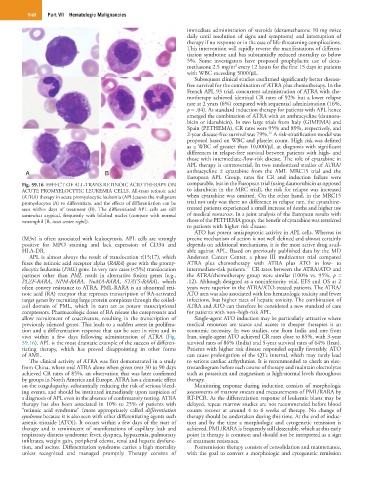
        Fig. 59.16  EFFECT OF ALL-TRANS RETINOIC ACID THERAPY ON   comparable, but in the European trial (using daunorubicin as opposed
        ACUTE PROMYELOCYTIC LEUKEMIA CELLS. All-trans retinoic acid   to idarubicin in the MRC trial), the risk for relapse was increased
        (ATRA) therapy in acute promyelocytic leukemia (APL)causes the malignant   when cytarabine was omitted. On the other hand, in the MRC15
        promyelocytes (A) to differentiate, and the effects of differentiation can be   trial not only was there no difference in relapse rate, the cytarabine-
        seen  within  days  of  treatment  (B).  The  differentiated  APL  cells  are  still   treated patients experienced a small increase of deaths and higher use
        somewhat  atypical,  frequently  with  bilobed  nuclei  (compare  with  normal   of medical resources. In a joint analysis of the European results with
        neutrophil [B, inset center right]).                  those of the PETHEMA group, the benefit of cytarabine was restricted
                                                              to patients with higher risk disease.
                                                                 ATO has potent antiapoptotic activity in APL cells. Whereas its
        (M3v) is often associated with leukocytosis. APL cells are strongly   precise mechanism of action is not well defined and almost certainly
        positive  for  MPO  staining  and  lack  expression  of  CD34  and   depends on additional mechanisms, it is the most active drug avail-
        HLA-DR.                                               able against APL. Based on previously published data by the MD
           APL is almost always the result of translocation t(15;17), which   Anderson  Cancer  Center,  a  phase  III  multicenter  trial  compared
        fuses the retinoic acid receptor alpha (RARA) gene with the promy-  ATRA  plus  chemotherapy  with  ATRA  plus  ATO  in  low-  to
                                                                                  27
        elocytic leukemia (PML) gene. In very rare cases (<5%) translocation   intermediate-risk patients.  CR rates between the ATRA/ATO and
        partners  other  than  PML  result  in  alternative  fusion  genes  (e.g.,   the  ATRA/chemotherapy  group  were  similar  (100%  vs.  95%, p  =
        PLZF-RARA,  NPM-RARA,  NuMA-RARA,  STAT5-RARA),  which   .12). Although designed as a noninferiority trial, EFS and OS at 2
        often convey resistance to ATRA. PML-RARA is an abnormal reti-  years were superior in the ATRA/ATO-treated patients. The ATRA/
        noic acid (RA) receptor that represses transcription of RA-activated   ATO arm was also associated with less hematologic toxicity and fewer
        target genes by recruiting large protein complexes through the coiled-  infections, but higher rates of hepatic toxicity. The combination of
        coil  domain  of  PML,  which  in  turn  act  as  potent  transcriptional   ATRA and ATO can therefore be considered a new standard of care
        corepressors. Pharmacologic doses of RA release the corepressors and   for patients with non–high-risk APL.
        allow  recruitment  of  coactivators,  resulting  in  the  transcription  of   Single-agent ATO induction may be particularly attractive where
        previously silenced genes. This leads to a sudden arrest in prolifera-  medical  resources  are  scarce  and  access  to  cheaper  therapies  is  an
        tion and a differentiation response that can be seen in vitro and in   economic  necessity.  In  two  studies,  one  from  India  and  one  from
        vivo  within  a  few  days  following  administration  of  ATRA  (Fig.   Iran, single-agent ATO achieved CR rates close to 85%, with 3-year
        59.16). APL is the most dramatic example of the success of differen-  survival rates of 86% (India) and 5-year survival rates of 64% (Iran).
        tiating  therapy,  which  has  proved  disappointing  in  other  forms     Patients with higher risk disease responded equally favorably. ATO
        of AML.                                               can cause prolongation of the QTc interval, which may rarely lead
           The clinical activity of ATRA was first demonstrated in a study   to serious cardiac arrhythmias. It is recommended to check an elec-
        from China, where oral ATRA alone when given over 30 to 90 days   trocardiogram before each course of therapy and maintain electrolytes
        achieved CR rates of 85%, an observation that was later confirmed   such as potassium and magnesium at high-normal levels throughout
        by groups in North America and Europe. ATRA has a dramatic effect   therapy.
        on the coagulopathy, substantially reducing the risk of serious bleed-  Monitoring  response  during  induction  consists  of  morphologic
        ing events, and should be instituted immediately upon suspicion of   assessments of marrow smears and measurements of PML/RARA by
        a diagnosis of APL even in the absence of confirmatory testing. ATRA   RT-PCR. As the differentiation response of leukemic blasts may be
        therapy  has  also  been  associated  in  10%  to  25%  of  patients  with   delayed, repeat marrow studies are not recommended before blood
        “retinoic  acid  syndrome”  (more  appropriately  called  differentiation   counts  recover  at  around  4  to  6  weeks  of  therapy.  No  change  of
        syndrome because it is also seen with other differentiating agents such   therapy should be undertaken during this time. At the end of induc-
        arsenic trioxide [ATO]). It occurs within a few days of the start of   tion  and  by  the  time  a  morphologic  and  cytogenetic  remission  is
        therapy  and  is  reminiscent  of  manifestations  of  capillary  leak  and   achieved, PML/RARA is frequently still detectable, which at this early
        respiratory distress syndrome: fever, dyspnea, hypoxemia, pulmonary   point in therapy is common and should not be interpreted as a sign
        infiltrates, weight gain, peripheral edema, renal and hepatic dysfunc-  of treatment resistance.
        tion, and ascites. Differentiation syndrome carries a high mortality   Postremission therapy consists of consolidation and maintenance,
        unless  recognized  and  managed  promptly.  Therapy  consists  of   with the goal to convert a morphologic and cytogenetic remission

