


Page 1136 - Hematology_ Basic Principles and Practice ( PDFDrive )
P. 1136
1002   Part VII  Hematologic Malignancies

        Clinical	Manifestations                               efficacy of very low doses of cytosine arabinoside is being tested in
                                                              prospective clinical trials. Several additional questions related to the
        Patients with Down syndrome typically present with TAM within 3   treatment of infants with TAM are also the subject of ongoing clinical
        months after birth, although TAM can be manifest at birth. Some of   trials. Among these is the identification of high-, intermediate-, and
        these children present with hydrops fetalis secondary to anemia and   low-risk populations, with treatment stratified on the basis of risk
        cardiac dysfunction. Although some patients may be asymptomatic,   group and a determination of whether treatment with very low-dose
        others can have myeloblast infiltration of the heart, liver, and spleen   cytosine arabinoside will prevent progression of TAM to ML-DS and
        that  can  result  in  hepatosplenomegaly;  hepatic  fibrosis;  pleural,   hepatic fibrosis.
        pericardial, and peritoneal effusions; and disseminated intravascular
        coagulopathy. In some cases, organ dysfunction can be severe, with
        failure of the liver, heart, kidneys, and lungs. In the COG’s recently   Prognosis
        published  prospective  study,  death  occurred  in  21%  of  patients,
        although only 10% died as a result of TAM-associated problems. 207  Recent data from the COG reporting the results of the POG-9481
                                                              prospective clinical trial offer insights into the natural history of TAM
                                                                                              229
                                                              and the identification of prognostic factors.  This study followed 48
        Laboratory	Manifestations                             children with TAM. Eighty-nine percent of infants achieved a spon-
                                                              taneous  remission,  74%  had  a  normalization  of  peripheral  blood
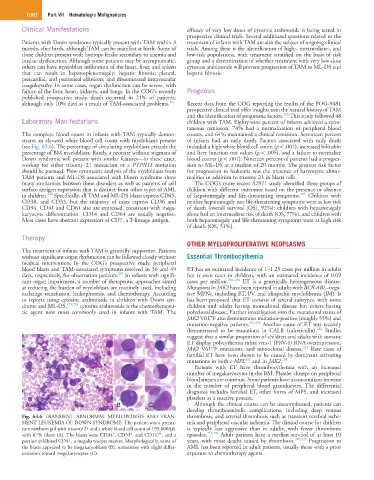
        The complete blood count in infants with TAM typically demon-  counts, and 64% maintained a clinical remission. Seventeen percent
        strates an elevated white blood cell count with myeloblasts present   of  infants  had  an  early  death.  Factors  associated  with  early  death
        (see Fig. 63.6). The percentage of circulating myeloblasts exceeds the   included a high white blood cell count (p < .001), increased bilirubin
        percentage of BM myeloblasts. Rarely, a neonate without stigmata of   and liver function test values (p < .005), and a failure to normalize
        Down syndrome will present with similar features—in these cases,   blood counts (p < .001). Nineteen percent of patients had a progres-
        workup  for  either  trisomy  21  mosaicism  or  a  PTPN11  mutation   sion to ML-DS at a median of 20 months. The greatest risk factor
        should be pursued. Flow cytometric analysis of the myeloblasts from   for progression to leukemia was the presence of karyotypic abnor-
        TAM patients and ML-DS associated with Down syndrome show   malities in addition to trisomy 21 in blasts cells.
        many similarities between these disorders as well as patterns of cell   The COG’s more recent A2971 study identified three groups of
        surface antigen expression that is distinct from other types of AML   children with different outcomes based on the presence or absence
                 226
                                                                                                   207
        in children.  Specifically, all TAM and ML-DS blasts express CD45,   of  hepatomegaly  and  life-threatening  symptoms.   Children  with
        CD38,  and  CD33,  but  the  majority  of  cases  express  CD36  and   neither hepatomegaly nor life-threatening symptoms were at low risk
        CD34. CD41 and CD61 also are expressed, consistent with mega-  of death (overall survival [OS], 92%); children with hepatomegaly
        karyocyte  differentiation.  CD14  and  CD64  are  usually  negative.   alone had an intermediate risk of death (OS, 77%), and children with
        Most cases have aberrant expression of CD7, a T-lineage antigen.  both hepatomegaly and life-threatening symptoms were at high risk
                                                              of death (OS, 51%).
        Therapy
                                                              OTHER MYELOPROLIFERATIVE NEOPLASMS
        The treatment of infants with TAM is generally supportive. Patients
        without significant organ dysfunction can be followed closely without   Essential Thrombocythemia
        medical  intervention.  In  the  COG’s  prospective  study,  peripheral
        blood blasts and TAM-associated symptoms resolved in 36 and 49   ET has an estimated incidence of 1–1.25 cases per million in adults
                                        207
        days, respectively, for observation patients.  In infants with signifi-  but is even rarer in children, with an estimated incidence of 0.09
        cant organ impairment, a number of therapeutic approaches aimed   cases  per  million. 230–234   ET  is  a  genetically  heterogeneous  disease.
        at reducing the burden of myeloblasts are routinely used, including   Mutations in JAK2 have been reported in adults with BCR-ABL–nega-
        exchange transfusion, leukophoresis, and chemotherapy. According   tive MPNs, including ET, PV, and idiopathic myelofibrosis (IM). It
        to  reports  using  cytosine  arabinoside  in  children  with  Down  syn-  has been proposed that ET consists of several subtypes, with some
        drome and ML-DS, 227,228  cytosine arabinoside is the chemotherapeu-  children  and  adults  having  monoclonal  disease  but  others  having
        tic  agent  now  most  commonly  used  in  infants  with  TAM.  The   polyclonal disease. Further investigation into the mutational status of
                                                              JAK2 V617F also demonstrates mutation-positive (roughly 55%) and
                                                              mutation-negative patients. 231,235  Another cause of ET was recently
                                                                                                         236
                                                              demonstrated  to  be  mutations  in  CALR  (calreticulin).   Studies
                                                              suggest that a similar proportion of children and adults with somatic
                                                              ET display polycythemia rubra vera-1 (PRV-1) RNA overexpression,
                                                                                                    237
                                                              JAK2  V617F  mutations,  and  monoclonal  disease.   Rare  cases  of
                                                              familial ET have been shown to be caused by dominant activating
                                                                                 237
                                                              mutations in both c-MPL  and in JAK2. 238
                                                                 Patients  with  ET  have  thrombocythemia  with  an  increased
                                                              number of megakaryocytes in the BM. Platelet clumps on peripheral
                                                              blood smears are common. Some patients have a concomitant increase
                                                              in  the  number  of  peripheral  blood  granulocytes.  The  differential
                                                              diagnosis includes familial ET, other forms of MPS, and increased
                                                              platelets as a reactive process.
         A                             B          C              Although the clinical course can be uncomplicated, patients can
                                                              develop  thromboembolic  complications,  including  deep  venous
        Fig.  63.6  TRANSIENT  ABNORMAL  MYELOPOIESIS  AND  TRAN-  thrombosis, and arterial thrombosis such as transient cerebral ische-
        SIENT LEUKEMIA OF DOWN SYNDROME. The patient was a prema-  mia and peripheral vascular ischemia. The clinical course for children
        ture newborn girl with trisomy 21 and a white blood cell count of 195,000/µL   is  typically  less  aggressive  than  in  adults,  with  fewer  thrombotic
                                                     +
                                      +
                                            +
        with 67% blasts (A). The blasts were CD34 , CD33 , and CD117 , and a   episodes. 237,239  Adult patients have a median survival of at least 10
        portion exhibited CD41, a megakaryocyte marker. Morphologically, some of   years, with most deaths caused by thrombosis. 240,241  Progression to
        the blasts appeared to be megakaryoblasts (B), sometimes with slight differ-  AML has been reported in adult patients, usually those with a prior
        entiation toward megakaryocytes (C).                  exposure to chemotherapy agents.

