


Page 1134 - Hematology_ Basic Principles and Practice ( PDFDrive )
P. 1134
1000   Part VII  Hematologic Malignancies


                                                       C


                       A                                            E


                      B                                D            F


                       G           H            I            J            K            L

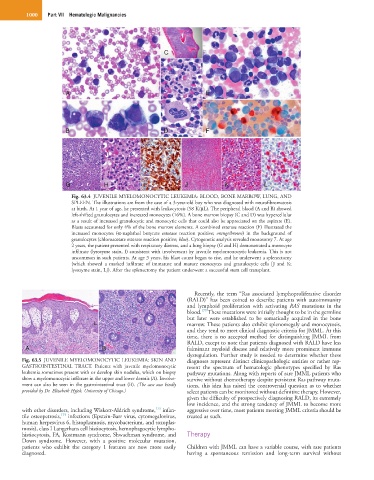
                        Fig. 63.4  JUVENILE MYELOMONOCYTIC LEUKEMIA: BLOOD, BONE MARROW, LUNG, AND
                        SPLEEN. The illustrations are from the case of a 3-year-old boy who was diagnosed with neurofibromatosis
                        at birth. At 1 year of age, he presented with leukocytosis (58 K/µL). The peripheral blood (A and B) showed
                        left-shifted granulocytes and increased monocytes (16%). A bone marrow biopsy (C and D) was hypercellular
                        as a result of increased granulocytic and monocytic cells that could also be appreciated on the aspirate (E).
                        Blasts accounted for only 4% of the bone marrow elements. A combined esterase reaction (F) illustrated the
                        increased  monocytes  (α-naphthol  butyrate  esterase  reaction  positive;  orange/brown)  in  the  background  of
                        granulocytes (chloroacetate esterase reaction positive; blue). Cytogenetic analysis revealed monosomy 7. At age
                        2 years, the patient presented with respiratory distress, and a lung biopsy (G and H) demonstrated a monocyte
                        infiltrate (lysozyme stain, I) consistent with involvement by juvenile myelomonocytic leukemia. This is not
                        uncommon in such patients. At age 3 years, his blast count began to rise, and he underwent a splenectomy
                        (which  showed  a  marked  infiltrate  of  immature  and  mature  monocytes  and  granulocytic  cells  [J  and  K;
                        lysozyme stain, L]). After the splenectomy the patient underwent a successful stem cell transplant.


                                                                 Recently, the term “Ras associated lymphoproliferative disorder
                                                              (RALD)” has been coined to describe patients with autoimmunity
                                                              and  lymphoid  proliferation  with  activating  RAS  mutations  in  the
                                                                   175
                                                              blood.  These mutations were initially thought to be in the germline
                                                              but  later  were  established  to  be  somatically  acquired  in  the  bone
                                L                             marrow. These patients also exhibit splenomegaly and monocytosis,
                                                              and they tend to meet clinical diagnostic criteria for JMML. At this
                                                              time, there is no accepted method for distinguishing JMML from
                                                              RALD, except to note that patients diagnosed with RALD have less
         A                        B                           fulminant myeloid disease and relatively more prominent immune
                                                              dysregulation. Further study is needed to determine whether these
        Fig. 63.5  JUVENILE MYELOMONOCYTIC LEUKEMIA: SKIN AND   diagnoses represent distinct clinicopathologic entities or rather rep-
        GASTROINTESTINAL  TRACT.  Patients  with  juvenile  myelomonocytic   resent  the  spectrum  of  hematologic  phenotypes  specified  by  Ras
        leukemia sometimes present with or develop skin nodules, which on biopsy   pathway mutations. Along with reports of rare JMML patients who
        show a myelomonocytic infiltrate in the upper and lower dermis (A). Involve-  survive without chemotherapy despite persistent Ras pathway muta-
        ment can also be seen in the gastrointestinal tract (B). (The case was kindly   tions, this idea has raised the controversial question as to whether
        provided by Dr. Elizabeth Hyjek, University of Chicago.)  select patients can be monitored without definitive therapy. However,
                                                              given the difficulty of prospectively diagnosing RALD, its extremely
                                                              low incidence, and the strong tendency of JMML to become more
                                                    173
        with other disorders, including Wiskott-Aldrich syndrome,  infan-  aggressive over time, most patients meeting JMML criteria should be
                     174
        tile osteopetrosis,  infections (Epstein-Barr virus, cytomegalovirus,   treated as such.
        human herpesvirus 6, histoplasmosis, mycobacterium, and toxoplas-
        mosis), class I Langerhans cell histiocytosis, hemophagocytic lympho-
        histiocytosis, FA, Kostmann syndrome, Shwachman syndrome, and   Therapy
        Down  syndrome.  However,  with  a  positive  molecular  mutation,
        patients  who  exhibit  the  category  1  features  are  now  more  easily   Children with JMML can have a variable course, with rare patients
        diagnosed.                                            having  a  spontaneous  remission  and  long-term  survival  without

