


Page 1131 - Hematology_ Basic Principles and Practice ( PDFDrive )
P. 1131
Chapter 63  Myelodysplastic Syndromes and Myeloproliferative Neoplasms in Children  997


                                                                       100
             Treatment Overview for Children With MDS
                                                                        90
             A multitude of agents have been studied for the treatment of myelodys-  80
             plastic syndromes (MDS) in adults, but only rarely in children. These   70
             include  low-dose  chemotherapy  (cytosine  arabinoside,  melphalan,   60
             hydroxyurea, etoposide, topotecan, 6-mercaptopurine, and busulfan),
             hormones  (glucocorticoids  and  androgens),  differentiating  agents   Probability of DFS, %  50  Matched, 57% (35–74)
             (13-cis-retinoic  acid,  all-trans  retinoic  acid),  hematopoietic  growth   40
             factors  (granulocyte-macrophage  colony-forming  factor,  granulocyte   30
             colony-forming  factor,  and  erythropoietin),  demethylating  agents            Mismatched, 33% (23–43)
             (decitabine,  5-azacytidine),  proteosome  inhibitors,  antiangiogenic   20
             agents, and arsenic. 60–75  This has resulted in three drugs (lenalidomide,   10  P = .003
             azacitidine,  and  decitabine)  that  are  now  approved  by  the  US  Food   0
             and Drug Administration for the treatment of MDS in adults. However,   0  1  2  3  4  5    6   7    8
             as there are currently no safety or efficacy data to support the use of
             these agents in children with MDS, these drugs are not approved for   A        Years
             MDS in children.
              In addition, a large number of agents are being tested in clinical trials
             in the broad categories of kinase inhibitors, deacetylase inhibitors and   100
             DNA methyltransferase inhibitors, altered cell metabolism, cytotoxics,   90
             cell  cycle  inhibitors,  immunomodulators  and  immunosuppressive   80
             agents, apoptosis modulators, and others. 76               70
              The difficulty in assessing the safety and efficacy of new agents in
             children  with  MDS  is  illustrated  by  the  Children’s  Oncology  Group’s   60       RC, 51% (34–65)
                                         77
             recent  prospective  study  of  amifostine.   This  prospective  Phase  II   Probability of DFS, %  50
             cooperative group study was unable to be completed because of lack   40               RAEB, 35% (22–48)
             of accrual. As a result, the safety and efficacy of amifostine in children
             with MDS remains uncertain. Despite a lack of successful prospective   30            RAEB-t, 29% (11–51)
             clinical  trials  in  children  with  MDS,  there  are  limited  retrospective   20
             data on the use of the hypomethylating agent azacytidine in children   10  P = .04
             with newly diagnosed MDS, and in the palliative setting, children with   0
             relapsed  MDS.  These  children  had  RCC,  advanced  and  secondary
             MDS,   and  prior  to  allogeneic  hematopoietic  cell  transplantation   0  1  2  3  4  5  6  7    8
                 78
             (HCT).  These retrospective reviews suggest that azacytidine is toler-  B      Years
                  79
             able and responses are possible, although the safety and efficacy in
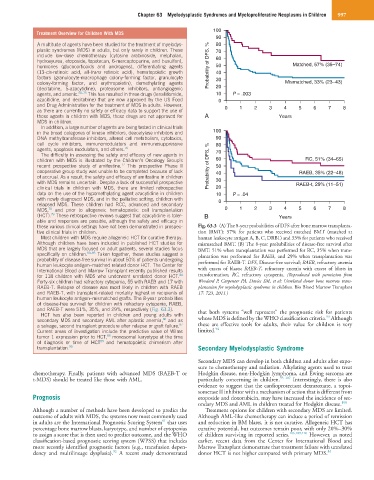
             these various clinical settings have not been demonstrated in prospec-  Fig. 63.3  (A) The 8-year probabilities of DFS after bone marrow transplanta-
             tive clinical trials in children.                    tion  (BMT):  57%  for  patients  who  received  matched  BMT  (matched  at
              Most children with MDS require allogeneic HCT for curative therapy.   human leukocyte antigen A, B, C, DRB1) and 33% for patients who received
             Although children have been included in published HCT studies for   mismatched BMT. (B) The 8-year probabilities of disease-free survival after
             MDS that are largely focused on adult patients, several studies focus   BMT: 51% when transplantation was performed for RC, 35% when trans-
             specifically on children. 80–85  Taken together, these studies suggest a   plantation  was  performed  for  RAEB,  and  29%  when  transplantation  was
             probability of disease-free survival in about 50% of patients undergoing   performed for RAEB-T. DFS, Disease-free survival; RAEB, refractory anemia
             human leukocyte antigen–matched related donor HCT. The Center for
             International Blood and Marrow Transplant recently published results   with  excess  of  blasts;  RAEB-T,  refractory  anemia  with  excess  of  blasts  in
             for  118  children  with  MDS  who  underwent  unrelated  donor  HCT.    transformation;  RC,  refractory  cytopenia.  (Reproduced  with  permission  from
                                                            84
             Forty-six children had refractory cytopenia, 55 with RAEB and 17 with   Woodard P, Carpenter PA, Davies SM, et al: Unrelated donor bone marrow trans-
             RAEB-T.  Relapse  of  disease  was  most  likely  in  children  with  RAEB   plantation for myelodysplastic syndrome in children. Bio Blood Marrow Transplant
             and RAEB-T, with transplant-related mortality highest in recipients of   17: 723, 2011.)
             human leukocyte antigen–mismatched grafts. The 8-year probabilities
             of disease-free survival for children with refractory cytopenia, RAEB,
             and RAEB-T were 51%, 35%, and 29%, respectively (Fig. 63.3).  that  both  systems  “well  represent”  the  prognostic  risk  for  patients
              HCT  has  also  been  reported  in  children  and  young  adults  with                        93
                                                      86
             secondary MDS and secondary AML after aplastic anemia,  and as   whose MDS is defined by the WHO classification criteria.  Although
                                                            87
             a salvage, second transplant procedure after relapse or graft failure.    these  are  effective  tools  for  adults,  their  value  for  children  is  very
                                                                        94
             Current  areas  of  investigation  include  the  predictive  value  of  Wilms   limited.
             tumor 1 expression prior to HCT,  monosomal karyotype at the time
                                    88
             of  diagnosis  or  time  of  HCT   and  hematopoietic  chimerism  after
                                  89
             transplantation. 90                                  Secondary Myelodysplastic Syndrome
                                                                  Secondary MDS can develop in both children and adults after expo-
                                                                  sure to chemotherapy and radiation. Alkylating agents used to treat
            chemotherapy.  Finally,  patients  with  advanced  MDS  (RAEB-T  or   Hodgkin disease, non-Hodgkin lymphoma, and Ewing sarcoma are
            t-MDS) should be treated like those with AML.         particularly  concerning  in  children. 95–107   Interestingly,  there  is  also
                                                                  evidence to suggest that the cardioprotectant dexrazoxane, a topoi-
                                                                  somerase II inhibitor with a mechanism of action that is different from
            Prognosis                                             etoposide and doxorubicin, may have increased the incidence of sec-
                                                                  ondary MDS and AML in children treated for Hodgkin disease. 108
            Although a number of methods have been developed to predict the   Treatment options for children with secondary MDS are limited.
            outcome of adults with MDS, the systems now most commonly used   Although AML-like chemotherapy can induce a period of remission
                                                      91
            in adults are the International Prognostic Scoring System  that uses   and reduction in BM blasts, it is not curative. Allogeneic HCT has
            percentage bone marrow blasts, karyotype, and number of cytopenias   curative potential, but outcomes remain poor, with only 20%–30%
            to assign a score that is then used to predict outcome, and the WHO   of children surviving in reported series. 106,109,110  However, as noted
            classification-based prognostic scoring system (WPSS) that includes   earlier,  recent  data  from  the  Center  for  International  Blood  and
            more recently identified prognostic factors (e.g., transfusion depen-  Marrow Transplant demonstrate that treatment failure with unrelated
                                      92
            dency  and  multilineage  dysplasia).   A  recent  study  demonstrated   donor HCT is not higher compared with primary MDS. 84

