


Page 1132 - Hematology_ Basic Principles and Practice ( PDFDrive )
P. 1132
998    Part VII  Hematologic Malignancies


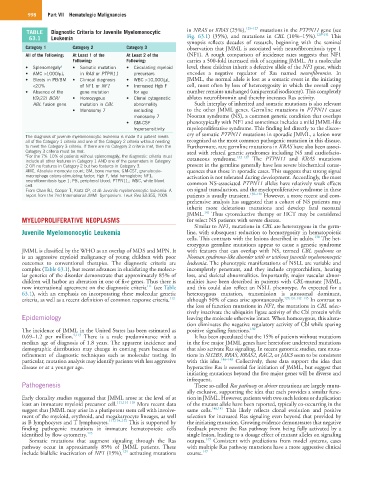
          TABLE   Diagnostic Criteria for Juvenile Myelomonocytic   in NRAS or KRAS (25%), 125–127  mutations in the PTPN11 gene (see
                                                                                                         128–131
          63.1    Leukemia                                    Fig.  63.1)  (35%),  and  mutations  in  CBL  (10%–15%).   This
                                                              synopsis  reflects  decades  of  research,  beginning  with  the  seminal
         Category 1      Category 2       Category 3          observation that JMML is associated with neurofibromitosis type 1
         All of the Following:  At Least 1 of the   At Least 2 of the   (NF1).  A  rough  comparison  of  incidence  rates  suggests  that  NF1
                         Following:       Following:          carries a 500-fold increased risk of acquiring JMML. At a molecular
         •	 Splenomegaly a  •	 Somatic	mutation	  •	 Circulating	myeloid	  level, these children inherit a defective allele of the NF1 gene, which
         •	 AMC	>1000/µL   in	RAS	or	PTPN11  precursors       encodes  a  negative  regulator  of  Ras  named  neurofibromin.  In
         •	 Blasts	in	PB/BM	  •	 Clinical	diagnosis	  •	 WBC	>10,000/µL  JMML, the normal allele is lost as a somatic event in the initiating
            <20%           of	NF1	or	NF1	  •	 Increased	Hgb	F	  cell, most often by loss of heterozygosity in which the overall copy
         •	 Absence	of	the	  gene	mutation   for	age          number remains unchanged (uniparental isodisomy). This completely
            t(9;22)	BCR/  •	 Homozygous	  •	 Clonal	cytogenetic	  ablates neurofibromin and thereby increases Ras activity.
            ABL	fusion	gene  mutation	in	CBL  abnormality	       Such interplay of inherited and somatic mutations is also relevant
                         •	 Monosomy	7       excluding	       to the other JMML genes. Germline mutations in PTPN11 cause
                                             monosomy	7       Noonan syndrome (NS), a common genetic condition that overlaps
                                          •	 GM-CSF	          phenotypically with NF1 and sometimes includes a mild JMML-like
                                             hypersensitivity  myeloproliferative syndrome. This finding led directly to the discov-
                                                              ery of somatic PTPN11 mutations in sporadic JMML, a lesion now
         The diagnosis of juvenile myelomonocytic leukemia is made if a patient meets
         all of the Category 1 criteria and one of the Category 2 criteria without needing   recognized as the most common pathogenic mutation in this disease.
         to meet the Category 3 criteria. If there are no Category 2 criteria met, then the   Furthermore, rare germline mutations in KRAS have also been associ-
         Category 3 criteria must be met.                     ated with related genetic syndromes including NS and cardiofacio-
         a For the 7%–10% of patients without splenomegaly, the diagnostic criteria must   132–137
         include all other features in Category 1 AND one of the parameters in Category   cutaneous  syndrome.    The  PTPN11  and  KRAS  mutations
         2 OR no features in Category 2 but two features in Category 3.  present in the germline generally have less severe biochemical conse-
         AMC, Absolute monocyte count; BM, bone marrow; GM-CSF, granulocyte-  quences than those in sporadic cases. This suggests that strong signal
         macrophage colony-stimulating factor; Hgb F, fetal hemoglobin; NF1,   activation is not tolerated during development. Accordingly, the most
         neurofibromitosis type 1; PB, peripheral blood; PTPN11,; WBC, white blood   common NS-associated PTPN11 alleles have relatively weak effects
         cell.
         From Chan RJ, Cooper T, Kratz CP, et al: Juvenile myelomonocytic leukemia: A   on signal transduction, and the myeloproliferative syndrome in these
         report from the 2nd International JMML Symposium. Leuk Res 33:355, 2009.  patients is usually transient. 138–140  However, a more recent and com-
                                                              prehensive analysis has suggested that a cohort of NS patients may
                                                              inherit  more  deleterious  mutations  and  develop  fatal  neonatal
                                                                    141
                                                              JMML.  Thus cytoreductive therapy or HCT may be considered
        MYELOPROLIFERATIVE NEOPLASMS                          for select NS patients with severe disease.
                                                                 Similar to NF1, mutations in CBL are heterozygous in the germ-
        Juvenile Myelomonocytic Leukemia                      line, with subsequent reduction to homozygosity in hematopoietic
                                                                                                        130
                                                              cells. This contrasts with the lesions described in adults.  The het-
                                                              erozygous germline mutations appear to cause a genetic syndrome
        JMML is classified by the WHO as an overlap of MDS and MPN. It   with  features  that  can  overlap  with  NS,  termed  CBL  syndrome  or
        is  an  aggressive  myeloid  malignancy  of  young  children  with  poor   Noonan syndrome-like disorder with or without juvenile myelomonocytic
        outcomes  to  conventional  therapies.  The  diagnostic  criteria  are   leukemia. The phenotypic manifestations of NSLL are variable and
        complex (Table 63.1), but recent advances in elucidating the molecu-  incompletely  penetrant,  and  they  include  cryptorchidism,  hearing
        lar genetics of the disorder demonstrate that approximately 85% of   loss, and skeletal abnormalities. Importantly, major vascular abnor-
        children will harbor an alteration in one of five genes. Thus there is   malities have been described in patients with CBL-mutant JMML,
                                                 111
        now international agreement on the diagnostic criteria  (see Table   and this could also reflect an NSLL phenotype. As expected for a
        63.1),  with  an  emphasis  on  incorporating  these  molecular  genetic   heterozygous  mutation,  transmission  is  autosomal  dominant,
        criteria, as well as a recent definition of common response criteria. 112  although 50% of cases arise spontaneously. 129,131,142–145  In contrast to
                                                              the loss of function mutations in NF1, the mutations in CBL selec-
                                                              tively inactivate the ubiquitin ligase activity of the Cbl protein while
        Epidemiology                                          leaving the molecule otherwise intact. When homozygous, this altera-
                                                              tion eliminates the negative regulatory activity of Cbl while sparing
        The incidence of JMML in the United States has been estimated as   positive signaling functions. 130
        0.69–1.2  per  million. 4,113   There  is  a  male  predominance  with  a   It has been speculated that the 15% of patients without mutations
        median age of diagnosis of 1.8 years. The apparent incidence and   in the five major JMML genes have heretofore undetected mutations
        demographic  distribution  may  change  in  coming  years  because  of   that also activate Ras signaling. In recent genomic studies, rare muta-
        refinement  of  diagnostic  techniques  such  as  molecular  testing.  In   tions in SH2B3, RRAS, RRAS2, RAC2, or JAK3 seem to be consistent
        particular, mutation analysis may identify patients with less aggressive   with  this  idea. 146–148   Collectively,  these  data  support  the  idea  that
        disease or at a younger age.                          hyperactive Ras is essential for initiation of JMML, but suggest that
                                                              initiating mutations beyond the five major genes will be diverse and
                                                              infrequent.
        Pathogenesis                                             These so-called Ras pathway or driver mutations are largely mutu-
                                                              ally exclusive, supporting the idea that each provides a similar func-
        Early clonality studies suggested that JMML arose at the level of at   tion in JMML. However, patients with two such lesions or duplication
        least an immature myeloid precursor cell. 111,114–118  More recent data   of the mutant allele have been reported, typically co-occurring in the
        suggest that JMML may arise in a pluripotent stem cell with involve-  same  cells. 146,147   This  likely  reflects  clonal  evolution  and  positive
        ment of the myeloid, erythroid, and megakaryocyte lineages, as well   selection for increased Ras signaling even beyond that provided by
        as B lymphocytes and T lymphocytes. 111,119–122  This is supported by   the initiating mutation. Growing evidence demonstrates that negative
        finding  pathogenic  mutations  in  immature  hematopoietic  cells   feedback prevents the Ras pathway from being fully activated by a
        identified by flow cytometry. 123                     single lesion, leading to a dosage effect of mutant alleles on signaling
                                                                    149
           Somatic  mutations  that  augment  signaling  through  the  Ras   outputs.   Consistent  with  predictions  from  model  systems,  cases
        pathway  occur  in  approximately  85%  of  JMML  patients.  These   with multiple Ras pathway mutations have a more aggressive clinical
                                         124
        include biallelic inactivation of NF1 (15%),  activating mutations   course. 147

