


Page 1147 - Hematology_ Basic Principles and Practice ( PDFDrive )
P. 1147
1006   Part VII  Hematologic Malignancies


                                                  Pediatric acute lymphoblastic leukemia
                                                    1.4% LYL1
                                                       t(7;19)
                                                 2.3% TLX3
                                                              0.3% TLX1
                                       7% TAL1
                                   t(1;14), t(1;7), 1 p32del                Hyperdiploid 20%
                                                               Other        >50 chromosomes
                              4% MYC-Ig Translocations         (T cell) 4%
                                  t(8;14), t(2;8), t(8;22)                           BCR-ABL1
                                                                                     2%
                                                                                     t(9;22)

                            10% Other (Precursor Bcell)
                                    5% TCF3-PBX1                                  ETV6-RUNX1
                                       t(1;19)                                    22%
                                                                                  t(12;21)
                                 1% TCF3-HLF
                                     t(17;19)
                                                                       MLL fusions 6%
                                   1% Hypodiploid                    t(1;11), t(4;11), t(11;19)
                                 <44 chromosomes

                                           Ph-Like 10%          iAmp21 2%
                                           CRLF2 rearranged 4%

                                   Genetic aberrations in
                                   Ph-Like ALL include:
                                   CRLF2 rearrangement     Precursor B cell  Mature B cell  T cell
                                   ABL1 fusion
                                   JAK2 rearrangement
                                   EPOR rearrangement
                                   RAS mutations
                                   JAK-STAT mutations
                              A
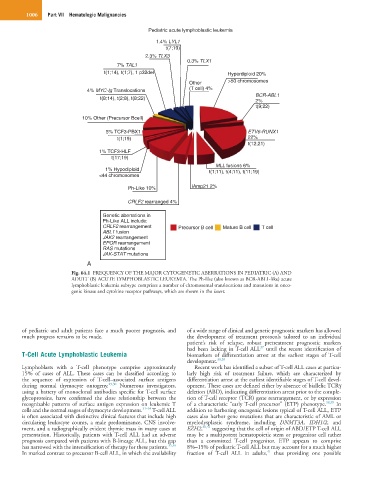
                        Fig. 64.1  FREQUENCY OF THE MAJOR CYTOGENETIC ABERRATIONS IN PEDIATRIC (A) AND
                        ADULT (B) ACUTE LYMPHOBLASTIC LEUKEMIA. The Ph-like (also known as BCR-ABL1-like) acute
                        lymphoblastic leukemia subtype comprises a number of chromosomal translocations and mutations in onco-
                        genic kinase and cytokine receptor pathways, which are shown in the insert.


        of pediatric and adult patients face a much poorer prognosis, and   of a wide range of clinical and genetic prognostic markers has allowed
        much progress remains to be made.                     the  development  of  treatment  protocols  tailored  to  an  individual
                                                              patient’s  risk  of  relapse,  robust  pretreatment  prognostic  markers
                                                                                      37
                                                              had been lacking in T-cell ALL  until the recent identification of
        T-Cell Acute Lymphoblastic Leukemia                   biomarkers  of  differentiation  arrest  at  the  earliest  stages  of  T-cell
                                                              development. 38,39
        Lymphoblasts  with  a  T-cell  phenotype  comprise  approximately   Recent work has identified a subset of T-cell ALL cases at particu-
        15%  of  cases  of  ALL.  These  cases  can  be  classified  according  to   larly  high  risk  of  treatment  failure,  which  are  characterized  by
        the  sequence  of  expression  of  T-cell–associated  surface  antigens   differentiation arrest at the earliest identifiable stages of T-cell devel-
        during  normal  thymocyte  ontogeny. 29,30   Numerous  investigators,   opment. These cases are defined either by absence of biallelic TCRγ
        using a battery of monoclonal antibodies specific for T-cell surface   deletion (ABD), indicating differentiation arrest prior to the comple-
        glycoproteins,  have  confirmed  the  close  relationship  between  the   tion of T-cell receptor (TCR) gene rearrangement, or by expression
        recognizable  patterns  of  surface  antigen  expression  on  leukemic T   of a characteristic “early T-cell precursor” (ETP) phenotype. 38,39  In
        cells and the normal stages of thymocyte development. 31–34  T-cell ALL   addition to harboring oncogenic lesions typical of T-cell ALL, ETP
        is often associated with distinctive clinical features that include high   cases also harbor gene mutations that are characteristic of AML or
        circulating  leukocyte  counts,  a  male  predominance,  CNS  involve-  myelodysplastic  syndrome,  including  DNMT3A,  IDH1/2,  and
        ment, and a radiographically evident thymic mass in many cases at   EZH2, 40,41  suggesting that the cell of origin of ABD/ETP T-cell ALL
        presentation. Historically, patients with T-cell ALL had an adverse   may be a multipotent hematopoietic stem or progenitor cell rather
        prognosis compared with patients with B-lineage ALL, but this gap   than  a  committed  T-cell  progenitor.  ETP  appears  to  comprise
        has narrowed with the intensification of therapy for these patients. 35,36    8%–15% of pediatric T-cell ALL but may account for a much higher
                                                                                        41
        In marked contrast to precursor B-cell ALL, in which the availability   fraction  of  T-cell  ALL  in  adults,   thus  providing  one  possible

