


Page 1151 - Hematology_ Basic Principles and Practice ( PDFDrive )
P. 1151
1010   Part VII  Hematologic Malignancies


        HSCs from adult bone marrow, but hematopoiesis is sustained by
                         171
        committed precursors.  Most ETV6-RUNX1 leukemias show loss                 Nicastrin
        of the normal ETV6 allele, suggesting that the leukemogenic effect
        of ETV6-RUNX1 may be mediated in part by loss of wild-type ETV6
        function. 172–175  Interestingly, germline loss-of-function ETV6 muta-  Signaling  Receiving
        tions have been recently identified in patients with familial throm-  cell  γ-Secretase  cell
        bocytopenia  and  a  predisposition  to  hematologic  malignancies
        including ALL, 176,177  further implicating wild-type ETV6 as an ALL   Cleavage 2
        tumor suppressor.                                                                         Nucleus
           RUNX1 is the DNA-binding component of the RUNX1-CBFβ            NOTCH     ICN
        transcription factor complex disrupted by the t(8;21), t(3;21), and   DSL                 ICN  MAML
        inv(16) in AML. RUNX1 is a transcription factor that is required for      Cleavage 1        CSL
        the expression of several hematopoietic genes involved in myeloid and
        lymphoid development, including PU.1 and IL-3, although it can
                                               178
        also act as a transcriptional repressor in some settings.  Homozygous   Metalloprotease
        disruption of the murine Runx1 or CBFB genes results in the lack of
        definitive hematopoiesis, indicating that genes regulated by RUNX1
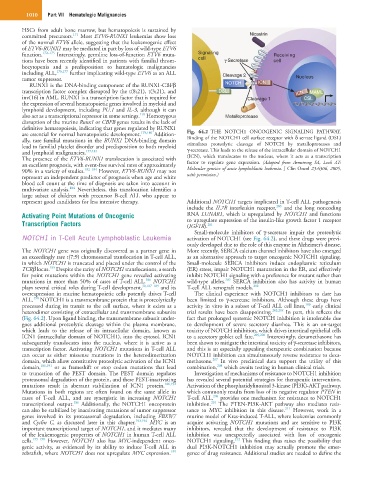
        are essential for normal hematopoietic development. 179,180  Addition-  Fig.  64.2  THE  NOTCH1  ONCOGENIC  SIGNALING  PATHWAY.
        ally, rare familial mutations in the RUNX1 DNA-binding domain   Binding of the NOTCH1 cell surface receptor with δ serrate ligand (DSL)
        lead to familial platelet disorder and predisposition to both myeloid   stimulates  proteolytic  cleavage  of  NOTCH  by  metalloproteases  and
        and lymphoid malignancies. 177,181                    γ-secretase. This leads to the release of the intracellular domain of NOTCH1
        The presence of the ETV6-RUNX1 translocation is associated with   (ICN),  which  translocates  to  the  nucleus,  where  it  acts  as  a  transcription
        an excellent prognosis, with event-free survival rates of approximately   factor  to  regulate  gene  expression.  (Adapted  from  Armstrong  SA,  Look  AT:
        90% in a variety of studies. 182–184  However, ETV6-RUNX1 may not   Molecular genetics of acute lymphoblastic leukemia. J Clin Oncol 23:6306, 2005,
        represent an independent predictor of prognosis when age and white   with permission.)
        blood cell count at the time of diagnosis are taken into account in
                        184
        multivariate  analysis.   Nevertheless,  this  translocation  identifies  a
        large  subset  of  children  with  precursor  B-cell  ALL  who  appear  to
        represent good candidates for less intensive therapy.  Additional NOTCH1 targets implicated in T-cell ALL pathogenesis
                                                                                           200
                                                              include  the  IL7R  interleukin  receptor,   and  the  long  noncoding
        Activating Point Mutations of Oncogenic               RNA LUNAR1, which is upregulated by NOTCH1 and functions
        Transcription Factors                                 to upregulate expression of the insulin-like growth factor 1 receptor
                                                                     201
                                                              (IGF1R).
                                                                 Small-molecule  inhibitors  of  γ-secretase  impair  the  proteolytic
        NOTCH1 in T-Cell Acute Lymphoblastic Leukemia         activation of NOTCH1 (see Fig. 64.2), and these drugs were previ-
                                                              ously developed due to the role of this enzyme in Alzheimer’s disease.
        The NOTCH1 gene was originally discovered as a partner gene in   More recently, SERCA calcium channel inhibitors have also emerged
        an exceedingly rare t(7;9) chromosomal translocation in T-cell ALL,   as an alternative approach to target oncogenic NOTCH1 signaling.
        in which NOTCH1 is truncated and placed under the control of the   Small-molecule  SERCA  inhibitors  induce  endoplasmic  reticulum
                 185
        TCRβ locus.  Despite the rarity of NOTCH1 translocations, a search   (ER) stress, impair NOTCH1 maturation in the ER, and effectively
        for point mutations within the NOTCH1 gene revealed activating   inhibit NOTCH1 signaling with a preference for mutant rather than
                                                 186
                                                                           202
        mutations in more than 50% of cases of T-cell ALL.  NOTCH1   wild-type  alleles.   SERCA  inhibition  also  has  activity  in  human
        plays several critical roles during T-cell development, 30,187–189  and its   T-cell ALL xenograft models. 202
        overexpression in murine hematopoietic cells potently drives T-cell   The  clinical  experience  with  NOTCH1  inhibitors  to  date  has
            190
        ALL.  NOTCH1 is a transmembrane protein that is proteolytically   been  limited  to  γ-secretase  inhibitors.  Although  these  drugs  have
                                                                                                     186
        processed during its transit to the cell surface, where it exists as a   activity in vitro in a subset of T-cell ALL cell lines,  early clinical
        heterodimer consisting of extracellular and transmembrane subunits   trial results have been disappointing. 203,204  In part, this reflects the
        (Fig. 64.2). Upon ligand binding, the transmembrane subunit under-  fact that prolonged systemic NOTCH inhibition is intolerable due
        goes  additional  proteolytic  cleavage  within  the  plasma  membrane,   to  development  of  severe  secretory  diarrhea.  This  is  an  on-target
        which  leads  to  the  release  of  its  intracellular  domain,  known  as   toxicity of NOTCH inhibition, which drives intestinal epithelial cells
        ICN1 (intracellular domain of NOTCH1), into the cytosol. ICN1   to a secretory goblet cell fate. 205,206  Interestingly, dexamethasone has
        subsequently  translocates  into  the  nucleus,  where  it  is  active  as  a   been shown to mitigate the intestinal toxicity of γ-secretase inhibitors,
        transcription factor. Activating NOTCH1 mutations in T-cell ALL   and this is an especially appealing therapeutic combination because
        can  occur  as  either  missense  mutations  in  the  heterodimerization   NOTCH1 inhibition can simultaneously reverse resistance to dexa-
                                                                       207
        domain, which allow constitutive proteolytic activation of the ICN1   methasone.   In  vivo  preclinical  data  support  the  utility  of  this
                                                                        208
        domain, 186,191   or  as  frameshift  or  stop  codon  mutations  that  lead   combination,  which awaits testing in human clinical trials.
        to  truncation  of  the  PEST  domain.  The  PEST  domain  regulates   Investigation of mechanisms of resistance to NOTCH1 inhibition
        proteasomal degradation of the protein, and these PEST-inactivating   has revealed several potential strategies for therapeutic intervention.
        mutations  result  in  aberrant  stabilization  of  ICN1  protein. 186,192    Activation of the phosphatidylinositol 3-kinase (PI3K)-AKT pathway,
        Mutations  in  both  regions  are  often  found  on  the  same  allele  in   which commonly results from loss of its negative regulator PTEN in
                                                                       209
        cases  of  T-cell  ALL,  and  are  synergistic  in  increasing  NOTCH1   T-cell ALL,  provides one mechanism for resistance to NOTCH1
                                                                      210
                         186
        transcriptional  output.   Additionally,  the  NOTCH1  oncoprotein   inhibition.   The  PTEN-PI3K-AKT  pathway  also  mediates  resis-
                                                                                              211
        can also be stabilized by inactivating mutations of tumor suppressor   tance  to  MYC  inhibition  in  this  disease.   However,  work  in  a
        genes  involved  in  its  proteasomal  degradation,  including  FBXW7   murine model of Kras-induced T-ALL, where leukemias commonly
        and  Cyclin  C,  as  discussed  later  in  this  chapter. 193,194   MYC  is  an   acquire  activating  NOTCH1  mutations  and  are  sensitive  to  PI3K
        important transcriptional target of NOTCH1, and it mediates many   inhibitors,  revealed  that  the  development  of  resistance  to  PI3K
        of the leukemogenic properties of NOTCH1 in human T-cell ALL   inhibition  was  unexpectedly  associated  with  loss  of  oncogenic
                                                                              212
        cells. 195–198   However,  NOTCH1  also  has  MYC-independent  onco-  NOTCH1 signaling.  This finding thus raises the possibility that
        genic  activity,  as  evidenced  by  its  ability  to  induce T-cell  ALL  in   dual  PI3K-NOTCH1  inhibition  may  actually  promote  the  emer-
                                                         199
        zebrafish, where NOTCH1 does not upregulate MYC expression.    gence of drug resistance. Additional studies are needed to define the

