


Page 1148 - Hematology_ Basic Principles and Practice ( PDFDrive )
P. 1148
Chapter 64  Pathobiology of Acute Lymphoblastic Leukemia  1007


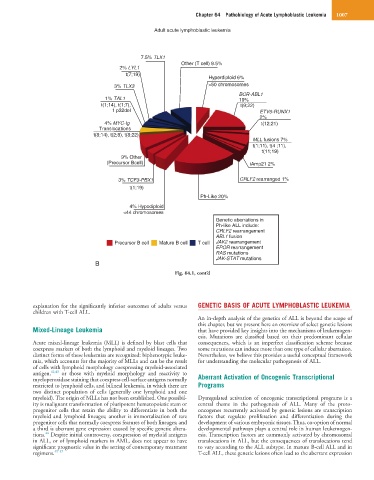
                                                   Adult acute lymphoblastic leukemia


                                               7.5% TLX1
                                                            Other (T cell) 9.5%
                                        2% LYL1
                                          t(7;19)
                                                                     Hyperdiploid 6%
                                      3% TLX3                        >50 chromosomes
                                                                               BCR-ABL1
                                   1% TAL1                                     19%
                                  t(1;14), t(1;7),                              t(9;22)
                                      1 p32del                                        ETV6-RUNX1
                                                                                      2%
                                   4% MYC-Ig                                          t(12;21)
                                 Translocations
                                t(8;14), t(2;8), t(8;22)
                                                                                    MLL fusions 7%
                                                                                    t(1;11), t(4 ;11),
                                                                                       t(11;19)
                                         9% Other
                                    (Precursor Bcell)                              iAmp21 2%

                                        3% TCF3-PBX1                           CRLF2 rearranged 1%
                                           t(1;19)
                                                                   Ph-Like 20%
                                           4% Hypodiploid
                                         <44 chromosomes
                                                                        Genetic aberrations in
                                                                        Ph-like ALL include:
                                                                        CRLF2 rearrangement
                                                                        ABL1 fusion
                                      Precursor B cell  Mature B cell  T cell  JAK2 rearrangement
                                                                        EPOR rearrangement
                                                                        RAS mutations
                                                                        JAK-STAT mutations
                                B
                                                          Fig. 64.1, cont’d


            explanation for the significantly inferior outcomes of adults versus   GENETIC BASIS OF ACUTE LYMPHOBLASTIC LEUKEMIA
            children with T-cell ALL.
                                                                  An in-depth analysis of the genetics of ALL is beyond the scope of
                                                                  this chapter, but we present here an overview of select genetic lesions
            Mixed-Lineage Leukemia                                that have provided key insights into the mechanisms of leukemogen-
                                                                  esis.  Mutations  are  classified  based  on  their  predominant  cellular
            Acute mixed-lineage leukemia (MLL) is defined by blast cells that   consequences,  which  is  an  imperfect  classification  scheme  because
            coexpress markers of both the lymphoid and myeloid lineages. Two   some mutations can induce more than one type of cellular aberration.
            distinct forms of these leukemias are recognized: biphenotypic leuke-  Nevertheless, we believe this provides a useful conceptual framework
            mia, which accounts for the majority of MLLs and can be the result   for understanding the molecular pathogenesis of ALL.
            of cells with lymphoid morphology coexpressing myeloid-associated
            antigen, 42,43   or  those  with  myeloid  morphology  and  reactivity  to
            myeloperoxidase staining that coexpress cell-surface antigens normally   Aberrant Activation of Oncogenic Transcriptional
            restricted to lymphoid cells, and bilineal leukemia, in which there are   Programs
            two  distinct  population  of  cells  (generally  one  lymphoid  and  one
            myeloid). The origin of MLLs has not been established. One possibil-  Dysregulated activation of oncogenic transcriptional programs is a
            ity is malignant transformation of pluripotent hematopoietic stem or   central  theme  in  the  pathogenesis  of  ALL.  Many  of  the  proto-
            progenitor  cells  that  retain  the  ability  to  differentiate  in  both  the   oncogenes recurrently activated by genetic lesions are transcription
            myeloid and lymphoid lineages; another is immortalization of rare   factors  that  regulate  proliferation  and  differentiation  during  the
            progenitor cells that normally coexpress features of both lineages; and   development of various embryonic tissues. Thus, co-option of normal
            a third is aberrant gene expression caused by specific genetic altera-  developmental pathways plays a central role in human leukemogen-
                44
            tions.  Despite initial controversy, coexpression of myeloid antigens   esis. Transcription factors are commonly activated by chromosomal
            in ALL, or of lymphoid markers in AML, does not appear to have   translocations in ALL, but the consequences of translocations tend
            significant prognostic value in the setting of contemporary treatment   to vary according to the ALL subtype. In mature B-cell ALL and in
            regimens. 45–47                                       T-cell ALL, these genetic lesions often lead to the aberrant expression

