


Page 117 - Hematology_ Basic Principles and Practice ( PDFDrive )
P. 117
88    Part I  Molecular and Cellular Basis of Hematology


                        Oxidative stressors               Hb
                      Drugs (Dose, schedule of                            “Damaging” variants in
                        administration), fava     2                          the G6PD gene
                        beans, infections

                                                        Met-Hb


                                                         GSSG              NADPH                 6PG
                                          H O
                                            2
                      Glutathion  1
                     production                                    GSR                  G6PD
                                                 GPX

                                      H 2 O 2           GSH
                                      ROS                                    NADP                G6P


                         Damage of erythrocytes
                      Acute hemolytic anemia (AHA)

                                                                             Tissue hypoxia

                            Co-morbidities                 3
                             Malaria, ALL,
                          methemoglobinemia

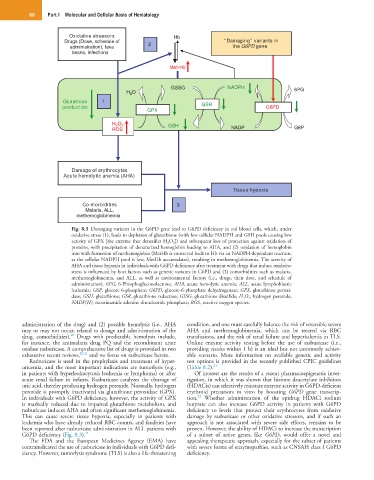
                        Fig. 8.3  Damaging variants in the G6PD gene lead to G6PD deficiency in red blood cells, which, under
                        oxidative stress (1), leads to depletion of glutathione (with low cellular NADPH and GSH pools causing low
                        activity of GPX [the enzyme that detoxifies H 2O 2]) and subsequent loss of protection against oxidation of
                        proteins, with precipitation of denaturized hemoglobin leading to AHA, and (2) oxidation of hemoglobin
                        iron with formation of methemoglobin (MetHb is converted back to Hb via an NADPH-dependent reaction;
                        as the cellular NADPH pool is low, MetHb accumulates), resulting in methemoglobinemia. The severity of
                        AHA and tissue hypoxia in individuals with G6PD deficiency after treatment with drugs that induce oxidative
                        stress is influenced by host factors such as genetic variants in G6PD and (3) comorbidities such as malaria,
                        methemoglobinemia,  and  ALL,  as  well  as  environmental  factors  (i.e.,  drugs,  their  dose,  and  schedule  of
                        administration). 6PG, 6-Phosphogluconolactone; AHA, acute hemolytic anemia; ALL, acute lymphoblastic
                        leukemia; G6P, glucose 6-phosphate; G6PD, glucose-6-phosphate dehydrogenase; GPX, glutathione peroxi-
                        dase; GSH, glutathione; GSR, glutathione reductase; GSSG, glutathione disulfide; H 2 O 2, hydrogen peroxide;
                        NADP(H), nicotinamide adenine dinucleotide phosphate; ROS, reactive oxygen species.


        administration of the drug) and (2) possible hemolysis (i.e., AHA     condition, and one must carefully balance the risk of reversible severe
        may or may not occur, related to dosage and administration of the   AHA  and  methemoglobinemia,  which  can  be  treated  via  RBC
                        20
        drug,  comorbidities).   Drugs  with  predictable  hemolysis  include,   transfusions, and the risk of renal failure and hyperkalemia in TLS.
        for  instance,  the  antimalaria  drug  PQ  and  the  recombinant  urate   Online  enzyme  activity  testing  before  the  use  of  rasburicase  (i.e.,
        oxidase rasburicase. A comprehensive list of drugs is provided in two   providing results within 1 h) is an ideal but not commonly achiev-
        exhaustive recent reviews, 20,21  and we focus on rasburicase herein.  able  scenario.  More  information  on  available  genetic  and  activity
           Rasburicase is used in the prophylaxis and treatment of hyper-  test options is provided in the recently published CPIC guidelines
        uricemia, and the most important indications are tumorlysis (e.g.,   (Table 8.2). 21
        in patients with hyperleukocytosis leukemia or lymphoma) or after   Of interest are the results of a recent pharmacoepigenetic inves-
        acute  renal  failure  in  infants.  Rasburicase  catalyzes  the  cleavage  of   tigation, in which it was shown that histone deacetylase inhibitors
        uric acid, thereby producing hydrogen peroxide. Normally, hydrogen   (HDACis) can selectively reinstate enzyme activity in G6PD-deficient
        peroxide is promptly inactivated via glutathione peroxidase (GPX).   erythroid  precursors  in  vitro  by  boosting  G6PD  gene  transcrip-
                                                                  22
        In individuals with G6PD deficiency, however, the activity of GPX   tion.   Whether  administration  of  the  epidrug  HDACi  sodium
        is markedly reduced due to impaired glutathione metabolism, and   butyrate  can  also  increase  G6PD  activity  in  patients  with  G6PD
        rasburicase induces AHA and often significant methemoglobinemia.   deficiency  to  levels  that  protect  their  erythrocytes  from  oxidative
        This  can  cause  severe  tissue  hypoxia,  especially  in  patients  with   damage  by  rasburicase  or  other  oxidative  stressors,  and  if  such  an
        leukemia who have already reduced RBC counts, and fatalities have   approach  is  not  associated  with  severe  side  effects,  remains  to  be
        been reported after rasburicase administration in ALL patients with   proven. However, the ability of HDACi to increase the transcription
        G6PD deficiency (Fig. 8.3). 21                        of  a  subset  of  active  genes,  like  G6PD,  would  offer  a  novel  and
           The  FDA  and  the  European  Medicines  Agency  (EMA)  have   appealing therapeutic approach, especially for the subset of patients
        contraindicated the use of rasburicase in individuals with G6PD defi-  with severe forms of enzymopathies, such as CNSAH class I G6PD
        ciency. However, tumorlysis syndrome (TLS) is also a life-threatening   deficiency.

