


Page 112 - Hematology_ Basic Principles and Practice ( PDFDrive )
P. 112
Chapter 8  Pharmacogenomics and Hematologic Diseases  83


                                             WT/WT                         WT/V                         V/V
              Genotype
                                  10.0                        10.0                         10.0
                                                  AUC = 100                   AUC = 200                     AUC = 400
                                  Concentration  1.0           1.0                         1.0
            Drug metabolism
              (degradation)


                                   0.1                         0.1                          0.1
                                      0   6    12    18   24      0   6    12    18   24      0   6     12   18   24
                                             Time (hr)                   Time (hr)                    Time (hr)
                                   100                         100                         100
                                                 Efficacy                      Toxicity                   Toxicity
                                  % Responding  50            % Responding  50  Efficacy  % Responding  50
             Drug receptor
               (efficacy)

                                    10             Toxicity     10                          10               Efficacy
                                    0                            0                           0
                                      0  100   200   300  400     0  100   200   300  400     0  100   200   300  400
                                              AUC                          AUC                         AUC
                                      Metabolism            Receptor                         Response
                                       genotype             genotype                Efficacy          Toxicity
                                                     +                                65%           Low (5%)
                                                     +                                32%           Low
                                                     +                                 9%           Low
                                                     +                                79%           Moderate (15%)
             Polygenic drug
               response                              +                                40%           Moderate
                                                     +                                10%           Moderate
                                                     +                                80%           High (80%)
                                                     +                                40%           High
                                                     +                                10%           High
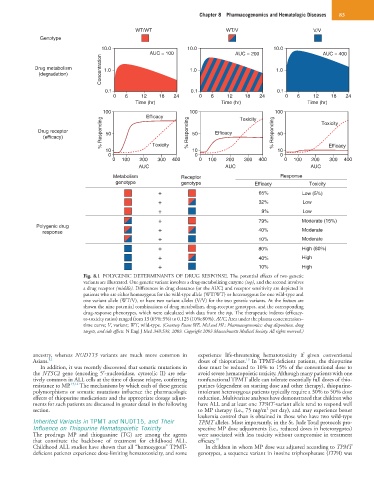
                            Fig. 8.1  POLYGENIC DETERMINANTS OF DRUG RESPONSE. The potential effects of two genetic
                            variants are illustrated. One genetic variant involves a drug-metabolizing enzyme (top), and the second involves
                            a drug receptor (middle). Differences in drug clearance (or the AUC) and receptor sensitivity are depicted in
                            patients who are either homozygous for the wild-type allele (WT/WT) or heterozygous for one wild-type and
                            one variant allele (WT/V), or have two variant alleles (V/V) for the two genetic variants. At the bottom are
                            shown the nine potential combinations of drug metabolism, drug-receptor genotypes, and the corresponding
                            drug-response phenotypes, which were calculated with data from the top. The therapeutic indexes (efficacy-
                            to-toxicity ratios) ranged from 13 (65%:5%) to 0.125 (10%:80%). AUC, Area under the plasma concentration–
                            time curve; V, variant; WT, wild-type. (Courtesy Evans WE, McLeod HL: Pharmacogenomics: drug disposition, drug
                            targets, and side effects. N Engl J Med 348:538, 2003. Copyright 2003 Massachusetts Medical Society. All rights reserved.)


            ancestry,  whereas  NUDT15  variants  are  much  more  common  in   experience  life-threatening  hematotoxicity  if  given  conventional
                                                                                 10
            Asians. 12                                            doses of thiopurines.  In TPMT-deficient patients, the thiopurine
              In addition, it was recently discovered that somatic mutations in   dose must be reduced to 10% to 15% of the conventional dose to
            the  NT5C2  gene  (encoding  5′-nucleotidase,  cytosolic  II)  are  rela-  avoid severe hematopoietic toxicity. Although many patients with one
            tively common in ALL cells at the time of disease relapse, conferring   nonfunctional TPMT allele can tolerate essentially full doses of thio-
            resistance to MP. 13,14  The mechanisms by which each of these genetic   purines (dependent on starting dose and other therapy), thiopurine-
            polymorphisms  or  somatic  mutations  influence  the  pharmacologic   intolerant heterozygous patients typically require a 30% to 50% dose
            effects of thiopurine medications and the appropriate dosage adjust-  reduction. Multivariate analyses have demonstrated that children who
            ments for such patients are discussed in greater detail in the following   have ALL and at least one TPMT-variant allele tend to respond well
                                                                                        2
            section.                                              to MP therapy (i.e., 75 mg/m  per day), and may experience better
                                                                  leukemia control than is obtained in those who have two wild-type
            Inherited Variants in TPMT and NUDT15, and Their      TPMT alleles. Most importantly, in the St. Jude Total protocols pro-
            Influence on Thiopurine Hematopoietic Toxicity        spective MP dose adjustments (i.e., reduced doses in heterozygotes)
            The  prodrugs  MP  and  thioguanine  (TG)  are  among  the  agents   were associated with less toxicity without compromise in treatment
            that  constitute  the  backbone  of  treatment  for  childhood  ALL.   efficacy. 10
            Childhood ALL studies have shown that all “homozygous” TPMT-  In children in whom MP dose was adjusted according to TPMT
            deficient patients experience dose-limiting hematotoxicity, and some   genotypes, a sequence variant in inosine triphosphatase (ITPA) was

