


Page 113 - Hematology_ Basic Principles and Practice ( PDFDrive )
P. 113
84    Part I  Molecular and Cellular Basis of Hematology


                Genotype/Phenotype             Drug dose               Systemic exposure             Toxicity
                   TPMT alleles            Conventional dosing
                *1                   500                                                     1
                    ATG                                          5000                              Deficient
                *2                                               4000                      0.8
                                                                                           0.6
                   ATG  238>C        250                        TGN (pmol/8 × 10 8  RBC)  3000  Cumulative incidence  0.4  Heterozygote
                                                                 2000
          TPMT  deficiency  *3A  ATG 460G>A 719A>C  0  v/v  wt/v  wt/wt  1000  Deficient  Wild-type  0.2 0    0  0.5  1.5 Wild-type
                                                                   0
                                                                                                           2 2.5
               *3C
                                                                          Heterozygote
                    ATG   719A>G                                         TPMT phenotype              1 Years
          10                               Individualized dosing
                       wt/wt
           8                         500                         5000                      0.8 1
          Percent  6 4  *2, *3A, *3C  MP mg/m 2 /wt  250        TGN (pmol/8 × 10 8  RBC)  4000  Cumulative incidence  0.4
                                                                                           0.6
                                                                 3000
           2  v/v  wt/v                                          2000                      0.2
                                                                 1000
           0                          0                            0                         0
             0     10     20    30         v/v   wt/v   wt/wt         Deficient  Wild-type      0  0.5  1  1.5  2 2.5
                   TPMT actvity                                           Heterozygote               Years
                                                                         TPMT phenotype
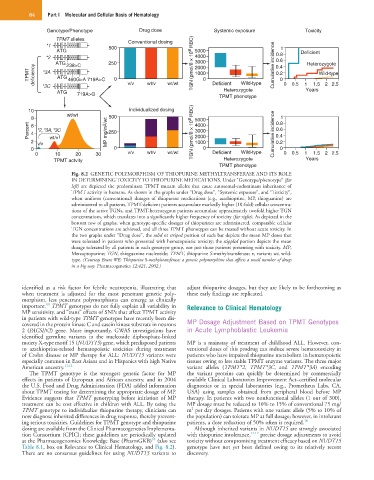
                        Fig. 8.2  GENETIC POLYMORPHISM OF THIOPURINE METHYLTRANSFERASE AND ITS ROLE
                        IN DETERMINING TOXICITY TO THIOPURINE MEDICATIONS. Under “Genotype/phenotype” (far
                        left) are depicted the predominant TPMT mutant alleles that cause autosomal-codominant inheritance of
                        TPMT activity in humans. As shown in the graphs under “Drug dose”, “Systemic exposure”, and “Toxicity”,
                        when  uniform  (conventional)  dosages  of  thiopurine  medications  (e.g.,  azathioprine,  MP,  thioguanine)  are
                        administered to all patients, TPMT-deficient patients accumulate markedly higher (10-fold) cellular concentra-
                        tions of the active TGNs, and TPMT-heterozygous patients accumulate approximately twofold higher TGN
                        concentrations, which translates into a significantly higher frequency of toxicity (far right). As depicted in the
                        bottom row of graphs, when genotype-specific dosages of thiopurines are administered, comparable cellular
                        TGN concentrations are achieved, and all three TPMT phenotypes can be treated without acute toxicity. In
                        the two graphs under “Drug dose”, the solid or striped portion of each bar depicts the mean MP doses that
                        were tolerated in patients who presented with hematopoietic toxicity; the stippled portion depicts the mean
                        dosage tolerated by all patients in each genotype group, not just those patients presenting with toxicity. MP,
                        Mercaptopurine; TGN, thioguanine nucleotide; TPMT, thiopurine S-methyltransferase; v, variant; wt, wild-
                        type. (Courtesy Evans WE: Thiopurine S-methyltransferase: a genetic polymorphism that affects a small number of drugs
                        in a big way. Pharmacogenetics 12:421, 2002.)


        identified  as  a  risk  factor  for  febrile  neutropenia,  illustrating  that   adjust thiopurine dosages, but they are likely to be forthcoming as
        when  treatment  is  adjusted  for  the  most  penetrant  genetic  poly-  these early findings are replicated.
        morphism,  less  penetrant  polymorphisms  can  emerge  as  clinically
                10
        important.  TPMT genotypes do not fully explain all variability in   Relevance to Clinical Hematology
        MP sensitivity, and “trans” effects of SNPs that affect TPMT activity
        in patients with wild-type TPMT genotypes have recently been dis-
        covered in the protein kinase C and casein kinase substrate in neurons   MP Dosage Adjustment Based on TPMT Genotypes
        2  (PACSIN2)  gene.  More  importantly,  GWAS  investigations  have   in Acute Lymphoblastic Leukemia
        identified  germline  variants  in  the  nucleoside  diphosphate-linked
        moiety X-type motif 15 (NUDT15) gene, which predisposed patients   MP  is  a  mainstay  of  treatment  of  childhood  ALL.  However,  con-
        to  azathioprine-related  hematopoietic  toxicities  during  treatment   ventional doses of this prodrug can induce severe hematotoxicity in
        of Crohn disease or MP therapy for ALL: NUDT15 variants were   patients who have impaired thiopurine metabolism in hematopoietic
        especially common in East Asians and in Hispanics with high Native   tissues owing to less stable TPMT enzyme variants. The three major
        American ancestry. 11,12                              variant  alleles  (TPMT*2,  TPMT*3C,  and  TPMT*3A)  encoding
           The  TPMT  genotype  is  the  strongest  genetic  factor  for  MP   the  variant  proteins  can  quickly  be  determined  by  commercially
        effects  in  patients  of  European  and  African  ancestry,  and  in  2004   available Clinical Laboratories Improvement Act–certified molecular
        the U.S. Food and Drug Administration (FDA) added information   diagnostics  or  in  special  laboratories  (e.g.,  Prometheus  Labs,  CA,
        about TPMT testing for determining the appropriate dosage of MP.   USA)  using  samples  obtained  from  peripheral  blood  before  MP
        Evidence  suggests  that  TPMT  genotyping  before  initiation  of  MP   therapy. In patients with two nonfunctional alleles (1 out of 300),
        treatment can be cost effective in children with ALL. By using the   MP dosage must be reduced to 10% to 15% of conventional 75 mg/
                                                                2
        TPMT genotype to individualize thiopurine therapy, clinicians can   m  per day dosages. Patients with one variant allele (5% to 10% of
        now diagnose inherited differences in drug response, thereby prevent-  the population) can tolerate MP at full dosage; however, in intolerant
        ing serious toxicities. Guidelines for TPMT genotype and thiopurine   patients, a dose reduction of 50% often is required. 10
        dosing are available from the Clinical Pharmacogenetics Implementa-  Although inherited variants in NUDT15 are strongly associated
        tion Consortium (CPIC); these guidelines are periodically updated   with thiopurine intolerance, 11,12  precise dosage adjustments to avoid
                                                   10
        at the Pharmacogenomics Knowledge Base (PharmGKB)  (also see   toxicity without compromising treatment efficacy based on NUDT15
        Table 8.1, box on Relevance to Clinical Hematology, and Fig. 8.2).   genotype  have  not  yet  been  defined  owing  to  its  relatively  recent
        There  are  no  consensus  guidelines  for  using  NUDT15  variants  to   discovery.

