


Page 1210 - Hematology_ Basic Principles and Practice ( PDFDrive )
P. 1210
1056   Part VII  Hematologic Malignancies


                                                              transduction–transplantation CML model has been helpful in study-
                                                              ing the role of BCR-ABL domains and signaling interaction in primary
                                                              hematopoietic cells in vivo. The ABL tyrosine kinase is crucial for
                                                              oncogenic  transformation.  Mice  that  express  a  form  of  BCR-ABL
                                                              with a point mutation in the ATP-binding site of ABL that inhibits
                                                              its kinase activity do not develop leukemia, suggesting that the ABL
                                                              kinase activity is essential for BCR-ABL leukemogenesis in vivo. The
                                                              success of kinase inhibitor therapy for CML provides further proof of
                                                              the importance of kinase activity in maintenance of human disease.
                                                              Other  important  domains  in  BCR-ABL  also  regulate  the  kinase
                        9                 22
                                                              activity of ABL or connect to other downstream signaling pathways.
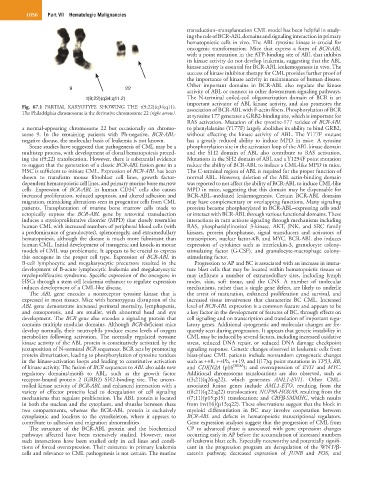
                             t(9;22)(q34;q11.2)               The  N-terminal  coiled-coil  oligomerization  domain  of  BCR  is  an
                                                              important  activator  of  ABL  kinase  activity,  and  also  promotes  the
        Fig.  67.1  PARTIAL  KARYOTYPE  SHOWING  THE  t(9;22)(q34;q11).   association of BCR-ABL with F-actin fibers. Phosphorylation of BCR
        The Philadelphia chromosome is the derivative chromosome 22 (right arrow).
                                                              at tyrosine 177 generates a GRB2-binding site, which is important for
                                                              RAS activation. Mutation of the tyrosine-177 residue of BCR-ABL
        a  normal-appearing  chromosome  22  but  occasionally  on  chromo-  to phenylalanine (Y177F) largely abolishes its ability to bind GRB2,
        some  9.  In  the  remaining  patients  with  Ph-negative,  BCR-ABL-  without  affecting  the  kinase  activity  of  ABL. The  Y177F  mutant
        negative disease, the molecular basis of leukemia is not known.  has  a  greatly  reduced  ability  to  induce  MPD  in  mice.  A  tyrosine
           Some studies have suggested that pathogenesis of CML may be a   phosphorylation site in the activation loop of the ABL kinase domain
        multistep process, with development of clonal hematopoiesis preced-  and  the  SH2  domain  of  ABL  also  contribute  to  RAS  activation.
        ing the t(9;22) translocation. However, there is substantial evidence   Mutations in the SH2 domain of ABL and a Y1294F point mutation
        to suggest that the generation of a classic BCR-ABL fusion gene in a   reduce the ability of BCR-ABL to induce a CML-like MPD in mice.
        HSC is sufficient to initiate CML. Expression of BCR-ABL has been   The C-terminal region of ABL is required for the proper function of
        shown  to  transform  mouse  fibroblast  cell  lines,  growth  factor-  normal ABL. However, deletion of the ABL actin-binding domain
        dependent hematopoietic cell lines, and primary murine bone marrow   was reported to not affect the ability of BCR-ABL to induce CML-like
                                             +
        cells.  Expression  of  BCR-ABL  in  human  CD34   cells  also  causes   MPD in mice, suggesting that this domain may be dispensable for
        increased proliferation, reduced apoptosis, and altered adhesion and   BCR-ABL–mediated  leukemogenesis.  Certain  BCR-ABL  domains
        migration, mimicking alterations seen in progenitor cells from CML   may have complementary or overlapping functions. Many signaling
        patients.  Transplantation  of  murine  bone  marrow  cells  made  to   proteins become phosphorylated in BCR-ABL–expressing cells and/
        ectopically  express  the  BCR-ABL  gene  by  retroviral  transduction   or interact with BCR-ABL through various functional domains. These
        induces a myeloproliferative disorder (MPD) that closely resembles   interactions in turn activate signaling through mechanisms including
        human CML with increased numbers of peripheral blood cells (with   RAS,  phosphatidylinositol  3-kinase,  AKT,  JNK,  and  SRC  family
        a predominance of granulocytes), splenomegaly, and extramedullary   kinases,  protein  phosphatase,  signal  transducers  and  activators  of
        hematopoiesis, although the disease is much more fulminant than   transcription, nuclear factor-κB, and MYC. BCR-ABL also induces
        human CML. Initial development of transgenic and knock-in mouse   expression  of  cytokines  such  as  interleukin-3,  granulocyte  colony-
        models of CML was problematic. It appears to be crucial to express   stimulating  factor  (G-CSF),  and  granulocyte-macrophage  colony-
        this  oncogene  in  the  proper  cell  type.  Expression  of  BCR-ABL  in   stimulating factor.
        B-cell  lymphocytic  and  megakaryocytic  precursors  resulted  in  the   Progression to AP and BC is associated with an increase in imma-
        development of B-acute lymphocytic leukemia and megakaryocytic   ture blast cells that may be located within hematopoietic tissues or
        myeloproliferative syndrome. Specific expression of the oncogene in   may  infiltrate  a  number  of  extramedullary  sites,  including  lymph
        HSCs through a stem cell leukemia enhancer to regulate expression   nodes,  skin,  soft  tissue,  and  the  CNS.  A  number  of  molecular
        induces development of a CML-like disease.            mechanisms, rather than a single gene defect, are likely to underlie
           The  ABL  gene  encodes  a  nonreceptor  tyrosine  kinase  that  is   the  arrest  of  maturation,  enhanced  proliferation  and  survival,  and
        expressed in most tissues. Mice with homozygous disruption of the   increased  tissue  invasiveness  that  characterize  BC  CML.  Increased
        ABL gene demonstrate increased perinatal mortality, lymphopenia,   level of BCR-ABL expression is a common feature and appears to be
        and  osteoporosis,  and  are  smaller,  with  abnormal  head  and  eye   a key factor in the development of features of BC, through effects on
        development. The BCR gene also encodes a signaling protein that   cell signaling and on transcription and translation of important regu-
        contains multiple modular domains. Although BCR-deficient mice   latory genes. Additional cytogenetic and molecular changes are fre-
        develop normally, their neutrophils produce excess levels of oxygen   quently seen during progression. It appears that genetic instability in
        metabolites  following  activation.  The  normally  regulated  tyrosine   CML may be induced by several factors, including increased oxidative
        kinase activity of the ABL protein is constitutively activated by the   stress,  reduced  DNA  repair,  or  reduced  DNA  damage  checkpoint
        juxtaposition of N-terminal BCR sequences. BCR acts by promoting   signaling response. Genetic changes observed in leukemic cells from
        protein dimerization, leading to phosphorylation of tyrosine residues   blast-phase CML patients include nonrandom cytogenetic changes
        in the kinase-activation loops and leading to constitutive activation   such as ++8, ++Ph, ++19, and I(17)q; point mutations in TP53, RB,
        of kinase activity. The fusion of BCR sequences to ABL also adds new   and  CDKN2A  (p16 INK4A );  and  overexpression  of  EVI1  and  MYC.
        regulatory  domains/motifs  to  ABL,  such  as  the  growth  factor   Additional  chromosome  translocations  are  also  observed,  such  as
        receptor-bound  protein  2  (GRB2)  SH2-binding  site.  The  uncon-  t(3;21)(q26;q22),  which  generates  AML1-EVI1.  Other  CML-
        trolled kinase activity of BCR-ABL and enhanced interaction with a   associated  fusion  genes  include  AML1-ETO,  resulting  from  the
        variety  of  effector  proteins  lead  to  deregulation  of  cell  signaling   t(8;21)(q22;q22) translocation; NUP98-HOXA9, resulting from the
        mechanisms that regulate proliferation. The ABL protein is located   t(7;11)(p15;p15) translocation; and CBFβ-SMMHC, which results
        in both the nucleus and the cytoplasm, and shuttles between these   from inv(16)(p13;q22). These observations suggest that the block in
        two  compartments,  whereas  the  BCR-ABL  protein  is  exclusively   myeloid  differentiation  in  BC  may  involve  cooperation  between
        cytoplasmic  and  localizes  to  the  cytoskeleton,  where  it  appears  to   BCR-ABL  and  defects  in  hematopoietic  transcriptional  regulators.
        contribute to adhesion and migration abnormalities.   Gene expression analyses suggest that the progression of CML from
           The  structure  of  the  BCR-ABL  protein  and  the  biochemical   CP  to  advanced  phase  is  associated  with  gene  expression  changes
        pathways  affected  have  been  extensively  studied.  However,  most   occurring early in AP before the accumulation of increased numbers
        such  interactions  have  been  studied  only  in  cell  lines  and  condi-  of leukemia blast cells. Especially noteworthy and potentially signifi-
        tions of forced overexpression. Their existence in primary leukemia   cant  in  the  progression  program  are  deregulation  of  the WNT/β-
        cells and relevance to CML pathogenesis is not certain. The murine   catenin  pathway,  decreased  expression  of  JUNB  and  FOS,  and

