


Page 1211 - Hematology_ Basic Principles and Practice ( PDFDrive )
P. 1211
Chapter 67  Chronic Myeloid Leukemia  1057


                             B                                         C


                        *


             A               D                                         E                   F
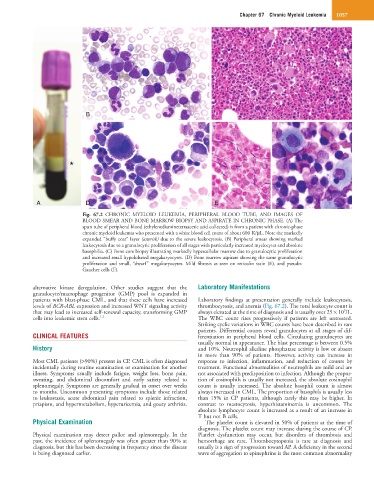
                            Fig.  67.2  CHRONIC  MYELOID  LEUKEMIA,  PERIPHERAL  BLOOD  TUBE,  AND  IMAGES  OF
                            BLOOD SMEAR AND BONE MARROW BIOPSY AND ASPIRATE IN CHRONIC PHASE. (A) The
                            spun tube of peripheral blood (ethylenediaminetetraacetic acid collected) is from a patient with chronic-phase
                            chronic myeloid leukemia who presented with a white blood cell count of about 600 K/µL. Note the markedly
                            expanded “buffy coat” layer (asterisk) due to the severe leukocytosis. (B) Peripheral smear showing marked
                            leukocytosis due to a granulocytic proliferation of all stages with particularly increased myelocytes and absolute
                            basophilia. (C) Bone core biopsy illustrating markedly hypercellular marrow due to granulocytic proliferation
                            and increased small hypolobated megakaryocytes. (D) Bone marrow aspirate showing the same granulocytic
                            proliferation and small, “dwarf” megakaryocytes. Mild fibrosis as seen on reticulin stain (E), and pseudo-
                            Gaucher cells (F).


            alternative  kinase  deregulation.  Other  studies  suggest  that  the   Laboratory Manifestations
            granulocyte/macrophage  progenitor  (GMP)  pool  is  expanded  in
            patients with blast-phase CML, and that these cells have increased   Laboratory  findings  at  presentation  generally  include  leukocytosis,
            levels of BCR-ABL expression and increased WNT signaling activity   thrombocytosis, and anemia (Fig. 67.2). The total leukocyte count is
                                                                                                                 9
            that may lead to increased self-renewal capacity, transforming GMP   always elevated at the time of diagnosis and is usually over 25 × 10 /L.
            cells into leukemic stem cells. 1,2                   The  WBC  count  rises  progressively  if  patients  are  left  untreated.
                                                                  Striking cyclic variations in WBC counts have been described in rare
                                                                  patients. Differential counts reveal granulocytes at all stages of dif-
            CLINICAL FEATURES                                     ferentiation  in  peripheral  blood  cells.  Circulating  granulocytes  are
                                                                  usually normal in appearance. The blast percentage is between 0.5%
            History                                               and 10%. Neutrophil alkaline phosphatase activity is low or absent
                                                                  in  more  than  90%  of  patients.  However,  activity  can  increase  in
            Most CML patients (>90%) present in CP. CML is often diagnosed   response  to  infection,  inflammation,  and  reduction  of  counts  by
            incidentally during routine examination or examination for another   treatment. Functional abnormalities of neutrophils are mild and are
            illness.  Symptoms  usually  include  fatigue,  weight  loss,  bone  pain,   not associated with predisposition to infection. Although the propor-
            sweating,  and  abdominal  discomfort  and  early  satiety  related  to   tion of eosinophils is usually not increased, the absolute eosinophil
            splenomegaly. Symptoms are generally gradual in onset over weeks   count  is  usually  increased. The  absolute  basophil  count  is  almost
            to months. Uncommon presenting symptoms include those related   always increased in CML. The proportion of basophils is usually less
            to  leukostasis,  acute  abdominal  pain  related  to  splenic  infraction,   than  15%  in  CP  patients,  although  rarely  this  may  be  higher.  In
            priapism, and hypermetabolism, hyperuricemia, and gouty arthritis.  contrast  to  mastocytosis,  hyperhistaminemia  is  uncommon.  The
                                                                  absolute lymphocyte count is increased as a result of an increase in
                                                                  T but not B cells.
            Physical Examination                                    The platelet count is elevated in 50% of patients at the time of
                                                                  diagnosis. The platelet count may increase during the course of CP.
            Physical  examination  may  detect  pallor  and  splenomegaly.  In  the   Platelet  dysfunction  may  occur,  but  disorders  of  thrombosis  and
            past, the incidence of splenomegaly was often greater than 90% at   hemorrhage  are  rare.  Thrombocytopenia  is  rare  at  diagnosis  and
            diagnosis, but this has been decreasing in frequency since the disease   usually is a sign of progression toward AP. A deficiency in the second
            is being diagnosed earlier.                           wave of aggregation to epinephrine is the most common abnormality

