


Page 1213 - Hematology_ Basic Principles and Practice ( PDFDrive )
P. 1213
Chapter 67  Chronic Myeloid Leukemia  1059


            bone marrow biopsy, or the development of extramedullary blastic   PROGNOSIS
            infiltrates. In approximately two-thirds of patients, the blasts have a
            myeloid or undifferentiated-like phenotype, whereas in the remaining   A number of prognostic scoring systems have been developed with
            third  the  blasts  appear  more  lymphoid-like.  Immunophenotypic   the goal of predicting the length of CP in individual patients. The
            analysis is recommended to characterize the nature of the blasts (Fig.   best-known and most widely used index was developed by Sokal and
            67.4). Extramedullary BC most commonly affects the skin, lymph   colleagues. An algorithm was identified using spleen size, percentage
            nodes, spleen, bone, or CNS, but it may occur elsewhere and may   of circulating blasts, platelet count, and age as prognostic factors for
            be of myeloid or lymphoid lineage.                    CP patients. However, the Sokal scale was based on therapies available
                                                                  at that time (busulfan [BU], splenectomy), and newer systems for
                                                                  patients treated with IFN subsequently resulted in newer prognostic
                                                                  scoring systems. These scales, however, may have limited predictive
             TABLE   WHO Criteria for Accelerated and Blast Phases of   value in the age of TKIs.
              67.1   Chronic Myeloid Leukemia                       Approximately  20%  of  patients  with  CML  have  deletions  of
             Accelerated   Diagnosis can be made if one or more of the   chromosomal material of varying size on the derivative 9q+. These
               phase        following is present:                 deletions presumably occur at the same time as the formation of the
                            Blasts 10% to 19% of peripheral blood white   Ph chromosome, and are thus not considered to be additional clonal
                               cells or bone marrow cells         changes as would be suggestive of AP disease. Patients with der 9q+
                            Peripheral blood basophils at least 20%  have  a  worse  prognosis  if  they  receive  IFN  therapy;  it  is  unclear
                            Persistent thrombocytopenia (<100 × 10 /L)   whether  or  not  such  deletions  have  a  poor  prognosis  in  patients
                                                        9
                               unrelated to therapy, or persistent   receiving imatinib therapy.
                               thrombocytosis (>1000 × 10 /L)       Population-based  studies  investigating  CML  mortality  in  the
                                                  9
                               unresponsive to therapy            imatinib era are now becoming available. They show that the pattern
                             Increasing spleen size and increasing WBC   of mortality in CML patients related to high Sokal scores has become
                               count unresponsive to therapy      similar to those of intermediate scores induced by the use of imatinib
                             Cytogenetic evidence of clonal evolution (i.e.,   in CP-CML patients. 4
                               the appearance of an additional genetic
                               abnormality that was not present in the
                               initial specimen at the time of diagnosis of   THERAPY
                               CP CML)
                             Megakaryocytic proliferation in sizable sheets   Definitions of Response to Treatment
                               and clusters, associated with marked
                               reticulin or collagen fibrosis, and/or severe   Hematologic, cytogenetic, and molecular responses to treatment in
                               granulocytic dysplasia, should be considered   CML  have  been  defined  (Table  67.2).  A  complete  hematologic
                               as suggestive of AP CML. (These findings   response (CHR) is defined as the achievement of normal WBC and
                               have not yet been analyzed in large clinical   platelet counts and normal differential, along with the disappearance
                               studies; thus, it is not clear whether they are   of all symptoms and signs of CML. A partial hematologic response
                               independent criteria for AP. They often occur   is defined as a decrease in the WBC count to less than 50% of the
                               simultaneously with one or more of the other   pretreatment level or the normalization of the WBC count accom-
                               features listed.)                  panied by persistent splenomegaly or immature cells in the peripheral
                                                                                                   +
             Blast crisis  Diagnosis can be made if one or more of following   blood. A CCR is defined as the absence of Ph  metaphases in marrow
                                                                                                                    +
                             is present:                          cells,  along  with  partial  cytogenetic  response  as  1%  to  34%  Ph
                             Blasts 20% or more of peripheral WBCs or bone   metaphases. Major cytogenetic remission (MCR) combines the per-
                               marrow cells                       centages of complete and partial response. There is now increasing
                             Extramedullary blast proliferation   reliance  on  BCR-ABL  mRNA  levels  for  assessment  of  response.
                             Large foci or clusters of blasts in bone marrow   According  to  the  international  scale  for  comparison  of  BCR-ABL
                                                                                                              3
                               biopsy                             mRNA levels, a MMR is defined as a value of 0.1% or less.  Lack of
                                                                  detection of BCR-ABL mRNA is referred to as a complete molecular
             AP, Accelerated phase; CML, chronic myeloid leukemia; CP, chronic phase;   response  (CMR).  Since  the  ability  to  detect  BCR-ABL  mRNA
             WBC, white blood cell.
                                                                  depends on the sensitivity of the PCR assay, there is now consensus


               A                            B                                         C

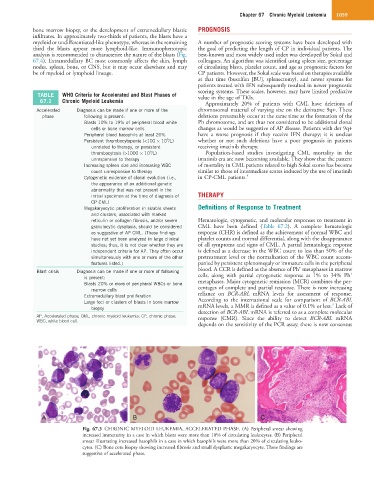
                            Fig. 67.3  CHRONIC MYELOID LEUKEMIA, ACCELERATED PHASE. (A) Peripheral smear showing
                            increased immaturity in a case in which blasts were more than 10% of circulating leukocytes. (B) Peripheral
                            smear illustrating increased basophils in a case in which basophils were more than 20% of circulating leuko-
                            cytes. (C) Bone core biopsy showing increased fibrosis and small dysplastic megakaryocyte. These findings are
                            suggestive of accelerated phase.

