


Page 1227 - Hematology_ Basic Principles and Practice ( PDFDrive )
P. 1227
Chapter 68  The Polycythemias  1073


            VHL protein has other binding partners, including atypical protein   suppresses EPO-dependent JAK2–STAT5 signaling. Thus, deletion
            kinase  C  and  a  family  of  deubiquitinating  enzymes  called  VHL-  of the distal C-terminal cytoplasmic portion of the EPOR abolishes
            interacting deubiquitinating enzymes 1 and 2. In addition, VHL has   negative regulatory elements and results in increased proliferation of
            been involved in numerous cellular processes, including regulation of   erythroid progenitor cells. Mutations in the EPOR gene have been
            extracellular  matrix,  cytoskeleton  stability,  cell  cycle  control,  and   observed  in  some  patients  with  primary  familial  and  congenital
            differentiation. VHL disease is not associated with erythrocytosis.  polycythemia (PFCP) and are occasionally found in erythroleukemia
                                                                  (see Fig. 68.2). Such secondary growth factors as insulin-like growth
                                                                  factor-1  (IGF-1)  and  the  components  of  the  renin–angiotensin
            THE ERYTHROPOIETIN RECEPTOR                           system (RAS) may also influence the production of RBCs.

            Interaction of EPO with the EPO receptor (EPOR) present on the
            erythroid progenitor and precursor cells leads to its homodimeriza-  THE RENIN–ANGIOTENSIN SYSTEM AND
            tion, resulting in (1) stimulation of cell division, (2) differentiation   HEMATOPOIESIS
            by induction of erythroid-specific gene expression, and (3) prevention
            of  erythroid  progenitor  and  precursor  cell  apoptosis.  EPOR  is  a
            member of the type I cytokine receptor superfamily. Signal transduc-  The RAS regulates fluid and electrolyte homeostasis and blood pres-
            tion  through  the  receptor  is  initiated  by  ligand  binding,  which   sure, and has been hypothesized to also play a role in the regulation
            induces dimerization of EPOR monomers. The predominant signal-  of erythropoiesis. The primary function of angiotensin during devel-
            ing cascade activated by EPOR and other cytokine receptors is the   opment  is  the  regulation  of  tissue  growth  and  differentiation.
            Janus-activated  kinase  (JAK)/signal  transducer  and  activator  of   Angiotensin II (AngII) is a ligand for two distinct receptors, type 1
            transcription (STAT) pathway. JAK tyrosine kinases are constitutively   and type 2 (AT1 and AT2). AT1 appears to play a major role in the
            associated with the membrane proximal regions of cytokine receptor   regulation of cell proliferation. 3
            cytoplasmic domains and are activated by receptor dimerization. The   The RAS was first postulated to influence erythropoiesis in the
            EPOR associates predominantly with JAK2. JAK2 binds to EPOR   1980s after the use of angiotensin-converting enzyme (ACE) inhibi-
            in the endoplasmic reticulum and acts as a chaperone protein trans-  tors to treat hypertension was shown to result in anemia. In animals,
            porting the EPOR to the plasma membrane. Immediately after EPO   increased blood levels of renin (a major regulator of AngII synthesis)
            binding,  JAK2  phosphorylates  itself  and  the  EPOR  on  multiple   were found to result in elevated serum EPO levels and erythrocytosis.
            tyrosine residues in its cytoplasmic domain, thus creating a platform   In  humans,  the  infusion  of  AngII  in  healthy  volunteers  increased
            for the recruitment and activation of multiple key signaling regula-  serum EPO levels by 35% or higher via activation of the AngII type
            tors. One of such proteins is STAT5. JAK2–STAT5 signaling plays   I  receptor,  and  ACE  inhibitors  significantly  decrease  plasma  EPO
            an essential role in EPO/EPOR-mediated regulation of erythropoi-  levels by as much as 20–30%. The pathway underlying AngII-driven
            esis.  Consistent  with  their  essential  roles  in  erythropoiesis,  EPO-,   EPO secretion is unknown. However, some investigators have sug-
            EPOR-  and  JAK2-deficient  mice  die  embryonically  from  severe   gested that AngII modulates renal EPO production through changes
            anemia.                                               in renal perfusion and sodium reabsorption. This hypothesis is based
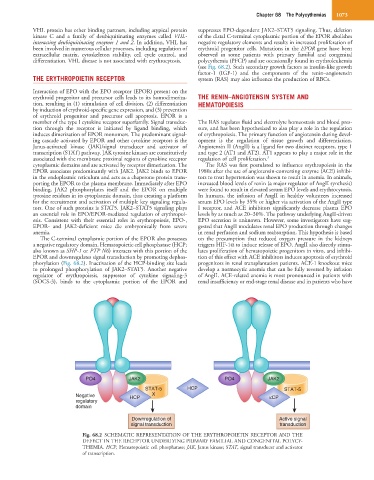
              The C-terminal cytoplasmic portion of the EPOR also possesses   on  the  presumption  that  reduced  oxygen  pressure  in  the  kidneys
            a negative regulatory domain. Hematopoietic cell phosphatase (HCP;   triggers HIF-1α to induce release of EPO. AngII also directly stimu-
            also known as SHP-1 or PTP N6) interacts with this portion of the   lates proliferation of hematopoietic progenitors in vitro, and inhibi-
            EPOR and downregulates signal transduction by promoting dephos-  tion of this effect with ACE inhibitors induces apoptosis of erythroid
            phorylation (Fig. 68.2). Inactivation of the HCP-binding site leads   progenitors in renal transplantation patients. ACE-1 knockout mice
            to  prolonged  phosphorylation  of  JAK2–STAT5.  Another  negative   develop a normocytic anemia that can be fully reversed by infusion
            regulator  of  erythropoiesis,  suppressor  of  cytokine  signaling-3   of AngII. ACE-related anemia is most pronounced in patients with
            (SOCS-3),  binds  to  the  cytoplasmic  portion  of  the  EPOR  and   renal insufficiency or end-stage renal disease and in patients who have


                             PO4           JAK2                            PO4           JAK2
                                                 STAT-5       HCP                             STAT-5
                          Negative         HCP     X                                     κCP
                          regulatory
                          domain

                                            Downregulation of                               Active signal
                                            signal transduction                             transduction
                            Fig. 68.2  SCHEMATIC REPRESENTATION OF THE ERYTHROPOIETIN RECEPTOR AND THE
                            DEFECT IN THE RECEPTOR UNDERLYING PRIMARY FAMILIAL AND CONGENITAL POLYCY-
                            THEMIA. HCP, Hematopoietic cell phosphatase; JAK, Janus kinase; STAT, signal transducer and activator
                            of transcription.

