


Page 1228 - Hematology_ Basic Principles and Practice ( PDFDrive )
P. 1228
1074   Part VII  Hematologic Malignancies


        received a renal allograft. The pathogenesis of this anemia is not clear,   somatic or inherited germ-line mutations expressed by hematopoietic
        but  reduced  levels  of  circulating  EPO  are  not  solely  responsible,   progenitor  cells  (HPCs).  In  contrast,  secondary  polycythemias  are
        suggesting that there might be other contributing factors. The AT1   characterized by an increase in regulatory growth factors, primarily
        receptor is present on erythroid progenitors, and its ligand, AngII,   EPO,  and  normal  responsiveness  of  their  erythroid  progenitors  to
        augments  EPO  stimulation  of  erythropoiesis. The  involvement  of   these growth factors. These conditions can usually be distinguished
        JAK2 kinase in AngII signaling suggests that this signal transduction   by in vitro assays of erythroid progenitor cells, quantitation of serum
        pathway  mediated  by  EPO  and  AngII  might  overlap.  Postrenal   EPO  levels,  and  detection  of  somatic  JAK2  mutations.  In  a  small
        transplant erythrocytosis likely can be accounted for by activation of   number of patients, the cause of erythrocytosis cannot be determined;
        the RAS.                                              these patients are classified as having idiopathic erythrocytosis.

        DEFINITION AND CLASSIFICATION OF POLYCYTHEMIA         RELATIVE POLYCYTHEMIA

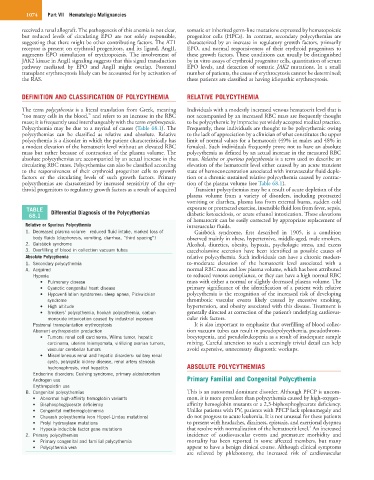
        The term polycythemia is a literal translation from Greek, meaning   Individuals with a modestly increased venous hematocrit level that is
        “too many cells in the blood,” and refers to an increase in the RBC   not accompanied by an increased RBC mass are frequently thought
        mass; it is frequently used interchangeably with the term erythrocytosis.   to be polycythemic by imprecise yet widely accepted medical practice.
        Polycythemia may be due to a myriad of causes (Table 68.1). The   Frequently, these individuals are thought to be polycythemic owing
        polycythemias  can  be  classified  as  relative  and  absolute.  Relative   to the lack of appreciation by a clinician of what constitutes the upper
        polycythemia is a disorder in which the patient characteristically has   limit of normal values for a hematocrit (49% in males and 48% in
        a modest elevation of the hematocrit level without an elevated RBC   females). Such individuals frequently prove not to have an absolute
        mass but rather because of contraction of the plasma volume. The   polycythemia as defined by an actual increase in the measured RBC
        absolute polycythemias are accompanied by an actual increase in the   mass. Relative or spurious polycythemia is a term used to describe an
        circulating RBC mass. Polycythemias can also be classified according   elevation of the hematocrit level either caused by an acute transient
        to  the  responsiveness  of  their  erythroid  progenitor  cells  to  growth   state of hemoconcentration associated with intravascular fluid deple-
        factors  or  the  circulating  levels  of  such  growth  factors.  Primary   tion or a chronic sustained relative polycythemia caused by contrac-
        polycythemias are characterized by increased sensitivity of the ery-  tion of the plasma volume (see Table 68.1).
        throid progenitors to regulatory growth factors as a result of acquired   Transient polycythemias may be a result of acute depletion of the
                                                              plasma  volume  from  a  variety  of  disorders,  including  protracted
                                                              vomiting or diarrhea, plasma loss from external burns, sudden cold
          TABLE   Differential Diagnosis of the Polycythemias  exposure or protracted exercise, insensible fluid loss from fever, sepsis,
          68.1                                                diabetic ketoacidosis, or acute ethanol intoxication. These elevations
                                                              of hematocrit can be easily corrected by appropriate replacement of
         Relative or Spurious Polycythemia                    intravascular fluids.
         1.  Decreased plasma volume—reduced fluid intake, marked loss of   Gaisböck  syndrome,  first  described  in  1905,  is  a  condition
            body fluids (diaphoresis, vomiting, diarrhea, “third spacing”)  observed mainly in obese, hypertensive, middle-aged, male smokers.
         2.  Gaisböck syndrome                                Alcohol,  diuretics,  obesity,  hypoxia,  psychologic  stress,  and  excess
         3.  Overfilling of blood in collection vacuum tubes  catecholamine  secretion  have  been  identified  as  possible  causes  of
         Absolute Polycythemia                                relative polycythemia. Such individuals can have a chronic modest-
         1.  Secondary polycythemia                           to-moderate  elevation  of  the  hematocrit  level  associated  with  a
         A.  Acquired                                         normal RBC mass and low plasma volume, which has been attributed
            Hypoxia                                           to reduced venous compliance, or they can have a high normal RBC
              •  Pulmonary disease                            mass with either a normal or slightly decreased plasma volume. The
              •  Cyanotic congenital heart disease            primary significance of the identification of a patient with relative
              •  Hypoventilation syndromes: sleep apnea, Pickwickian   polycythemia is the recognition of the increased risk of developing
                 syndrome                                     thrombotic  vascular  events  likely  caused  by  excessive  smoking,
              •  High altitude                                hypertension, and obesity associated with this disease. Treatment is
              •  Smokers’ polycythemia, hookah polycythemia, carbon   generally directed at correction of the patient’s underlying cardiovas-
                 monoxide intoxication caused by industrial exposure  cular risk factors.
            Postrenal transplantation erythrocytosis             It is also important to emphasize that overfilling of blood collec-
            Aberrant erythropoietin production                tion vacuum tubes can result in pseudopolycythemia, pseudothrom-
              •  Tumors: renal cell carcinoma, Wilms tumor, hepatic   bocytopenia, and pseudoleukopenia as a result of inadequate sample
                 carcinoma, uterine leiomyomata, virilizing ovarian tumors,   mixing. Careful attention to such a seemingly trivial detail can help
                 vascular cerebellar tumors                   avoid expensive, unnecessary diagnostic workups.
              •  Miscellaneous renal and hepatic disorders: solitary renal
                 cysts, polycystic kidney disease, renal artery stenosis
                 hydronephrosis, viral hepatitis              ABSOLUTE POLYCYTHEMIAS
            Endocrine disorders: Cushing syndrome, primary aldosteronism
            Androgen use                                      Primary Familial and Congenital Polycythemia
            Erythropoietin use
         B.  Congenital polycythemias                         This is an autosomal dominant disorder. Although PFCP is uncom-
            •  Abnormal high-affinity hemoglobin variants     mon, it is more prevalent than polycythemia caused by high-oxygen–
            •  Bisphosphoglycerate deficiency                 affinity hemoglobin mutants or a 2,3-biphosphoglycerate deficiency.
            •  Congenital methemoglobinemia                   Unlike patients with PV, patients with PFCP lack splenomegaly and
            •  Chuvash polycythemia (von Hippel-Lindau mutations)  do not progress to acute leukemia. It is not unusual for these patients
            •  Prolyl hydroxylase mutations                   to present with headaches, dizziness, epistaxis, and exertional dyspnea
                                                                                                      4
            •  Hypoxia-inducible factor gene mutations        that resolve with normalization of the hematocrit level.  An increased
         2.  Primary polycythemias                            incidence  of  cardiovascular  events  and  premature  morbidity  and
            •  Primary congenital and familial polycythemia   mortality  has  been  reported  in  some  affected  members,  but  many
            •  Polycythemia vera                              appear to have a benign clinical course. Although clinical symptoms
                                                              are  relieved  by  phlebotomy,  the  increased  risk  of  cardiovascular

