


Page 1245 - Hematology_ Basic Principles and Practice ( PDFDrive )
P. 1245
Chapter 68  The Polycythemias  1091


            symptoms can be abolished by reducing the platelet counts to normal   Another situation that puts patients with PV and ET at high risk
            levels and can be rapidly reversed after the institution of antiplatelet   for thrombosis is pregnancy. Maternal and fetal complications have
            aggregation  therapy  but  not  coumadin.  Therefore,  the  cause  of   been reported. Specifically, the rate of fetal loss is higher than that of
            erythromelalgia appears to be closely linked to abnormal arachidonic   the general population.
            acid metabolism that occurs within platelets in this disorder.  Generalized pruritus occurs in approximately 40% of cases of PV.
              Retrospective reviews have revealed a higher than expected number   Water contact, such as during showers or bathing, induces attacks of
            of patients with PV and pulmonary hypertension. Proposed etiologies   intolerable pruritus. There appears to be no clear relationship between
            include  direct  obstruction  of  pulmonary  arteries  by  circulating   the degree of the pruritus and severity of the disease, and 20% of
            megakaryocytes,  extramedullary  hematopoiesis  in  the  pulmonary   patients  continue  to  experience  itching  despite  reduction  of  their
            parenchyma, smooth muscle hyperplasia induced by release of PDGF   hematocrits to normal levels. Aquagenic pruritus is significantly more
            from activated platelets, chronic disseminated intravascular coagula-  common  among  JAK2V617F  homozygous  patients  than  heterozy-
            tion, and unrecognized recurrent pulmonary emboli. The diagnosis   gotes. The degree of pruritus is so severe in some patients that they
            of pulmonary hypertension is made, on average, 9.5 years after the   are unable to tolerate bathing at all and find it necessary to substitute
            diagnosis  of  the  underlying  MPN  and  is  associated  with  a  poor   gentle  skin  swabbing  or  to  simply  not  bathe. The  etiology  of  the
            prognosis, with death usually occurring as a result of congestive heart   pruritus in PV remains uncertain. Several groups have attempted to
            failure  or  pneumonia.  Although  anecdotal  reports  have  claimed   implicate elevated blood and urine histamine levels in its pathobiol-
            improvements in patients’ pulmonary artery pressure with control of   ogy. A strong correlation between skin mast cell numbers and the
            the underlying disease, others have not found any change in serial   severity of itching has been demonstrated, and mast cells in PV have
            measurements  of  11  patients’  pulmonary  arterial  pressures  despite   been shown to be JAK2V617F positive. However, the failure of the
            good disease control. Recently, ruxolitinib therapy has been reported   pruritus to respond to antihistamine therapy in many patients sug-
            to result in improved outcomes, pulmonary and echocardiographic   gests that abnormally high histamine levels probably do not constitute
            findings,  as  well  as  correction  of  cytokine  dysregulation  in  MPN   the sole factor in its development.
            patients with pulmonary hypertension.                   Iron deficiency has also been implicated as a factor contributing
              As many as 30–40% of patients with PV experience some sort of   to pruritus in PV patients who are almost invariably iron deficient.
            hemorrhagic event, which can be relatively trivial, such as epistaxis   Iron-substitution therapy has resulted in symptomatic improvement,
            or gingival hemorrhage, or can be life-threatening, such as gastro-  but this approach is less than optimal because it frequently results in
            intestinal  hemorrhage  or  hematomas  involving  vital  organs.  The   uncontrollable erythrocytosis. Ruxolitinib therapy has been reported
            gastrointestinal tract is a frequent site of hemorrhagic complications   to be effective in alleviating the patient’s aquagenic pruritis in 80%
            because patients with PV are predisposed to portal vein thrombosis   of patients.
            and resultant variceal bleeding and peptic ulcer disease. Gastroduo-  The development of post-PV MF was increased with prolonged
            denal  erosions  and  ulcers,  and  Helicobacter  pylori  infection  are  all   duration of disease and is directly related to the duration of long-term
            significantly more common in PV patients than in control patients   follow-up, but the influence of the modality used to treat the initial
            with dyspepsia. This may be partly attributable to altered mucosal   PV phase of the disease on the rate of transformation to this more
            blood flow as a result of increased plasma viscosity or increased his-  accelerated  form  of  the  disease  remains  uncertain.  Post-PV  MF
            tamine  release  caused  by  peripheral  blood  basophilia.  Cerebral   should be considered the natural evolution of PV. Criteria for the
            hemorrhage is a common cause of morbidity and mortality. Bleeding   diagnosis of post-PV MF have been established (Table 68.2) and can
            events frequently occur with the use of aspirin or other nonsteroidal   be used as a guide for documenting this transition in disease pheno-
            antiinflammatory agents; an association between the hemorrhage and   type, which in reality represents a point in the continuum of PV. For
            the use of high doses of these platelet-paralyzing drugs has been made   patients with disease duration greater than 10 years, the hazard ratio
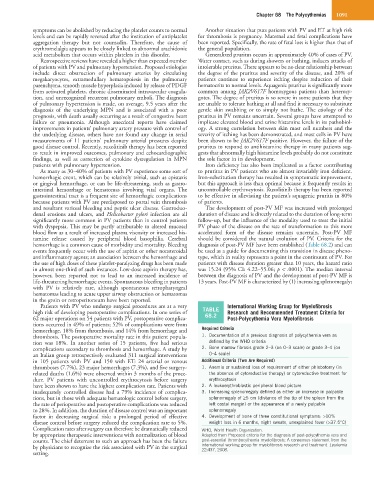
            in almost one-third of such instances. Low-dose aspirin therapy has,   was 15.24 (95% CI: 4.22–55.06; p < .0001). The median interval
            however,  been  reported  not  to  lead  to  an  increased  incidence  of   between the diagnosis of PV and the development of post-PV MF is
            life-threatening hemorrhagic events. Spontaneous bleeding in patients   13 years. Post-PV MF is characterized by (1) increasing splenomegaly;
            with  PV  is  relatively  rare,  although  spontaneous  retropharyngeal
            hematomas leading to acute upper airway obstruction or hematomas
            in the groin or retroperitoneum have been reported.
              Patients with PV who undergo surgical procedures are at a very   International Working Group for Myelofibrosis
            high risk of developing postoperative complications. In one series of   TABLE   Research and Recommended Treatment Criteria for
                                                                    68.2
            62 major operations on 54 patients with PV, postoperative complica-  Post-Polycythemia Vera Myelofibrosis
            tions occurred in 49% of patients; 52% of complications were from
            hemorrhage, 18% from thrombosis, and 14% from hemorrhage and   Required Criteria
            thrombosis. The postoperative mortality rate in this patient popula-  1.  Documentation of a previous diagnosis of polycythemia vera as
            tion  was  18%.  In  another  series  of  15  patients,  five  had  serious   defined by the WHO criteria
            complications secondary to thrombosis and hemorrhage. A study by   2.  Bone marrow fibrosis grade 2–3 (on 0–3 scale) or grade 3–4 (on
            an Italian group retrospectively evaluated 311 surgical interventions   0–4 scale)
            in  105  patients  with  PV  and  150  with  ET:  24  arterial  or  venous   Additional Criteria (Two Are Required)
            thromboses (7.7%), 23 major hemorrhages (7.3%), and five surgery-  1.  Anemia or sustained loss of requirement of either phlebotomy (in
            related deaths (1.6%) were observed within 3 months of the proce-  the absence of cytoreductive therapy) or cytoreductive treatment for
            dure.  PV  patients  with  uncontrolled  erythrocytosis  before  surgery   erythrocytosis
            have been shown to have the highest complication rate. Patients with   2.  A leukoerythroblastic peripheral blood picture
            inadequately controlled disease had a 79% incidence of complica-  3.  Increasing splenomegaly defined as either an increase in palpable
            tions, but in those with adequate hematologic control before surgery,   splenomegaly of ≥5 cm (distance of the tip of the spleen from the
            the rate of perioperative and postoperative complications was reduced   left costal margin) or the appearance of a newly palpable
            to 28%. In addition, the duration of disease control was an important   splenomegaly
            factor  in  decreasing  surgical  risk;  a  prolonged  period  of  effective   4.  Development of ≥one of three constitutional symptoms: >10%
            disease control before surgery reduced the complication rate to 5%.   weight loss in 6 months, night sweats, unexplained fever (>37.5°C)
            Complication rates after surgery can therefore be dramatically reduced   WHO, World Health Organization.
            by appropriate therapeutic interventions with normalization of blood   Adapted from Proposed criteria for the diagnosis of post-polycythemia vera and
            counts. The chief deterrent to such an approach has been the failure   post-essential thrombocythemia myelofibrosis: A consensus statement from the
            by physicians to recognize the risk associated with PV in the surgical   international working group for myelofibrosis research and treatment. Leukemia
                                                                   22:437, 2008.
            setting.

