


Page 1250 - Hematology_ Basic Principles and Practice ( PDFDrive )
P. 1250
1096   Part VII  Hematologic Malignancies


                             1               2              3               4              5


                           6          7          8          9          10         11         12


                           13           14           15           16           17           18


                           19           20            21            22              X          Y
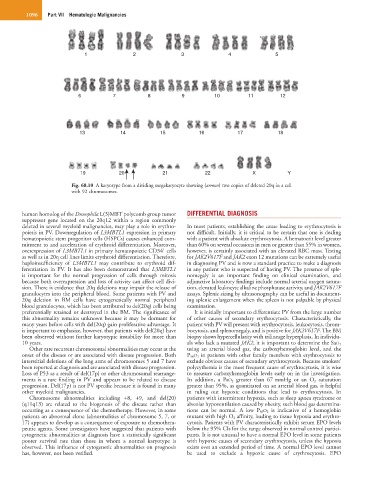
                        Fig. 68.10  A karyotype from a dividing megakaryocyte showing (arrows) two copies of deleted 20q in a cell
                        with 92 chromosomes.


        human homolog of the Drosophila L(3)MBT polycomb group tumor   DIFFERENTIAL DIAGNOSIS
        suppressor  gene  located  on  the  20q12  within  a  region  commonly
        deleted in several myeloid malignancies, may play a role in erythro-  In most patients, establishing the cause leading to erythrocytosis is
        poiesis in PV. Downregulation of L3MBTL1 expression in primary   not difficult. Initially, it is critical to be certain that one is dealing
        hematopoietic stem progenitor cells (HSPCs) causes enhanced com-  with a patient with absolute erythrocytosis. A hematocrit level greater
        mitment to and acceleration of erythroid differentiation. Moreover,   than 60% on several occasions in men or greater than 55% in women,
                                                      +
        overexpression of L3MBTL1 in primary hematopoietic CD34  cells   however, is certainly associated with an elevated RBC mass. Testing
        as well as in 20q cell lines limits erythroid differentiation. Therefore,   for JAK2V617F and JAK2 exon 12 mutations can be extremely useful
        haploinsufficiency  of  L3MBTL1  may  contribute  to  erythroid  dif-  in diagnosing PV and is now a standard practice to make a diagnosis
        ferentiation  in  PV.  It  has  also  been  demonstrated  that  L3MBTL1   in any patient who is suspected of having PV. The presence of sple-
        is  important  for  the  normal  progression  of  cells  through  mitosis   nomegaly  is  an  important  finding  on  clinical  examination,  and
        because both overexpression and loss of activity can affect cell divi-  adjunctive laboratory findings include normal arterial oxygen satura-
        sion. There is evidence that 20q deletions may impair the release of   tion, elevated leukocyte alkaline phosphatase activity, and JAK2V617F
        granulocytes into the peripheral blood. Some patients with PV and   assays. Splenic sizing by ultrasonography can be useful in document-
        20q  deletion  in  BM  cells  have  cytogenetically  normal  peripheral   ing splenic enlargement when the spleen is not palpable by physical
        blood granulocytes, which has been attributed to del(20q) cells being   examination.
        preferentially retained or destroyed in the BM. The significance of   It is initially important to differentiate PV from the large number
        this abnormality remains unknown because it may be dormant for   of  other  causes  of  secondary  erythrocytosis.  Characteristically,  the
        many years before cells with del(20q) gain proliferative advantage. It   patient with PV will present with erythrocytosis, leukocytosis, throm-
        is important to emphasize, however, that patients with del(20q) have   bocytosis, and splenomegaly, and is positive for JAK2V617F. The BM
        been observed without further karyotypic instability for more than     biopsy shows hypercellularity with trilineage hyperplasia. In individu-
        10 years.                                             als who lack a mutated JAK2, it is important to determine the SaO 2
           Other rare recurrent chromosomal abnormalities may occur at the   using  an  arterial  blood  gas,  the  carboxyhemoglobin  level,  and  the
        onset of the disease or are associated with disease progression. Both   P 50 O 2  in patients with other family members with erythrocytosis to
        interstitial deletions of the long arms of chromosomes 5 and 7 have   exclude obvious causes of secondary erythrocytosis. Because smokers’
        been reported at diagnosis and are associated with disease progression.   polycythemia is the most frequent cause of erythrocytosis, it is wise
        Loss of P53 as a result of del(17p) or other chromosomal rearrange-  to measure carboxyhemoglobin levels early on in the investigation.
        ments is a rare finding in PV and appears to be related to disease   In  addition,  a  PaO 2   greater  than  67 mmHg  or  an  O 2   saturation
        progression. Del(17p) is not PV specific because it is found in many   greater than 95%, as quantitated on an arterial blood gas, is helpful
        other myeloid malignancies.                           in  ruling  out  hypoxic  conditions  that  lead  to  erythrocytosis.  In
           Chromosome  abnormalities  including  +8,  +9,  and  del(20)  patients with intermittent hypoxia, such as sleep apnea syndrome or
        (q11q13)  are  related  to  the  biogenesis  of  the  disease  rather  than   alveolar hypoventilation caused by obesity, such blood gas determina-
        occurring as a consequence of the chemotherapy. However, in some   tions  can  be  normal.  A  low  P 50 O 2  is  indicative  of  a  hemoglobin
        patients an abnormal clone (abnormalities of chromosome 5, 7, or   mutant with high O 2 affinity, leading to tissue hypoxia and erythro-
        17) appears to develop as a consequence of exposure to chemothera-  cytosis. Patients with PV characteristically exhibit serum EPO levels
        peutic agents. Some investigators have suggested that patients with   below the 95% CIs for the range observed in normal control partici-
        cytogenetic abnormalities at diagnosis have a statistically significant   pants. It is not unusual to have a normal EPO level in some patients
        poorer  survival  rate  than  those  in  whom  a  normal  karyotype  is   with hypoxic causes of secondary erythrocytosis, unless the hypoxia
        observed. This influence of cytogenetic abnormalities on prognosis   exists over an extended period of time. A normal EPO level cannot
        has, however, not been verified.                      be  used  to  exclude  a  hypoxic  cause  of  erythrocytosis.  EPO

