


Page 1248 - Hematology_ Basic Principles and Practice ( PDFDrive )
P. 1248
1094   Part VII  Hematologic Malignancies


                                                                                          D


                       A                  B B                 CC                          E E

                        Fig.  68.6  PHOTOMICROGRAPH  OF  BONE  MARROW  BIOPSY  OBTAINED  FROM  A  PATIENT
                        WITH POLYCYTHEMIA VERA IN MYELOFIBROTIC PHASE DEMONSTRATING HYPERCELLU-
                        LARITY AND INCREASED NUMBER OF MEGAKARYOCYTES (×160).

        are at an increased risk to develop a thrombotic episode or to evolve   +der(9)t(1;9)(q12;q12)  +8  +8,+9
        into post-PV MF but not acute leukemia during the course of their
        disease.
           The pathologic appearance of the spleen in PV depends on the
        stage of the disease at which the organ is examined. Spleens from
        patients in the erythrocytotic phase of the disease are characterized
        by striking congestion with mature erythrocytes. Small numbers of
        hematopoietic  precursor  cells  are  frequently  present.  By  contrast,
        spleens examined during the PV-related MF phase are characterized
        by prominent numbers of foci of extramedullary hematopoiesis, with
        representation of all BM precursor elements.                   +9         del(13)(q14q22)  del(20)(q11q13)
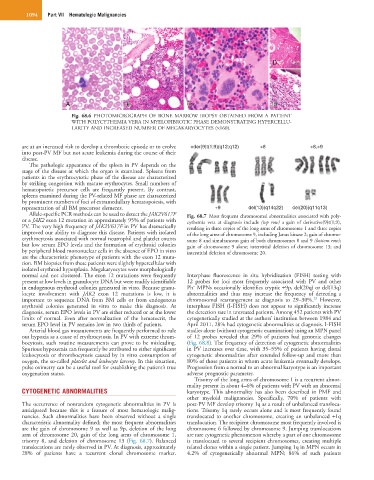
           Allele-specific PCR methods can be used to detect the JAK2V617F   Fig. 68.7  Most frequent chromosomal abnormalities associated with poly-
        or a JAK2 exon 12 mutation in approximately 95% of patients with   cythemia  vera  at  diagnosis  include  (top  row)  a  gain  of  derivative(9)t(1;9),
        PV. The very high frequency of JAK2V617F in PV has dramatically   resulting in three copies of the long arms of chromosome 1 and three copies
        improved our ability to diagnose this disease. Patients with isolated   of the long arms of chromosome 9, including Janus kinase 2; gain of chromo-
        erythrocytosis associated with normal neutrophil and platelet counts   some 8 and simultaneous gain of both chromosomes 8 and 9 (bottom row);
        but low serum EPO levels and the formation of erythroid colonies   gain of chromosome 9 alone; interstitial deletion of chromosome 13; and
        by peripheral blood mononuclear cells in the absence of EPO in vitro   interstitial deletion of chromosome 20.
        are the characteristic phenotype of patients with the exon 12 muta-
        tion. BM biopsies from these patients were slightly hypercellular with
        isolated erythroid hyperplasia. Megakaryocytes were morphologically
        normal and not clustered. The exon 12 mutations were frequently   Interphase  fluorescence  in  situ  hybridization  (FISH)  testing  with
        present at low levels in granulocyte DNA but were readily identifiable   12  probes  for  loci  most  frequently  associated  with  PV  and  other
                                                                −
        in endogenous erythroid colonies generated in vitro. Because granu-  Ph  MPNs occasionally identifies cryptic +9p, del(20q) or del(13q)
        locyte  involvement  with  JAK2  exon  12  mutations  is  low,  it  is   abnormalities  and  thus  may  increase  the  frequency  of  detecting  a
                                                                                                        23
        important  to  sequence  DNA  from  BM  cells  or  from  endogenous   chromosomal  rearrangement  at  diagnosis  to  29–30%.   However,
        erythroid  colonies  generated  in  vitro  to  make  this  diagnosis.  At   interphase FISH (I-FISH) does not appear to significantly increase
        diagnosis, serum EPO levels in PV are either reduced or at the lower   the detection rate in untreated patients. Among 452 patients with PV
        limits  of  normal.  Even  after  normalization  of  the  hematocrit,  the   cytogenetically studied at the authors’ institution between 1984 and
        serum EPO level in PV remains low in two thirds of patients.  April 2011, 28% had cytogenetic abnormalities at diagnosis. I-FISH
           Arterial blood gas measurements are frequently performed to rule   studies alone (without cytogenetic examination) using an MPN panel
        out hypoxia as a cause of erythrocytosis. In PV with extreme throm-  of  12  probes  revealed  that  29%  of  patients  had  genomic  changes
        bocytosis, such routine measurements can prove to be misleading.   (Fig. 68.8). The frequency of detection of cytogenetic abnormalities
        Spurious hypoxemia can frequently be attributed to either significant   in PV increases over time, with 35–55% of patients having clonal
        leukocytosis or thrombocytosis caused by in vitro consumption of   cytogenetic  abnormalities  after  extended  follow-up  and  more  than
        oxygen, the so-called platelet and leukocyte larceny. In this situation,   80% of those patients in whom acute leukemia eventually develops.
        pulse oximetry can be a useful tool for establishing the patient’s true   Progression from a normal to an abnormal karyotype is an important
        oxygenation status.                                   adverse prognostic parameter.
                                                                 Trisomy of the long arms of chromosome 1 is a recurrent abnor-
                                                              mality present in about 4–6% of patients with PV with an abnormal
        CYTOGENETIC ABNORMALITIES                             karyotype. This  abnormality  has  also  been  described  in  PMF  and
                                                              other  myeloid  malignancies.  Specifically,  70%  of  patients  with
        The  occurrence  of  nonrandom  cytogenetic  abnormalities  in  PV  is   post-PV MF develop trisomy 1q as a result of unbalanced transloca-
        anticipated  because  this  is  a  feature  of  most  hematologic  malig-  tions. Trisomy 1q rarely occurs alone and is most frequently found
        nancies.  Such  abnormalities  have  been  observed  without  a  single   translocated  to  another  chromosome,  creating  an  unbalanced  +1q
        characteristic abnormality defined; the most frequent abnormalities   translocation. The recipient chromosome most frequently involved is
        are  the  gain  of  chromosome  9  as  well  as  9p,  deletion  of  the  long   chromosome 6 followed by chromosome 9. Jumping translocations
        arm of chromosome 20, gain of the long arms of chromosome 1,   are rare cytogenetic phenomenon whereby a part of one chromosome
        trisomy  8,  and  deletion  of  chromosome  13  (Fig.  68.7).  Balanced   is translocated to several recipient chromosomes, creating multiple
        translocations are rarely observed in PV. At diagnosis, approximately   related clones within a single patient. Jumping 1q in MPN occurs in
        28%  of  patients  have  a  recurrent  clonal  chromosome  marker.   4.2%  of  cytogenetically  abnormal  MPN;  86%  of  such  patients

