


Page 125 - Hematology_ Basic Principles and Practice ( PDFDrive )
P. 125
96    Part II  Cellular Basis of Hematology


                         Mouse
                                     LT-HSC                 ST-HSC                 MPP
                                                                   –
                                            –
                                                                                         –
                                                                                     –
                                                               lo
                                                       +
                                                                        +
                                                                              +
                             c-Kit +   Thy-1.1 lo   Lin  Sca-1 +   c-Kit    Thy-1.1   Lin   Sca-1   c-Kit   Thy-1.1  Lin  Sca-1 +
                                                          –
                                         –
                                    –
                                                                                +
                                                                                      +
                                FLK2  CD34  CD150 +   FLK2 CD34 +  CD150 +    FLK2   CD34   CD150 –
                         Human
                                     LT-HSC                 ST-HSC                 MPP
                                                                            –
                                             –
                                                                               –
                                          –
                                     +
                                                                       +
                                CD34  CD38  Lin                   CD34  CD38  Lin
                                                                            –
                                                                       –
                                     –
                                                                                  –
                                                +
                                          +
                               CD45RA  Thy1  CD49f               CD45RA  Thy1  CD49f
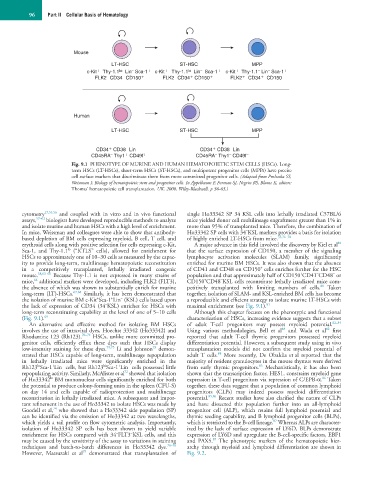
                        Fig. 9.1  PHENOTYPE OF MURINE AND HUMAN HEMATOPOIETIC STEM CELLS (HSCs). Long-
                        term HSCs (LT-HSCs), short-term HSCs (ST-HSCs), and multipotent progenitor cells (MPPs) have precise
                        cell surface markers that discriminate them from more committed progenitor cells. (Adapted from Prohaska SS,
                        Weissman I: Biology of hematopoietic stem and progenitor cells. In Appelbaum F, Forman SJ, Negrin RS, Blume K, editors:
                        Thomas’ hematopoietic cell transplantation, UK, 2008, Wiley-Blackwell, p 36-63.)
                                                                                −
        cytometry 17,55,56   and  coupled  with  in  vitro  and  in  vivo  functional   single Ho33342 SP 34 KSL cells into lethally irradiated C57BL/6
        assays, 57–62  biologists have developed reproducible methods to analyze   mice yielded donor cell multilineage engraftment greater than 1% in
        and isolate murine and human HSCs with a high level of enrichment.   more than 95% of transplanted mice. Therefore, the combination of
                                                                                 −
        In mice, Weissman and colleagues were able to show that antibody-  Ho33342 SP cells with 34 KSL markers provides a basis for isolation
        based depletion of BM cells expressing myeloid, B cell, T cell, and   of highly enriched LT-HSCs from mice. 55,76–78
                                                                                                               80
        erythroid cells along with positive selection for cells expressing c-Kit,   A major advance in this field involved the discovery by Kiel et al
                       lo
        Sca-1,  and  Thy-1.1   (“KTLS”  cells),  allowed  for  enrichment  for   that  the  surface  expression  of  CD150,  a  member  of  the  signaling
        HSCs to approximately one of 10–30 cells as measured by the capac-  lymphocyte  activation  molecules  (SLAM)  family,  significantly
        ity to provide long-term, multilineage hematopoietic reconstitution   enriched for murine BM HSCs. It was also shown that the absence
                                                                                      +
        in  a  competitively  transplanted,  lethally  irradiated  congenic   of CD41 and CD48 on CD150  cells enriches further for the HSC
                                                                                                   +
                                                                                                         −
                                                                                                              −
        mouse. 58,63–66   Because Thy-1.1  is  not  expressed  in  many  strains  of   population and that approximately half of CD150 CD41 CD48  or
                                                                         −
                                                                    +
            64
        mice,  additional markers were developed, including FLK2 (FLT3),   CD150 CD48 KSL cells reconstitute lethally irradiated mice com-
                                                                                                          80
        the absence of which was shown to substantially enrich for murine   petitively  transplanted  with  limiting  numbers  of  cells.   Taken
        long-term (LT)-HSCs. 67,68  Similarly, it has been demonstrated that   together, isolation of SLAM- and KSL-enriched BM cells has become
                                         −
                                     +
                                 +
        the isolation of murine BM c-Kit Sca-1 Lin  (KSL) cells based upon   a reproducible and efficient strategy to isolate murine LT-HSCs with
                                   −
        the lack of expression of CD34 (34 KSL) enriches for HSCs with   maximal enrichment (see Fig. 9.1). 81
        long-term reconstituting capability at the level of one of 5–10 cells   Although this chapter focuses on the phenotypic and functional
        (Fig. 9.1). 69                                        characterization of HSCs, increasing evidence suggests that a subset
           An  alternative  and  effective  method  for  isolating  BM  HSCs   of  adult  T-cell  progenitors  may  possess  myeloid  potential. 82–84
                                                                                                            82
                                                                                             83
        involves the use of intravital dyes, Hoechst 33342 (Ho33342) and   Using  various  methodologies,  Bell  et  al   and  Wada  et  al   first
        Rhodamine 123 (Rh123). 70–74  HSCs, unlike more committed pro-  reported  that  adult  T-cell  thymic  progenitors  possessed  myeloid
        genitor  cells,  efficiently  efflux  these  dyes  such  that  HSCs  display   differentiation potential. However, a subsequent study using in vivo
                                                   73
        low-intensity staining for these dyes. 74,75  Li and Johnson  demon-  transplantation  models  did  not  confirm  the  myeloid  potential  of
                                                                        84
        strated that HSCs capable of long-term, multilineage repopulation   adult T  cells.   More  recently,  De  Obaldia  et al  reported  that  the
        in  lethally  irradiated  mice  were  significantly  enriched  in  the   majority of resident granulocytes in the mouse thymus were derived
                  +
                                           −
                     −
                                        +
                                   hi
                                                                                      85
             lo
        Rh123 Sca-1 Lin  cells, but Rh123 Sca-1 Lin  cells possessed little   from  early  thymic  progenitors.   Mechanistically,  it  has  also  been
                                          72
        repopulating activity. Similarly, McAlister et al  showed that isolation   shown that the transcription factor, HES1, constrains myeloid gene
                 lo
                                                                                                          86
        of Ho33342  BM mononuclear cells significantly enriched for both   expression in T-cell progenitors via repression of C/EPB-α.  Taken
        the potential to produce colony-forming units in the spleen (CFU-S)   together, these data suggest that a population of common lymphoid
        on  day  14  and  cells  capable  of  radioprotection  and  multilineage   progenitors  (CLPs)  may  indeed  possess  myeloid  differentiation
        reconstitution in lethally irradiated mice. A subsequent and impor-  potential. 85,86  Recent studies have also clarified the nature of CLPs
        tant refinement in the use of Ho33342 to isolate HSCs was made by   and  have  dissected  this  population  further  into  an  all-lymphoid
                  74
        Goodell et al,  who showed that a Ho33342 side population (SP)   progenitor  cell  (ALP),  which  retains  full  lymphoid  potential  and
        can be identified via the emission of Ho33342 at two wavelengths,   thymic seeding capability, and B lymphoid progenitor cells (BLPs),
                                                                                          87
        which yields a tail profile on flow cytometric analysis. Importantly,   which is restricted to the B-cell lineage.  Whereas ALPs are character-
        isolation  of  Ho33342  SP  cells  has  been  shown  to  yield  variable   ized by the lack of surface expression of LY6D, BLPs demonstrate
                                            −
                                       −
        enrichment for HSCs compared with 34 FLT3 KSL cells, and this   expression of LY6D and upregulate the B-cell-specific factors, EBF1
                                                                       87
        may be caused by the sensitivity of the assay to variations in staining   and  PAX5.   The  phenotypic  markers  of  the  hematopoietic  hier-
        techniques  and  batch-to-batch  differences  in  Ho33342  dye. 76–78    archy through myeloid and lymphoid differentiation are shown in
                            79
        However,  Matsuzaki  et  al   demonstrated  that  transplantation  of   Fig. 9.2.

