


Page 128 - Hematology_ Basic Principles and Practice ( PDFDrive )
P. 128
Chapter 9  Hematopoietic Stem Cell Biology  99


                            Donor (test)   BM cells          HSCs
                                                      FACs               Recipient (host)
                             CD45.2
                                                                                        Lethal irradiation

                                            BM cells         HSCs           CD45.1
                                                      FACs
                                                                               <4 months (ST-HSCs)
                                                                               >4 months (LT-HSCs)
                             CD45.1

                                                                       CD45.1 10 5 4 3  Host +
                                                                       10
                                                                                      competitor
                                                                       10
                                                                       10 2           Donor
                                                                         0
                                                                          0 10 10 10 10 5
                                                                               3
                                                                                 4
                                                                             2
                                                                             CD45.2
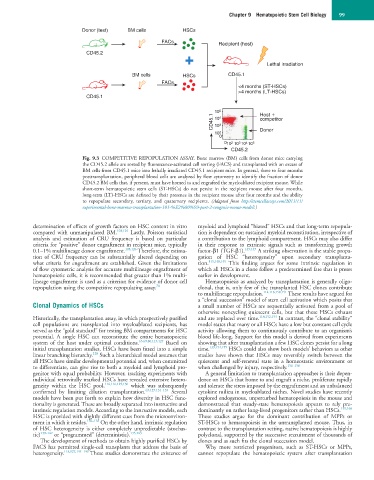
                            Fig. 9.3  COMPETITIVE REPOPULATION ASSAY. Bone marrow (BM) cells from donor mice carrying
                            the CD45.2 allele are sorted by fluorescence-activated cell sorting (FACS) and transplanted with an excess of
                            BM cells from CD45.1 mice into lethally irradiated CD45.1 recipient mice. In general, three to four months
                            posttransplantation, peripheral blood cells are analyzed by flow cytometry to identify the fraction of donor
                            CD45.2 BM cells that, if present, must have homed to and engrafted the myeloablated recipient mouse. While
                            short-term  hematopoietic  stem  cells  (ST-HSCs)  do  not  persist  in  the  recipient  mouse  after  four  months,
                            long-term (LT)-HSCs are defined by their presence in the recipient mouse after four months and the ability
                            to  repopulate  secondary,  tertiary,  and  quaternary  recipients.  (Adapted  from  http://stemcellassays.com/2011/11/
                            experimental-bone-marrow-transplantation-101-%E2%80%93-part-2-congenic-mouse-model/.)


            determination of effects of growth factors on HSC content in vitro   myeloid and lymphoid “biased” HSCs and that long-term repopula-
            compared  with  unmanipulated  BM. 103,125   Lastly,  Poisson  statistical   tion is dependent on sustained myeloid reconstitution, irrespective of
            analysis  and  estimation  of  CRU  frequency  is  based  on  particular   a contribution to the lymphoid compartment. HSCs may also differ
            criteria for “positive” donor engraftment in recipient mice, typically   in  their  response  to  extrinsic  signals  such  as  transforming  growth
            0.1–1% multilineage donor engraftment. 103,126  Therefore, the estima-  factor-β1 (TGF-β1). 145,147  A striking observation is the stable propa-
            tion  of  CRU  frequency  can  be  substantially  altered  depending  on   gation  of  HSC  “heterogeneity”  upon  secondary  transplanta-
            what criteria for engraftment are established. Given the limitations   tion. 115,148,149   This  finding  argues  for  some  intrinsic  regulation  in
            of flow cytometric analysis for accurate multilineage engraftment of   which all HSCs in a clone follow a predetermined fate that is preset
            hematopoietic cells, it is recommended that greater than 1% multi-  earlier in development.
            lineage engraftment is used as a criterion for evidence of donor cell   Hematopoiesis as analyzed by transplantation is generally oligo-
            repopulation using the competitive repopulating assay. 78  clonal, that is, only few of the transplanted HSC clones contribute
                                                                  to multilineage repopulation. 114,116,150,151  These results have argued for
                                                                  a “clonal succession” model of stem cell activation which posits that
            Clonal Dynamics of HSCs                               a small number of HSCs are sequentially activated from a pool of
                                                                  otherwise noncycling quiescent cells, but that these HSCs exhaust
            Historically, the transplantation assay, in which prospectively purified   and are replaced over time. 114,152,153  In contrast, the “clonal stability”
            cell  populations  are  transplanted  into  myeloablated  recipients,  has   model states that many or all HSCs have a low but constant cell cycle
            served as the “gold standard” for testing BM compartments for HSC   activity allowing them to continuously contribute to an organism’s
            potential.  A  single  HSC  can  reconstitute  the  entire  hematopoietic   blood life-long. Support for this model is derived from experiments
            system  of  the  host  under  optimal  conditions. 63,69,80,115,127   Based  on   showing that after transplantation a few HSC clones persist for a long
            initial transplantation studies, HSCs have been fitted into a simple   time. 139,154,155  HSCs could also show both models’ behaviors as other
                               128
            linear branching hierarchy.  Such a hierarchical model assumes that   studies  have  shown  that  HSCs  may  reversibly  switch  between  the
            all HSCs have similar developmental potential and, when committed   quiescent  and  self-renewal  state  in  a  homeostatic  environment  or
            to differentiate, can give rise to both a myeloid and lymphoid pro-  when challenged by injury, respectively. 156–158
            genitor with equal probability. However, tracking experiments with   A general limitation to transplantation approaches is their depen-
            individual retrovirally marked HSCs have revealed extensive hetero-  dence on HSCs that home to and engraft a niche, proliferate rapidly
            geneity  within  the  HSC  pool, 114,116,129,130   which  was  subsequently   and tolerate the stress imposed by the engraftment and an unbalanced
            confirmed  by  limiting  dilution  transplantation. 63,127,131–135   Several   cytokine milieu in myeloablated niches. Novel studies have recently
            models have been put forth to explain how diversity in HSC func-  explored endogenous, unperturbed hematopoiesis in the mouse and
            tionality is generated. These are broadly separated into instructive and   demonstrated  that  steady-state  hematopoiesis  appears  to  rely  pre-
            intrinsic regulation models. According to the instructive models, each   dominantly on rather long-lived progenitors rather than HSCs. 159,160
            HSC is provided with slightly different cues from the microenviron-  These  studies  argue  for  the  dominant  contribution  of  MPPs  or
            ment in which it resides. 136–138  On the other hand, intrinsic regulation   ST-HSCs to hematopoiesis in the untransplanted mouse. Thus, in
            of  HSC  heterogeneity  is  either  completely  unpredictable  (stochas-  contrast to the transplantation setting, native hematopoiesis is highly
            tic) 139–142  or “programmed” (deterministic). 135,143  polyclonal, supported by the successive recruitment of thousands of
              The development of methods to obtain highly purified HSCs by   clones and as such fits the clonal succession model.
            FACS has permitted single-cell transplants that address the basis of   Why  more  restricted  progenitors,  such  as  ST-HSCs  or  MPPs,
            heterogeneity. 115,127,144–146  These studies demonstrate the existence of   cannot  repopulate  the  hematopoietic  system  after  transplantation

