


Page 135 - Hematology_ Basic Principles and Practice ( PDFDrive )
P. 135
106    Part II  Cellular Basis of Hematology


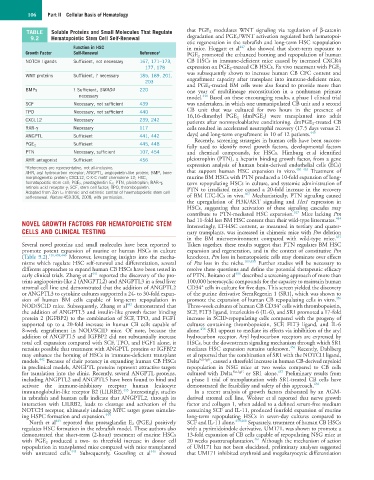
          TABLE   Soluble Proteins and Small Molecules That Regulate   that  PGE 2  modulates  WNT  signaling  via  regulation  of  β-catenin
           9.2    Hematopoietic Stem Cell Self-Renewal        degradation and PGE 2/WNT activation regulated both hematopoi-
                                                              etic regeneration in the zebrafish and long-term HSC repopulation
                         Function in HSC                      in  mice.  Hoggatt  et  al   also  showed  that  short-term  exposure  to
                                                                               447
         Growth Factor   Self-Renewal          Reference a    PGE 2 promoted the enhanced homing and repopulation of human
         NOTCH ligands   Sufficient, not necessary  167, 171–173,   CB  HSCs  in  immune-deficient  mice  caused  by  increased  CXCR4
                                                177, 178      expression on PGE 2-treated CB HSCs. Ex vivo treatment with PGE 2
                                                              was subsequently shown to increase human CB CFC content and
         WNT proteins    Sufficient, ? necessary  185, 189, 201,   engraftment  capacity  after  transplant  into  immune-deficient  mice,
                                                203
                                                              and PGE 2-treated BM cells were also found to provide more than
         BMPs            ? Sufficient, SMAD4   220            one  year  of  multilineage  reconstitution  in  a  nonhuman  primate
                           necessary                          model.  Based on these encouraging results, a phase I clinical trial
                                                                   448
         SCF             Necessary, not sufficient  439       was undertaken, in which one unmanipulated CB unit and a second
         TPO             Necessary, not sufficient  440       CB  unit  that  was  cultured  for  two  hours  in  the  presence  of
                                                              16,16-dimethyl  PGE 2  (dmPGE 2)  were  transplanted  into  adult
         CXCL12          Necessary             239, 242       patients after nonmyeloablative conditioning. dmPGE 2-treated CB
         RAR-γ           Necessary             117            cells resulted in accelerated neutrophil recovery (17.5 days versus 21
         ANGPTL          Sufficient            441, 442       days) and long-term engraftment in 10 of 12 patients. 449
                                                                 Recently, screening strategies in human cells have been success-
                         Sufficient            445, 448
                                                              fully  used  to  identify  novel  growth  factors,  developmental  factors
         PGE 2
         PTN             Necessary, sufficient  107, 454      and  chemical  compounds,  for  HSCs.  Himburg  et al  identified
         AHR antagonist  Sufficient            456            pleiotrophin (PTN), a heparin binding growth factor, from a gene
         a References are representative, not all-inclusive.  expression  analysis  of  human  brain-derived  endothelial  cells  (ECs)
                                                                                                  450–453
         AHR, aryl hydrocarbon receptor; ANGPTL, angiopoietin-like protein; BMP, bone   that  support  human  HSC  expansion  in  vitro.    Treatment  of
         morphogenetic protein; CXCL12, C-X-C motif chemokine 12; HSC,   murine BM HSCs with PTN produced a 10-fold expansion of long-
         hematopoietic stem cell; PGE 2 , prostaglandin E 2 ; PTN, pleiotrophin; RAR-γ,   term repopulating HSCs in culture, and systemic administration of
         retinoic acid receptor γ; SCF, stem cell factor; TPO, thrombopoietin.  PTN  to  irradiated  mice  caused  a  20-fold  increase  in  the  recovery
         Adapted from Zon L: Intrinsic and extrinsic control of haematopoietic stem cell   107
         self-renewal. Nature 453:306, 2008, with permission.  of BM LTC-ICs in vivo.  Mechanistically, PTN signaling caused
                                                              the  upregulation  of  PI3K/AKT  signaling  and  Hes1  expression  in
                                                              HSCs,  suggesting  that  activation  of  these  signaling  cascades  may
                                                                                                 107
                                                              contribute  to PTN-mediated  HSC expansion.   Mice lacking  Ptn
                                                                                                               454
        NOVEL GROWTH FACTORS FOR HEMATOPOIETIC STEM           had 11-fold less BM HSC content than their wild-type littermates.
                                                              Interestingly, LT-HSC content, as measured in tertiary and quater-
        CELLS AND CLINICAL TESTING                            nary transplants, was increased in chimeric mice with Ptn deletion
                                                                                                               455
                                                              in  the  BM  microenvironment  compared  with  wild-type  mice.
        Several  novel  proteins  and  small  molecules  have  been  reported  to   Taken together, these results suggest that PTN regulates BM HSC
        promote  potent  expansion  of  murine  or  human  HSCs  in  culture   expansion and regeneration, and in the context of constitutive Ptn
        (Table  9.2). 107,439,440   Moreover,  leveraging  insights  into  the  mecha-  knockout, Ptn loss in hematopoietic cells may dominate over effects
        nisms which regulate HSC self-renewal and differentiation, several   of  Ptn  loss  in  the  niche. 109,455   Further  studies  will  be  necessary  to
        different approaches to expand human CB HSCs have been tested in   resolve these questions and define the potential therapeutic efficacy
                                                                              456
                               441
        early clinical trials. Zhang et al  reported the discovery of the pro-  of PTN. Boitano et al  described a screening approach of more than
        teins angiopoietin-like 2 (ANGPTL2) and ANGPTL3 in a fetal liver   100,000 heterocyclic compounds for the capacity to maintain human
                                                                   +
        stromal cell line and demonstrated that the addition of ANGPTL2   CD34  cells in culture for five days. This screen yielded the discovery
        or ANGPTL3 to cytokine cultures supported a 24- to 30-fold expan-  of the purine derivative StemRegenin 1 (SR1), which was shown to
                                                                                                               456
        sion  of  human  BM  cells  capable  of  long-term  repopulation  in   promote the expansion of human CB repopulating cells in vitro.
                                                                                            +
                                           442
        NOD/SCID mice. Subsequently, Zhang et al  demonstrated that   Three-week cultures of human CB CD34  cells with thrombopoietin,
        the addition of ANGPTL5 and insulin-like growth factor binding   SCF, FLT3 ligand, interleukin-6 (IL-6), and SR1 promoted a 17-fold
        protein 2 (IGFBP2) to the combination of SCF, TPO, and FGF1   increase in SCID-repopulating cells compared with the progeny of
        supported  up  to  a  20-fold  increase  in  human  CB  cells  capable  of   cultures  containing  thrombopoietin,  SCF,  FLT3  ligand,  and  IL-6
                                                                   456
        8-week  engraftment  in  NOD/SCID  mice.  Of  note,  because  the   alone.  SR1 appears to mediate its effects via inhibition of the aryl
        addition of ANGPTL5 and IGFBP2 did not substantially increase   hydrocarbon receptor. Aryl hydrocarbon receptors are expressed by
        total cell expansion compared with SCF, TPO, and FGF1 alone, it   HSCs, but the downstream signaling mechanism through which SR1
                                                                                                456
        remains possible that treatment with ANGPTL proteins or IGFBP2   mediates HSC expansion remains unknown.  Recently, Dahlberg
        may enhance the homing of HSCs in immune-deficient transplant   et al reported that the combination of SR1 with the NOTCH ligand,
              442
        models.  Because of their potency in expanding human CB HSCs   Delta Ext-IgG , caused a threefold increase in human CB-derived myeloid
        in preclinical models, ANGPTL proteins represent attractive targets   repopulation  in  NSG  mice  at  two  weeks  compared  to  CB  cells
                                                                                            457
        for translation into the clinic. Recently, several ANGPTL proteins,   cultured with Delta Ext-IgG  or SR1 alone.  Preliminary results from
        including ANGPTL2 and ANGPTL5 have been found to bind and   a  phase  I  trial  of  transplantation  with  SR1-treated  CB  cells  have
        activate  the  immune-inhibitory  receptor  human  leukocyte   demonstrated the feasibility and safety of this approach. 458
                                         443
        immunoglobulin-like receptor B2 (LILRB2).  Interestingly, studies   In  a  recent  analysis  of  growth  factors  elaborated  by  an  AGM-
        in zebrafish and human cells indicate that ANGPTL2, through its   derived  stromal  cell  line, Wohrer  et al  reported  that  nerve  growth
        interaction  with  LILRB2,  leads  to  cleavage  and  activation  of  the   factor and collagen 1, when added to a defined serum-free medium
        NOTCH receptor, ultimately inducing MYC target genes stimulat-  containing SCF and IL-11, produced fourfold expansion of murine
        ing HSPC formation and expansion. 444                 long-term  repopulating  HSCs  in  seven-day  cultures  compared  to
                   445
           North et al  reported  that prostaglandin E 2  (PGE 2)  positively   SCF and IL-11 alone. 459,460  Separately, treatment of human CB HSCs
        regulates HSC formation in the zebrafish model. These authors also   with a pyrimidoindole derivative, UM171, was shown to promote a
        demonstrated that short-term (2-hour) treatment of murine HSCs   13-fold expansion of CB cells capable of repopulating NSG mice at
                                                                                    461
        with  PGE 2  produced  a  two-  to  threefold  increase  in  donor  cell   20 weeks posttransplantation.  Although the mechanism of action
        repopulation in transplanted mice compared with mice transplanted   of UM171 has not been elucidated, preliminary analyses suggested
                        445
                                                  446
        with  untreated  cells.   Subsequently,  Goessling  et  al   showed   that UM171 inhibited erythroid and megakaryocytic differentiation

