


Page 131 - Hematology_ Basic Principles and Practice ( PDFDrive )
P. 131
102    Part II  Cellular Basis of Hematology

                             244
        transcribing DNA into RNA.  Because the intrinsic phenotype or state   regulated, at least in part, by the antagonism of lineage-specific tran-
        of a cell is the result of its gene expression, it is governed by the concerted   scription factors. To promote a given lineage, transcription factors need
        action of transcription factors (guided by the epigenetic landscape dis-  to actively counteract factor(s) supporting other cell fates. Third, and
        cussed further below). The balance between self-renewal and differentia-  most relevant to clinical situations, most hematopoietic transcription
        tion of HSCs is intricately regulated by transcription factors of many   factors are subject to somatic mutation and/or chromosomal transloca-
                    245
        different classes.  Several general principles have emerged. First, given   tion in one or more hematopoietic malignancies. Thus, malignancy can
        the relative limited number of transcription factors, they are used at   be viewed as a disruption of normal development. Fig. 9.2 depicts key
        multiple stages in development, such that they may be required in HSCs   transcription factors within the hematopoietic hierarchy, and Table 9.1
                                           18
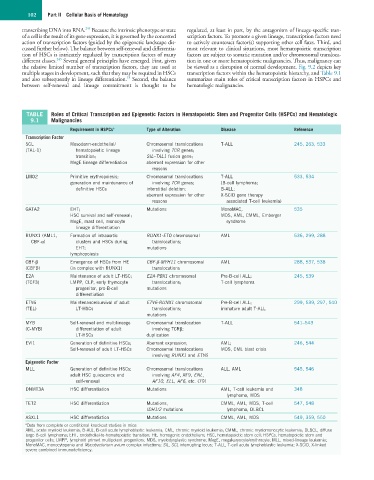
        and also subsequently in lineage differentiation.  Second, the balance   summarizes main roles of critical transcription factors in HSPCs and
        between  self-renewal  and  lineage  commitment  is  thought  to  be     hematologic malignancies.


          TABLE   Roles of Critical Transcription and Epigenetic Factors in Hematopoietic Stem and Progenitor Cells (HSPCs) and Hematologic
           9.1    Malignancies
                        Requirement in HSPCs a   Type of Alteration      Disease                 Reference
         Transcription Factor
         SCL            Mesoderm-endothelial/    Chromosomal translocations   T-ALL              245, 263, 533
         (TAL-1)          hematopoietic lineage    involving TCR genes;
                          transition;            SIL–TAL1 fusion gene;
                        MegE lineage differentiation  aberrant expression for other
                                                   reasons
         LMO2           Primitive erythropoiesis;  Chromosomal translocations   T-ALL            533, 534
                        generation and maintenance of   involving TCR genes;  (B-cell lymphoma;
                          definitive HSCs        interstitial deletion;  B-ALL;
                                                 aberrant expression for other   X-SCID gene therapy
                                                   reasons                 associated T-cell leukemia)
         GATA2          EHT;                     Mutations               MonoMAC,                535
                        HSC survival and self-renewal;                   MDS, AML, CMML, Emberger
                        MegE, mast cell, monocyte                          syndrome
                          lineage differentiation
         RUNX1 (AML1,   Formation of intraaortic   RUNX1-ETO chromosomal   AML                   536, 299, 288
           CBF-α)         clusters and HSCs during   translocations;
                          EHT;                   mutations
                        lymphopoiesis
         CBF-β          Emergence of HSCs from HE  CBF-β-MYH11 chromosomal   AML                 288, 537, 538
         (CBFB)         (in complex with RUNX1)    translocations
         E2A            Maintenance of adult LT-HSC;  E2A-PBX1 chromosomal   Pre-B-cell ALL;     245, 539
         (TCF3)         LMPP, CLP, early thymocyte   translocations;     T-cell lymphoma
                          progenitor, pro-B-cell   mutations
                          differentiation
         ETV6           Maintenance/survival of adult   ETV6-RUNX1 chromosomal   Pre-B-cell ALL;  299, 539, 297, 540
         (TEL)            LT-HSCs                  translocations;       immature adult T-ALL
                                                 mutations
         MYB            Self-renewal and multilineage   Chromosomal translocation   T-ALL        541–543
         (C-MYB)          differentiation of adult   involving TCRβ;
                          LT-HSCs                duplication
         EVI1           Generation of definitive HSCs;  Aberrant expression;  AML;               246, 544
                        Self-renewal of adult LT-HSCs  Chromosomal translocations   MDS, CML blast crisis
                                                   involving RUNX1 and ETV6
         Epigenetic Factor
         MLL            Generation of definitive HSCs;  Chromosomal translocations   ALL, AML    545, 546
                        adult HSC quiescence and   involving AF4, AF9, ENL,
                          self-renewal             AF10, ELL, AF6, etc. (79)
         DNMT3A         HSC differentiation      Mutations               AML, T-cell leukemia and   348
                                                                           lymphoma, MDS
         TET2           HSC differentiation      Mutations,              CMML, AML, MDS, T-cell   547, 548
                                                 IDH1/2 mutations          lymphoma, DLBCL
         ASXL1          HSC differentiation      Mutations               CMML, AML, MDS          549, 359, 550
         a Data from complete or conditional knockout studies in mice
         AML, acute myeloid leukemia; B-ALL, B-cell acute lymphoblastic leukemia; CML, chronic myeloid leukemia; CMML, chronic myelomonocytic leukemia; DLBCL, diffuse
         large B-cell lymphoma; EHT, endothelial-to-hematopoietic transition; HE, hemogenic endothelium; HSC, hematopoietic stem cell; HSPCs, hematopoietic stem and
         progenitor cells; LMPP, lymphoid primed multipotent progenitors; MDS, myelodysplastic syndrome; MegE, megakaryocyte/erythrocyte; MLL, mixed-lineage leukemia;
         MonoMAC, monocytopenia and Mycobacterium avium complex infections; SIL, SCL interrupting locus; T-ALL, T-cell acute lymphoblastic leukemia; X-SCID, X-linked
         severe combined immunodeficiency.

