


Page 1374 - Hematology_ Basic Principles and Practice ( PDFDrive )
P. 1374
1220   Part VII  Hematologic Malignancies


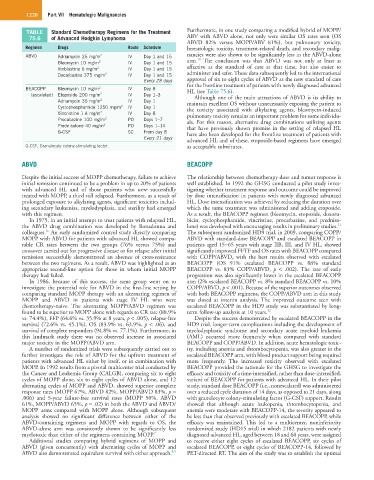
          TABLE   Standard Chemotherapy Regimens for the Treatment   Furthermore, in one study comparing a modified hybrid of MOPP/
          75.6    of Advanced Hodgkin Lymphoma                ABV with ABVD alone, not only were similar OS rates seen (OS
                                                              ABVD  82%  versus  MOPP/ABV  81%),  but  pulmonary  toxicity,
         Regimen    Drugs                  Route  Schedule    hematologic toxicity, treatment-related death, and secondary malig-
         ABVD       Adriamycin 25 mg/m 2   IV   Day 1 and 15  nancies were also shown to be significantly less in the ABVD-alone
                                                                  10
                    Bleomycin 10 mg/m 2    IV   Day 1 and 15  arm.   The  conclusion  was  that  ABVD  was  not  only  at  least  as
                    Vinblastine 6 mg/m 2   IV   Day 1 and 15  effective  as  the  standard  of  care  at  that  time,  but  also  easier  to
                    Dacarbazine 375 mg/m 2  IV  Day 1 and 15  administer and safer. These data subsequently led to the international
                                                Every 28 days  approval of six to eight cycles of ABVD as the new standard of care
                                                              for the frontline treatment of patients with newly diagnosed advanced
         BEACOPP    Bleomycin 10 mg/m 2    IV   Day 8         HL (see Table 75.6).
           (escalated)  Etoposide 200 mg/m 2  IV  Day 1–3        Although one of the main attractions of ABVD is its ability to
                    Adriamycin 35 mg/m 2   IV   Day 1         maintain excellent OS without unnecessarily exposing the patient to
                    Cyclophosphamide 1250 mg/m 2  IV  Day 1   the  toxicity  associated  with  alkylating  agents,  bleomycin-induced
                    Vincristine 1.4 mg/m 2  IV  Day 8         pulmonary toxicity remains an important problem for some individu-
                    Procabazine 100 mg/m 2  PO  Days 1–7      als.  For  this  reason,  alternative  drug  combinations  utilizing  agents
                    Prednisolone 40 mg/m 2  PO  Days 1–14     that have previously shown promise in the setting of relapsed HL
                    G-CSF                  SC   From day 8    have also been developed for the frontline treatment of patients with
                                                Every 21 days  advanced HL and of these, etoposide-based regimens have emerged
         G-CSF, Granulocyte colony-stimulating factor.        as acceptable substitutes.


        ABVD                                                  BEACOPP

        Despite the initial success of MOPP chemotherapy, failure to achieve   The relationship between chemotherapy dose and tumor response is
        initial remission continued to be a problem in up to 20% of patients   well established. In 1992 the GHSG conducted a pilot study inves-
        with  advanced  HL  and  of  those  patients  who  were  successfully   tigating whether treatment response and outcome could be improved
        treated with MOPP, a third still relapsed. Furthermore, as a result of   by dose intensification in patients with newly diagnosed advanced
        prolonged exposure to alkylating agents, significant toxicities includ-  HL. Dose intensification was achieved by reducing the duration over
        ing secondary leukemias, myelodysplasia, and sterility had emerged   which the same treatment was administered and adding etoposide.
        with this regimen.                                    As a result, the BEACOPP regimen (bleomycin, etoposide, doxoru-
           In 1975, in an initial attempt to treat patients with relapsed HL,   bicin,  cyclophosphamide,  vincristine,  procarbazine,  and  predniso-
                                                                                                               11
        the  ABVD  drug  combination  was  developed  by  Bonadonna  and   lone) was developed with encouraging results in preliminary studies.
                6a
        colleagues.  An early randomized control study directly comparing   The subsequent randomized HD9 trial, in 2009, comparing COPP/
        MOPP with ABVD for patients with advanced HL showed compa-  ABVD with standard-dose BEACOPP and escalated BEACOPP in
        rable  CR  rates  between  the  two  groups  (76%  versus  75%)  and   patients aged 15−65 years with stage IIB, III, and IV HL, showed
        crossover carried out for progressive disease or for relapse after initial   significantly improved FFTF and OS rates with BEACOPP compared
        remission  successfully  demonstrated  an  absence  of  cross-resistance   with  COPP/ABVD,  with  the  best  results  observed  with  escalated
        between the two regimens. As a result, ABVD was highlighted as an   BEACOPP  (OS  91%  escalated  BEACOPP  vs.  88%  standard
        appropriate  second-line  option  for  those  in  whom  initial  MOPP   BEACOPP  vs.  83%  COPP/ABVD,  p  <  .002).  The  rate  of  early
        therapy had failed.                                   progression was also significantly lower in the escalated BEACOPP
           In  1986,  because  of  this  success,  the  same  group  went  on  to   arm (2% escalated BEACOPP vs. 8% standard BEACOPP vs. 10%
        investigate the potential role for ABVD in the first-line setting by   COPP/ABVD, p < .001). Because of the superior outcomes observed
        comparing standard MOPP therapy with an alternating regimen of   with both BEACOPP regimens, the COPP/ABVD arm in this study
        MOPP  and  ABVD  in  patients  with  stage  IV  HL  who  were   was  closed  at  interim  analysis.  The  improved  outcome  seen  with
        chemotherapy-naive.  The  alternating  MOPP/ABVD  regimen  was   escalated BEACOPP in the HD9 study was substantiated by long-
        found to be superior to MOPP alone with regards to CR rate (88.9%   term follow-up analysis at 10 years. 12
        vs. 74.4%), FFP (64.6% vs. 35.9% at 8 years, p < .005), relapse-free   Despite the success demonstrated by escalated BEACOPP in the
        survival (72.6% vs. 45.1%), OS (83.9% vs. 63.9%, p < .06), and   HD9 trial, longer-term complications including the development of
        survival of complete responders (94.8% vs. 77.1%). Furthermore, in   myelodysplastic  syndrome  and  secondary  acute  myeloid  leukemia
        this  landmark  study  there  was  no  observed  increase  in  associated   (AML)  occurred  more  frequently  when  compared  with  standard
        major toxicity in the MOPP/ABVD arm.                  BEACOPP and COPP/ABVD. In addition, acute hematologic toxic-
           A number of randomized trials were subsequently carried out to   ity, including anemia and thrombocytopenia, was also greater in the
        further investigate the role of ABVD for the upfront treatment of   escalated BEACOPP arm, with blood product support being required
        patients with advanced HL either by itself, or in combination with   more  frequently.  The  increased  toxicity  observed  with  escalated
        MOPP. In 1992 results from a pivotal multicenter trial conducted by   BEACOPP provided the rationale for the GHSG to investigate the
        the Cancer and Leukemia Group (CALGB), comparing six to eight   efficacy and toxicity of a time-intensified, rather than dose-intensified,
        cycles of MOPP alone, six to eight cycles of ABVD alone, and 12   variant of BEACOPP for patients with advanced HL. In their pilot
        alternating cycles of MOPP and ABVD, showed superior complete   study, standard dose BEACOPP (i.e., nonescalated) was administered
        response rates (MOPP 67%, ABVD 82%, MOPP/ABVD 83%, p =   over a reduced cycle duration of 14 days, as opposed to 21 days, along
        .006)  and  5-year  failure-free  survival  rates  (MOPP  50%,  ABVD   with granulocyte colony-stimulating factor (G-CSF) support. Results
        61%, MOPP/ABVD 65%, p = .02) in both the ABVD and ABVD/  showed  that  although  acute  leukopenia,  thrombocytopenia,  and
        MOPP  arms  compared  with  MOPP  alone.  Although  subsequent   anemia were moderate with BEACOPP-14, the severity appeared to
        analysis  showed  no  significant  difference  between  either  of  the   be less than that observed previously with escalated BEACOPP, while
        ABVD-containing  regimens  and  MOPP  with  regards  to  OS,  the   efficacy  was  maintained. This  led  to  a  multicenter,  noninferiority
        ABVD-alone  arm  was  consistently  shown  to  be  significantly  less   randomized study (HD15 trial) in which 2182 patients with newly
        myelotoxic than either of the regimens containing MOPP. 7  diagnosed advanced HL, aged between 18 and 60 years, were assigned
           Additional  studies  comparing  hybrid  regimens  of  MOPP  and   to  receive  either  eight  cycles  of  escalated  BEACOPP,  six  cycles  of
        ABVD (given concurrently) with alternating cycles of MOPP and   escalated BEACOPP, or eight cycles of BEACOPP-14, followed by
                                                         8,9
        ABVD also demonstrated equivalent survival with either approach.    PET-directed RT. The aim of the study was to establish the optimal

