


Page 1369 - Hematology_ Basic Principles and Practice ( PDFDrive )
P. 1369
Chapter 75  Hodgkin Lymphoma  1215


                                 A                                B


                                 C                               D

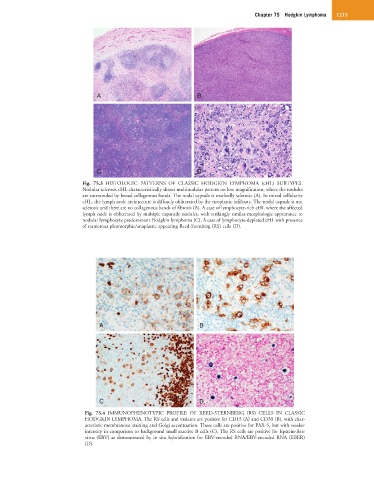
                            Fig.  75.3  HISTOLOGIC  PATTERNS  OF  CLASSIC  HODGKIN  LYMPHOMA  (cHL)  SUBTYPES.
                            Nodular sclerosis cHL characteristically shows multinodular pattern on low magnification, where the nodules
                            are surrounded by broad collagenous bands. The nodal capsule is markedly sclerotic (A). In mixed cellularity
                            cHL, the lymph node architecture is diffusely obliterated by the neoplastic infiltrate. The nodal capsule is not
                            sclerotic and there are no collagenous bands of fibrosis (B). A case of lymphocyte-rich cHL where the affected
                            lymph node is obliterated by multiple expansile nodules, with strikingly similar morphologic appearance to
                            nodular lymphocyte predominant Hodgkin lymphoma (C). A case of lymphocyte-depleted cHL with presence
                            of numerous pleomorphic/anaplastic appearing Reed-Sternberg (RS) cells (D).


                                  A                               B


                                  C                               D

                             Fig.  75.4  IMMUNOPHENOTYPIC  PROFILE  OF  REED-STERNBERG  (RS)  CELLS  IN  CLASSIC
                             HODGKIN LYMPHOMA. The RS cells and variants are positive for CD15 (A) and CD30 (B), with char-
                             acteristic membranous staining and Golgi accentuation. These cells are positive for PAX-5, but with weaker
                             intensity in comparison to background small reactive B cells (C). The RS cells are positive for Epstein-Barr
                             virus (EBV) as demonstrated by in situ hybridization for EBV-encoded RNA/EBV-encoded RNA (EBER)
                             (D).

